Bug Squad Logo

Bug Squad

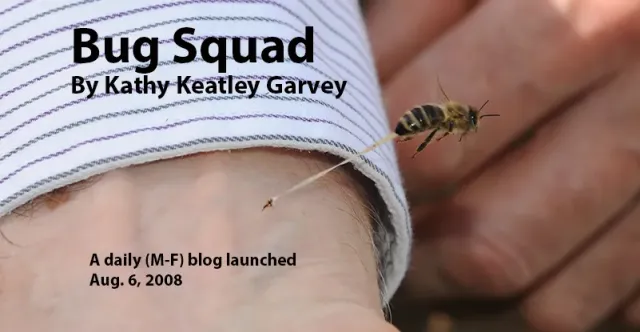
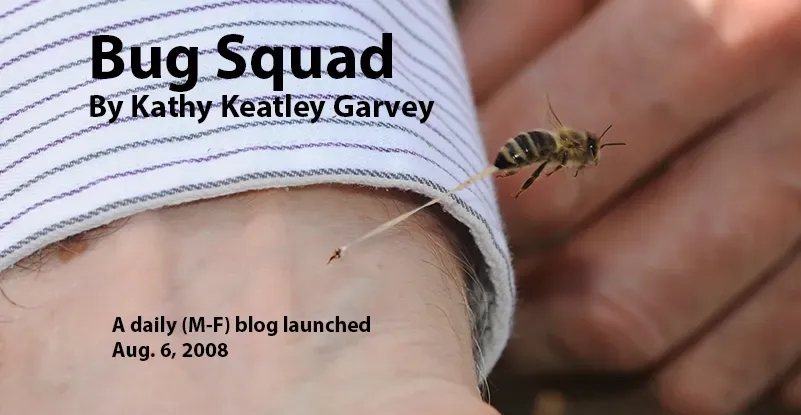
Bug Squad blog image depicts a honey bee sting in action.

Welcome to the Bug Squad blog! The Bug Squad blog was launched Aug. 6, 2008 and is a daily blog (Monday through Friday). It showcases entomologists and the work they do.  The blog focuses on scientists in the UC Davis Department of Entomology and Nematology, the Bohart Museum of Entomology, Harry H. Laidlaw Jr. Honey Bee Research Facility, the UC Davis Bee Haven, and assorted campuswide events, including UC Davis Picnic Day, UC Davis Biodiversity Museum Day, and Bohart Museum open houses. The blog spotlights insects, including bees, butterflies, dragonflies, and praying mantises, as well as arachnids such as jumping spiders and crab spiders. Author and photographer is Kathy Keatley Garvey, communications specialist, UC Davis Department of Entomology and Nematology, and a longtime journalist and community scientist with two degrees from Washington State University.  She is a member of the Entomological Society of America (ESA) and the Association for Communication Excellence (ACE). Her blog posts and images have won international awards from ACE and ESA and appeared on journal and magazine covers. She shoots primarily with a Nikon Z-8 mirrorless camera, a Nikon D500 and Nikon 800, with assorted macro lenses. Feedspot lists it as one of the top entomology blogs on the Internet. 

Primary Image
Honey bee pollinating a strawberry blossom. (Photo by Kathy Keatley Garvey)

Berry, Berry Fine!

July 1, 2011
By Kathy Keatley Garvey
If you're gearing up for the Fourth of July weekend, you'll probably head to the farmers' market, a roadside stand, or the produce department of your favorite grocery store for some freshly picked strawberries. And you can thank a honey bee if your berry is fully formed.
View Article
Primary Image
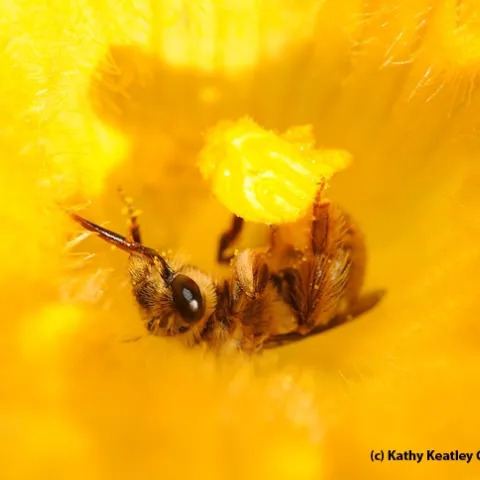
Male squash bee nestled inside a squash blossom. (Photo by Kathy Keatley Garvey)

Squash Blossom Special

June 30, 2011
By Kathy Keatley Garvey
Male squash bees know just where to sleep--inside a squash blossom. If you're growing squash and you head out to your garden just after sunrise, you'll probably see the males fast asleep, waiting for visiting females to arrive.
View Article
Primary Image
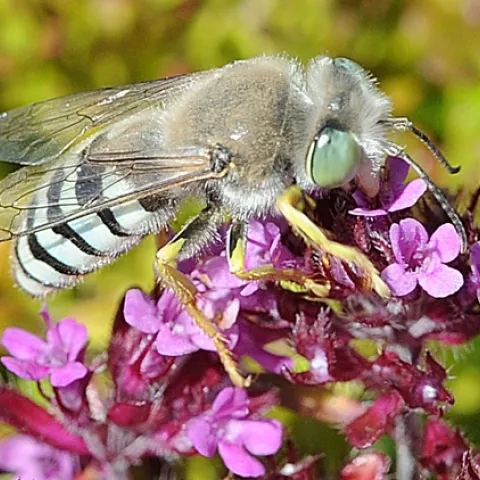
Sand wasp on red flowering thyme. (Photo by Kathy Keatley Garvey)

'The Little White Bees'

June 29, 2011
By Kathy Keatley Garvey
If it looks like a bee, sips nectar like a bee, and buzzes away like a bee, that doesn't mean it's a bee. Last weekend we visited a Fort Bragg nursery specializing in succulents, and these "little white bees" were all over the red flowering thyme (Thymus serphyllum). "Little white bees.
View Article
Primary Image
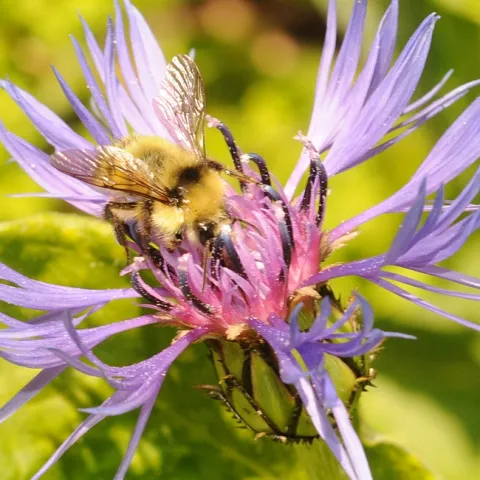
Male bumble bee (Bombus flavifrons) nectaring perennial cornflower (Centaurea montana). (Photo by Kathy Keatley Garvey)

A Bumble Bee to Remember

June 28, 2011
By Kathy Keatley Garvey
Not all bumble bees are primarily black. Take the Bombus flavifrons. We spotted a male Bombus flavifrons nectaring on Centaurea montana, aka perennial cornflower or mountain cornflower, recently in Mill Valley.
View Article
Primary Image
Tell-tale sign of an earwig. (Photo by Kathy Keatley Garvey)

Forceps, Please

June 27, 2011
By Kathy Keatley Garvey
Forceps, please! Have you ever stopped to admire a blossom and seen forceps protruding? Earwig! We were walking near Mrak Hall, UC Davis, on a hot summery afternoon and spotted a tell-tale sign: abdominal forceps, aka pinchers or pincers. Earwig! We unfolded the blossom and an earwig crawled out.
View Article