Bug Squad Logo

Bug Squad

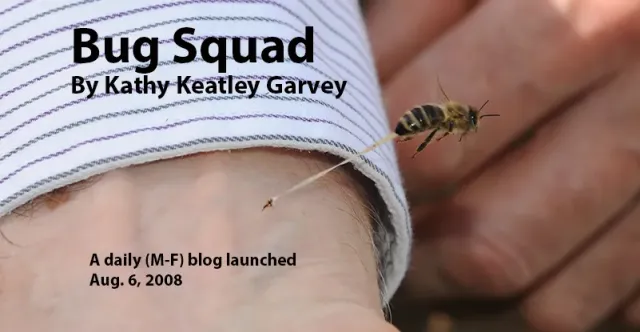
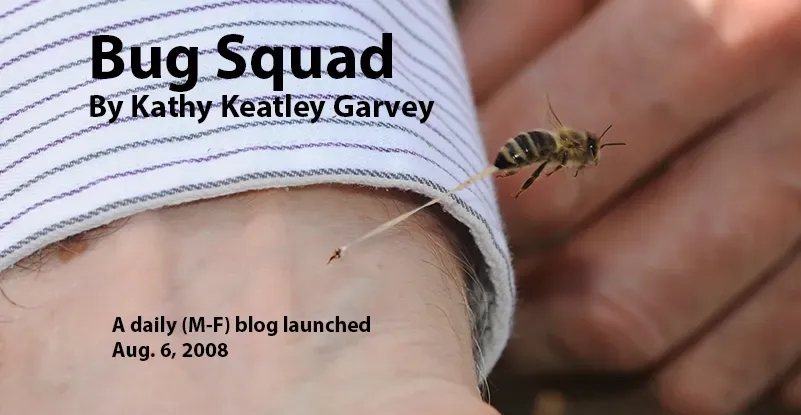
Bug Squad blog image depicts a honey bee sting in action.

Welcome to the Bug Squad blog! The Bug Squad blog was launched Aug. 6, 2008 and is a daily blog (Monday through Friday). It showcases entomologists and the work they do.  The blog focuses on scientists in the UC Davis Department of Entomology and Nematology, the Bohart Museum of Entomology, Harry H. Laidlaw Jr. Honey Bee Research Facility, the UC Davis Bee Haven, and assorted campuswide events, including UC Davis Picnic Day, UC Davis Biodiversity Museum Day, and Bohart Museum open houses. The blog spotlights insects, including bees, butterflies, dragonflies, and praying mantises, as well as arachnids such as jumping spiders and crab spiders. Author and photographer is Kathy Keatley Garvey, communications specialist, UC Davis Department of Entomology and Nematology, and a longtime journalist and community scientist with two degrees from Washington State University.  She is a member of the Entomological Society of America (ESA) and the Association for Communication Excellence (ACE). Her blog posts and images have won international awards from ACE and ESA and appeared on journal and magazine covers. She shoots primarily with a Nikon Z-8 mirrorless camera, a Nikon D500 and Nikon 800, with assorted macro lenses. Feedspot lists it as one of the top entomology blogs on the Internet. 
Primary Image
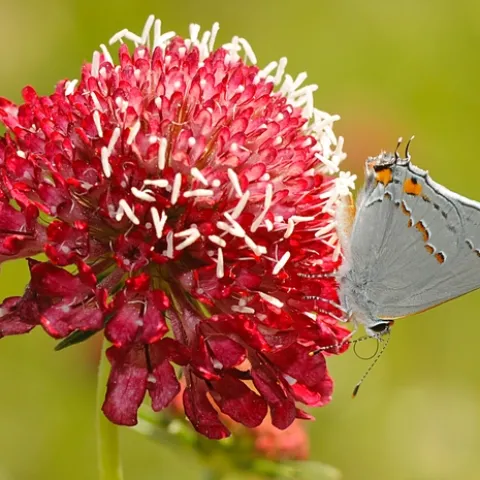
Gray hairstreak (Strymon melinus) on a red pincushion flower (Scabiosa). (Photo by Kathy Keatley Garvey)

A Streak of Gray

June 17, 2011
By Kathy Keatley Garvey
A streak of gray, but don't wash it away. The gray hairstreak is a butterfly. We spotted this delicate-looking butterfly (Strymon melinus) on a red pincushion flower (Scabiosa) this week in Winters, Yolo County. Gray on red. Fauna on flora. A Strymon on a Scabiosa.
View Article
Primary Image
ene Robinson of the University of Illinois, shown here following his Jan. 6 talk at UC Davis, is heavily involved in "The Manhattan Project of Entomology." (Photo by Kathy Keatley Garvey)

'The Manhattan Project of Entomology'

June 16, 2011
By Kathy Keatley Garvey
It's been dubbed "The Manhattan Project of Entomology." And it may have "the potential to revolutionize the way we think about insects," says Richard Levine, communications program manager of the Entomological Society of America (ESA). Call it "The Manhattan Project of Entomology.
View Article
Primary Image
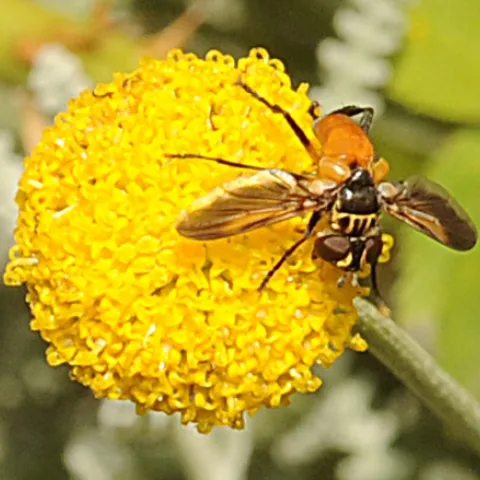
Distinctively colored tachinid fly, probably Trichopoda pennipes, on Santolina rosmarinifolia. (Photo by Kathy Keatley Garvey)

Not Your Average Lookin' Fly

June 15, 2011
By Kathy Keatley Garvey
The feather-legged fly looks as if it were formed by a committee. It's about the size of a house fly, but there the similarity ends. Black head and thorax, hind legs fringed with a "comb" of short black hairs, and an abdomen that's the color of honey--bright orange honey.
View Article
Primary Image
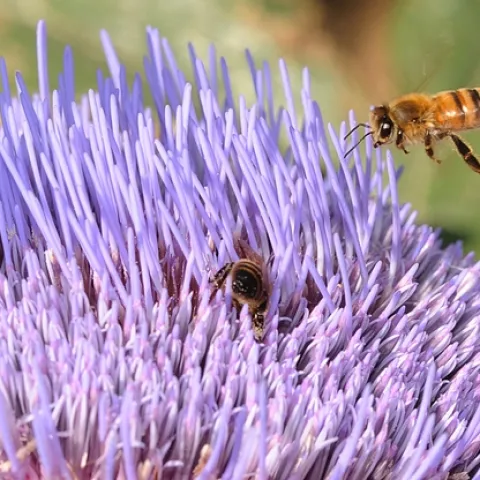
Honey bee heads for flowering artichoke in the Haagen-Dazs Honey Bee Haven at UC Davis. Photo by Kathy Keatley Garvey)

Let the Artichokes Flower

June 14, 2011
By Kathy Keatley Garvey
To attract honey bees to your garden, it's a good idea to let the artichokes flower. Sure, you could pick them for your dinner, but you'd be depriving honey bees of theirs. At the Hagen-Dazs Honey Bee Haven at UC Davis, the artichokes are beginning to flower.
View Article
Primary Image
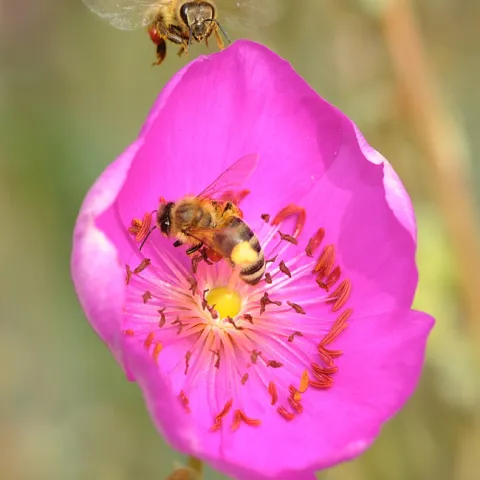
Pollen-packing honey bee heads toward a rock purslane blossom, already occupied by another worker. (Photo by Kathy Keatley Garvey)

In the Pink

June 13, 2011
By Kathy Keatley Garvey
Honey bees in the pink? Yes. If you plant rock purslane (Calandrinia grandiflora), a perennial succulent, be prepared for a posse of honey bees.
View Article