Bug Squad Logo

Bug Squad

Bug Squad blog image depicts a honey bee sting in action.

Welcome to the Bug Squad blog! The Bug Squad blog was launched Aug. 6, 2008 and is a daily blog (Monday through Friday). It showcases entomologists and the work they do.  The blog focuses on scientists in the UC Davis Department of Entomology and Nematology, the Bohart Museum of Entomology, Harry H. Laidlaw Jr. Honey Bee Research Facility, the UC Davis Bee Haven, and assorted campuswide events, including UC Davis Picnic Day, UC Davis Biodiversity Museum Day, and Bohart Museum open houses. The blog spotlights insects, including bees, butterflies, dragonflies, and praying mantises, as well as arachnids such as jumping spiders and crab spiders. Author and photographer is Kathy Keatley Garvey, communications specialist, UC Davis Department of Entomology and Nematology, and a longtime journalist and community scientist with two degrees from Washington State University.  She is a member of the Entomological Society of America (ESA) and the Association for Communication Excellence (ACE). Her blog posts and images have won international awards from ACE and ESA and appeared on journal and magazine covers. She shoots primarily with a Nikon Z-8 mirrorless camera, a Nikon D500 and Nikon 800, with assorted macro lenses. Feedspot lists it as one of the top entomology blogs on the Internet. 
Primary Image
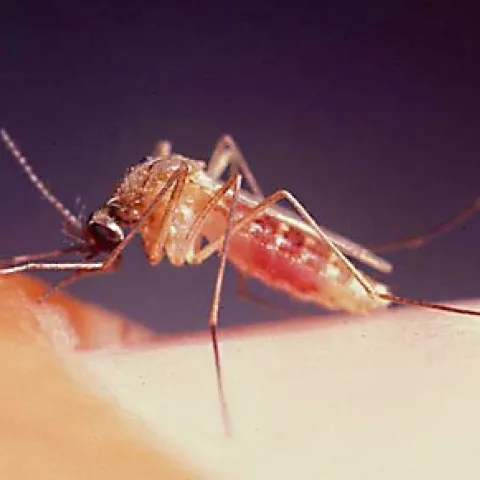
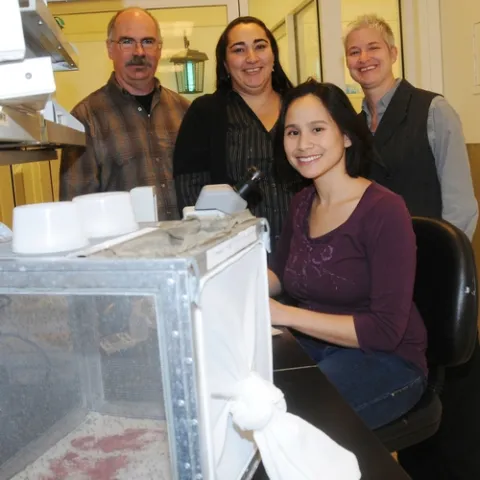
TARGETING MALARIA--This is the UC Davis team that co-authored research (with University of Arizona scientists) that made Time Magazine's "Top 50 Inventions of 2010"--the malaria-proof mosquito. In front, at the microscope, is entomology doctoral student Anna Drexler. In back (from left) are professor Edwin Lewis, postdoctoral scholar Nazzy Pakpour, and professor Shirley Luckhart. In the foreground: anopheline mosquitoes. (Photo by Kathy Keatley Garvey)

Malaria-Proof Mosquito Takes the Spotlight

January 7, 2011
By Kathy Keatley Garvey
Shirley Luckhart, Edwin Lewis, Anna Drexler and Nazzy Pakpour ought to be dancing. They're probably not, though. They're too busy doing research. They're the UC Davis scientists who worked on a malaria-proof mosquito that just made Time Magazines 50 Best Inventions of 2010. It's listed as No.
View Article
Primary Image
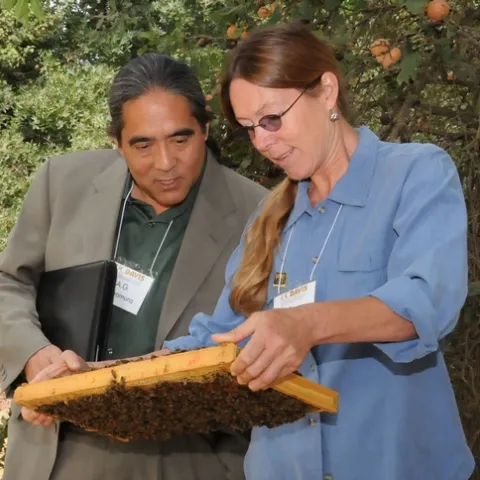
BEE BREEDER-GENETICIST Susan Cobey shows A. G. Kawamura, secretary of the California Department of Food and Agriculture, her line of New World Carniolans during his recent visit to the Harry H. Laidlaw Jr. Honey Bee Research Facility at the University of California, Davis. In his youth, Kawamura reared bees. (Photo by Kathy Keatley Garvey)

Honey, They're in Galveston

January 5, 2011
By Kathy Keatley Garvey
If you're looking for your favorite beekeepers, apiculturists and bee researchers, odds are you won't find them. Unless you're in Galveston, Texas. The 2011 North American Bee Conference and Trade Show is taking place Jan. 4-8 in Galveston.
View Article
Primary Image
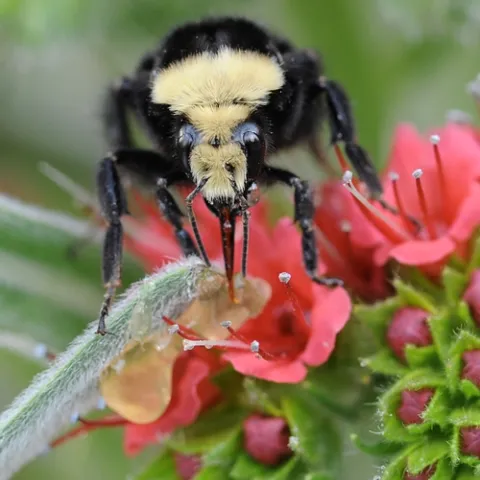
YELLOW-FACED BUMBLE BEE, Bombus vosnesenskii, gathers nectar from a tower of jewels. The Cameron study looked at three species of western bumble bees, including this species. (Photo by Kathy Keatley Garvey)

Declining Bumble Bees: Alarming

January 4, 2011
By Kathy Keatley Garvey
Some species of bumble bees are disappearing at an alarming rate. And that, in itself, is alarming. A three-year study published Jan.
View Article
Primary Image
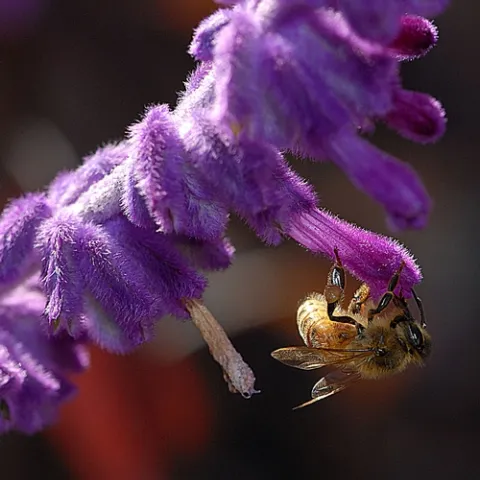
HONEY BEE nectaring salvia. This one is Salvia leucantha or "Mexican sage." (Photo by Kathy Keatley Garvey)

Salivating the Salvia

January 3, 2011
By Kathy Keatley Garvey
Hmm, ever wonder why honey bees love salvia? Are they going for that nectar or are they going for something else? Salvia divinorum, which like all the salvias, is a member of the mint family, is gaining notoriety for its hallucinogenic effects.
View Article