Bug Squad Logo

Bug Squad

Bug Squad blog image depicts a honey bee sting in action.

Welcome to the Bug Squad blog! The Bug Squad blog was launched Aug. 6, 2008 and is a daily blog (Monday through Friday). It showcases entomologists and the work they do.  The blog focuses on scientists in the UC Davis Department of Entomology and Nematology, the Bohart Museum of Entomology, Harry H. Laidlaw Jr. Honey Bee Research Facility, the UC Davis Bee Haven, and assorted campuswide events, including UC Davis Picnic Day, UC Davis Biodiversity Museum Day, and Bohart Museum open houses. The blog spotlights insects, including bees, butterflies, dragonflies, and praying mantises, as well as arachnids such as jumping spiders and crab spiders. Author and photographer is Kathy Keatley Garvey, communications specialist, UC Davis Department of Entomology and Nematology, and a longtime journalist and community scientist with two degrees from Washington State University.  She is a member of the Entomological Society of America (ESA) and the Association for Communication Excellence (ACE). Her blog posts and images have won international awards from ACE and ESA and appeared on journal and magazine covers. She shoots primarily with a Nikon Z-8 mirrorless camera, a Nikon D500 and Nikon 800, with assorted macro lenses. Feedspot lists it as one of the top entomology blogs on the Internet. 
Primary Image
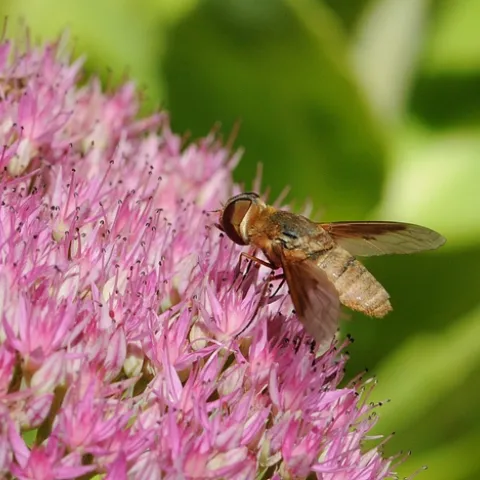
A BEE FLY nectars on sedum. (Photo by Kathy Keatley Garvey)

Not Bees--They're Flies

September 7, 2010
By Kathy Keatley Garvey
There are "bees" and there are "flies." And then there are "bee flies." Bee flies? They're so named because they look somewhat like bees. Order: Diptera. Family: Bombyliidae. We spotted a single bee fly, as identified by UC Davis forensic entomologist Bob Kimsey, foraging on our sedum yesterday.
View Article
Primary Image
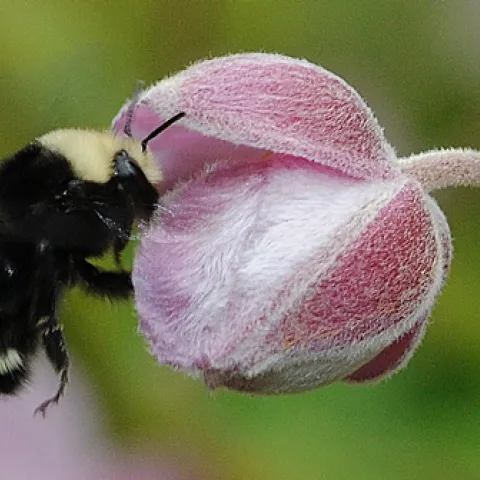
WORKER BUMBLE BEE on anemone. This is a female yellow-faced bumble bee (Bombus vosnesenskii), as identified by native pollinator specialist Robbin Thorp, emeritus professor of entomology at UC Davis. (Photo by Kathy Keatley Garvey)

Give Us an A, B, and C

September 6, 2010
By Kathy Keatley Garvey
"A" is for anemone, "B" is for bumble bee and "C" is for coneflower. A visit to the Oregon state capitol grounds in Salem last Tuesday found scores of yellow-faced bumble bees (Bombus vosnesenskii) working the anemones and purple coneflowers.
View Article
Primary Image
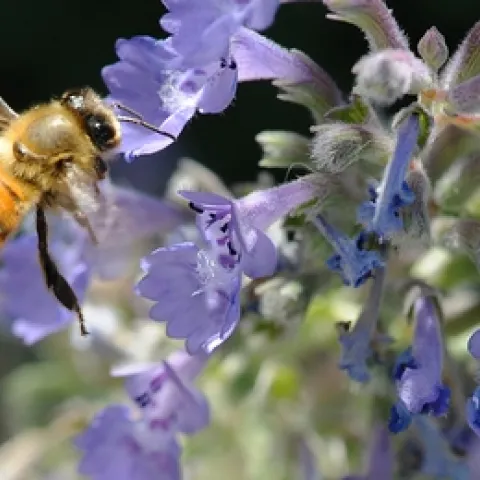
HONEY BEE heads for catmint (Nepeta). Catmint is one of the plants in the Häagen-Dazs Honey Bee Haven that attracts honey bees, native bees, butterflies and assorted other insects. (Photo by Kathy Keatley Garvey)

Mint Condition

September 3, 2010
By Kathy Keatley Garvey
When the Hagen-Dazs Honey Bee Haven's grand opening celebration takes place on Saturday, Sept. 11, visitors can expect to see scores of flowers, including the ever-popular catmint (Nepeta). Honey bees love the mints. So do bumble bees, carpenter bees, butterflies and assorted other insects.
View Article
Primary Image
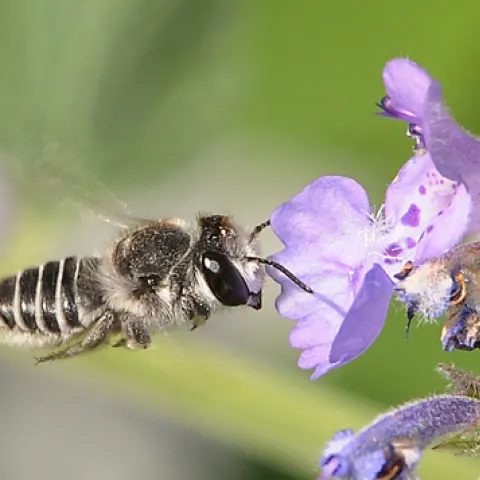
CAUGHT IN FLIGHT, a leafcutter bee heads toward a catmint flower (Nepeta). (Photo by Kathy Keatley Garvey)

Catching Up with a Leafcutter Bee

September 2, 2010
By Kathy Keatley Garvey
Leafcutter bees (Megachile spp.), so named because they cut leaves and petals to line their nests, are smaller than the honey bees but move faster. These native bees are easily recognizable by the black-white bands on their abdomen. Catching them in flight requires a lot of patience.
View Article
Primary Image
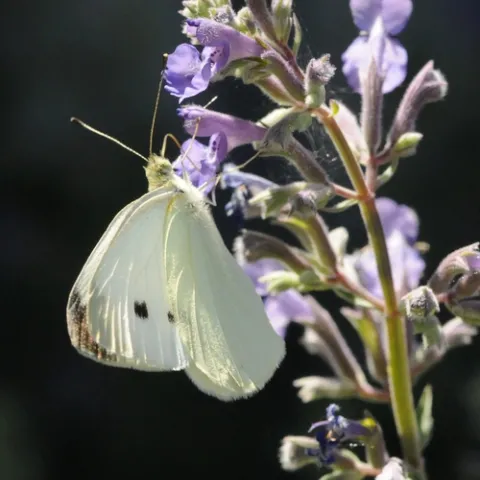
CABBAGE WHITE butterfly glows in the late afternoon sun as it nectars on catmint (Nepeta). (Photo by Kathy Keatley Garvey)

Lovely Indeed

September 1, 2010
By Kathy Keatley Garvey
If we were to describe the cabbage white butterfly (Pieris rapae) in one word, it would be "lovely." Especially when it nectars from catmint (Nepeta) in the early evening, as the sun drops low in the horizon.
View Article