Bug Squad Logo

Bug Squad

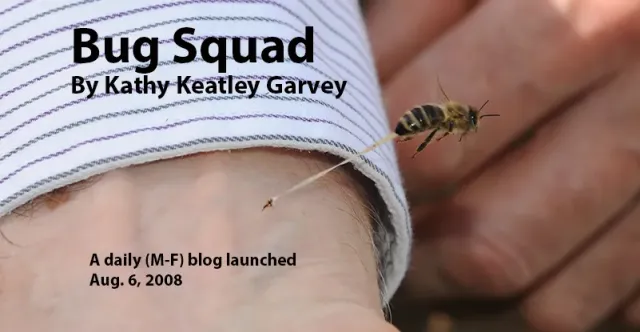
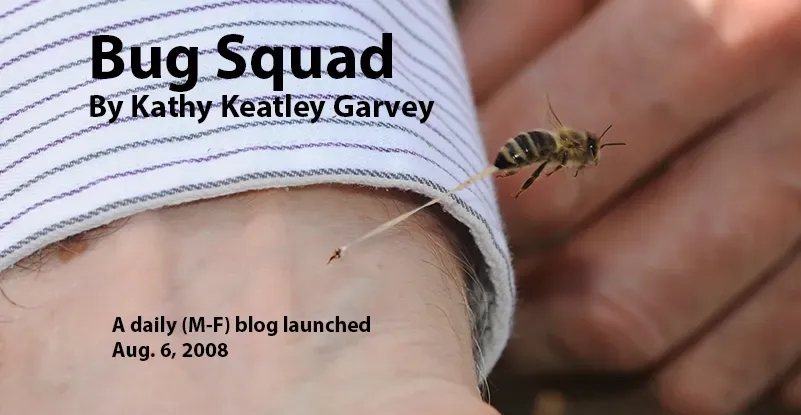
Bug Squad blog image depicts a honey bee sting in action.

Welcome to the Bug Squad blog! The Bug Squad blog was launched Aug. 6, 2008 and is a daily blog (Monday through Friday). It showcases entomologists and the work they do.  The blog focuses on scientists in the UC Davis Department of Entomology and Nematology, the Bohart Museum of Entomology, Harry H. Laidlaw Jr. Honey Bee Research Facility, the UC Davis Bee Haven, and assorted campuswide events, including UC Davis Picnic Day, UC Davis Biodiversity Museum Day, and Bohart Museum open houses. The blog spotlights insects, including bees, butterflies, dragonflies, and praying mantises, as well as arachnids such as jumping spiders and crab spiders. Author and photographer is Kathy Keatley Garvey, communications specialist, UC Davis Department of Entomology and Nematology, and a longtime journalist and community scientist with two degrees from Washington State University.  She is a member of the Entomological Society of America (ESA) and the Association for Communication Excellence (ACE). Her blog posts and images have won international awards from ACE and ESA and appeared on journal and magazine covers. She shoots primarily with a Nikon Z-8 mirrorless camera, a Nikon D500 and Nikon 800, with assorted macro lenses. Feedspot lists it as one of the top entomology blogs on the Internet. 
Primary Image
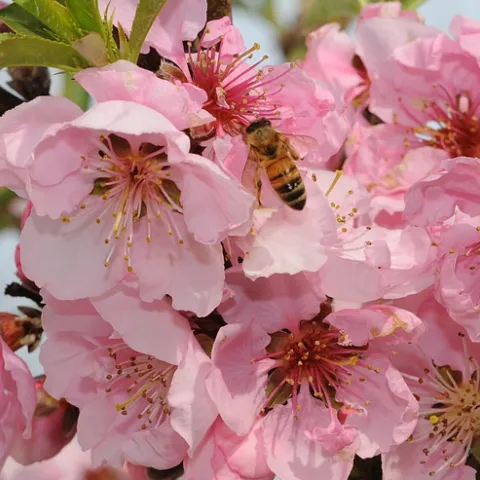
HONEY BEE nectaring nectarine blossoms. (Photo by Kathy Keatley Garvey)

In the Pink

March 2, 2010
By Kathy Keatley Garvey
It's a peach of a tree, but it isn't a peach. It's a nectarine, a close variety of the peach--the result of a genetic mutation. In between the rain storms, honey bees are nectaring the nectarines and packing pollen, getting ready for the spring hive build-ups.
View Article
Primary Image
ICELAND POPPIES provide color to the backdrop of the old Town Hall in Vacaville, Calif. (Photo by Kathy Keatley Garvey)

Town Hall meeting

March 1, 2010
By Kathy Keatley Garvey
The old Town Hall off Main Street, Vacaville, Calif., is the perfect backdrop for Iceland poppies (Papaver nudicaule) thriving in planters. The Iceland poppies, sometimes called arctic poppies, are native to northern Europe and North America. "Papaver" is the Greek word for "poppy.
View Article
Primary Image
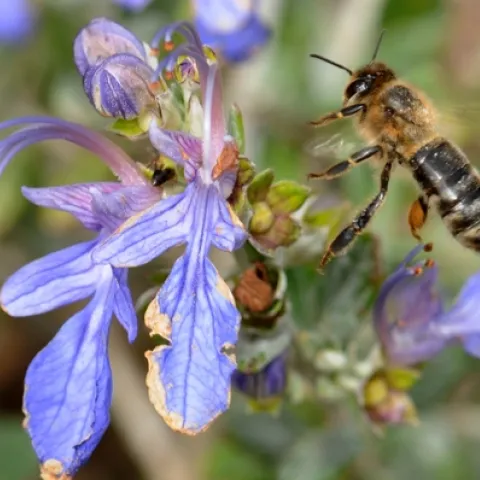
HONEY BEE heads for a Teucrium frutican "Azureum"--also known as a blue bush germander. Note the ant in the middle. (Photo by Kathy Keatley Garvey)

Bee Bliss

February 26, 2010
By Kathy Keatley Garvey
It didn't take long. Last year at this time the field next to the Harry H. Laidlaw Jr. Honey Bee Research Facility on Bee Biology Road at the University of California, Davis stood bleak and barren. Nothing there but scattered patches of grass and a few pocket gophers and ground squirrels.
View Article
Primary Image
HONEY BEE in flight at the Harry H. Laidlaw Jr. Honey Bee Research Facility at the University of California, Davis. Scientists say the bee is more fuel efficient than even the most fuel-efficient car; the bee can get nearly 5 million miles to the gallon. (Photo by Kathy Keatley Garvey)

Fuels Rush In

February 25, 2010
By Kathy Keatley Garvey
How fuelish is the honey bee? Is it as fuel-efficient as say, the new Volkswagen that gets an estimated 170 miles per gallon, more MPG than any other vehicle? National Public Radio recently posted an interesting article on its Web site comparing the VW with the HB (the honey bee, Apis mellifera).
View Article
Primary Image
APICULTURIST ERIC MUSSEN stands amid the almond blossoms at the Harry H. Laidlaw Jr. Honey Bee Research Facility at UC Davis. He is the 2010 winner of the statewide Pedro Ilic Outstanding Agriculture Educator. (Photo by Kathy Keatley Garvey)

An A-Plus for "The B Guy"

February 24, 2010
By Kathy Keatley Garvey
Eric Mussen is used to fielding questions about honey bees--how and why they gather nectar, honey, propolis and water; how many eggs a queen bee can lay in a day; and why beekeeper use smokers.
View Article