Bug Squad Logo

Bug Squad

Bug Squad blog image depicts a honey bee sting in action.

Welcome to the Bug Squad blog! The Bug Squad blog was launched Aug. 6, 2008 and is a daily blog (Monday through Friday). It showcases entomologists and the work they do.  The blog focuses on scientists in the UC Davis Department of Entomology and Nematology, the Bohart Museum of Entomology, Harry H. Laidlaw Jr. Honey Bee Research Facility, the UC Davis Bee Haven, and assorted campuswide events, including UC Davis Picnic Day, UC Davis Biodiversity Museum Day, and Bohart Museum open houses. The blog spotlights insects, including bees, butterflies, dragonflies, and praying mantises, as well as arachnids such as jumping spiders and crab spiders. Author and photographer is Kathy Keatley Garvey, communications specialist, UC Davis Department of Entomology and Nematology, and a longtime journalist and community scientist with two degrees from Washington State University.  She is a member of the Entomological Society of America (ESA) and the Association for Communication Excellence (ACE). Her blog posts and images have won international awards from ACE and ESA and appeared on journal and magazine covers. She shoots primarily with a Nikon Z-8 mirrorless camera, a Nikon D500 and Nikon 800, with assorted macro lenses. Feedspot lists it as one of the top entomology blogs on the Internet. 
Primary Image
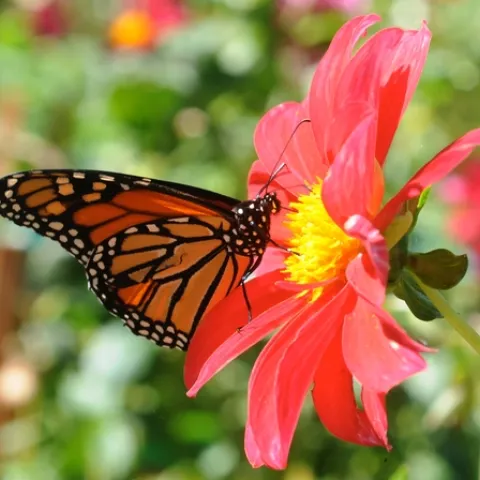
MONARCH BUTTERFLY (Danaus plexippus), shown here in the Luther Burbank Gardens, Santa Rosa, is one of the butterflies that Art Shapiro has studied for the last 35 years. (Photo by Kathy Keatley Garvey)

Fleeting Butterflies

January 19, 2010
By Kathy Keatley Garvey
It's good to see those fluttering butterflies back in the news again. But they are fleeting butterflies.
View Article
Primary Image
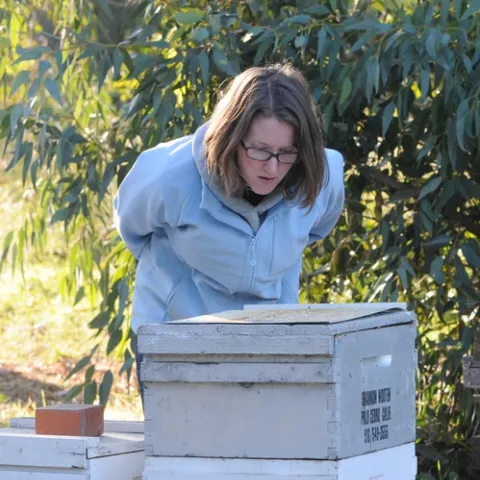
BEEKEEPER Elizabeth "Liz" Frost of the Harry H. Laidlaw Jr. Honey Bee Research Facility, UC Davis, looks for ants on the tray she's just pulled out. (Photo by Kathy Keatley Garvey)

Unwanted Guests

January 18, 2010
By Kathy Keatley Garvey
Pull out the bottom tray (floor) of a beehive and you're likely to see lots of bee droppings, a little pollen, a few mites, a few dead bees and...a few scurrying ants. Ants find a bee hive nice and cozy, especially in the winter as temperatures drop. Beekeeper Elizabeth "Liz" Frost of the Harry H.
View Article
Primary Image
THIS BUMBLE BEE, Bombus californicus, is among the native bees in the area near the American and Consumnes rivers. (Photo by Kathy Keatley Garvey)

Dragonflies, Damselflies, Dermestids and Bees

January 15, 2010
By Kathy Keatley Garvey
Dragonflies, damselflies, dermestids and native bees. Does an entomological life get any better than this? Those are some of the topics to be discussed at the next meeting of the Northern California Entomological Society, set for Thursday, Feb.
View Article
Primary Image
BUMBLE BEE expert Robbin Thorp, emeritus professor of entomology at UC Davis, with his image of Franklin's bumble bee on his computer screen. (Photo by Kathy Keatley Garvey)

Declining Bumble Bees

January 14, 2010
By Kathy Keatley Garvey
The bumble bee population is declining and some species are teetering on the brink of extinction.
View Article
Primary Image
UC DAVIS RESEARCHER Ian Pearse in front of the Peter J. Shields Oak Grove, on Garrod Drive, UC Davis Arboretum. Pearse received a fellowship from the National Science Foundation for his oak tree research. Long interested in plant biochemistry, he joined the UC Davis graduate program in entomology in 2006, after studying a year in Germany with the Max Planck Society for Chemical Ecology. He received his bachelor of science degree in plant biology from the University of Illinois, Urbana-Champaign, in 2004.(P

Why Some and Not Others

January 13, 2010
By Kathy Keatley Garvey
When you visit the Peter J. Shields Oak Grove in the UC Davis Arboretum, you'll see one of the most diverse mature oak collections in the United States.
View Article