Bug Squad Logo

Bug Squad

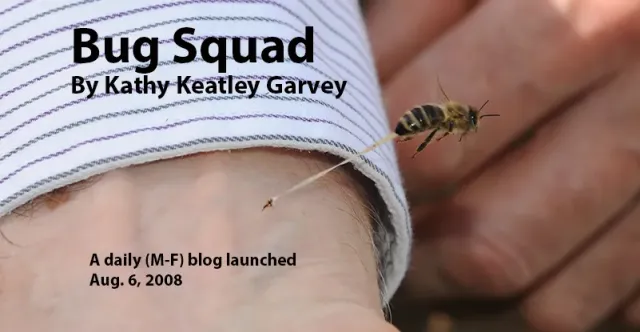
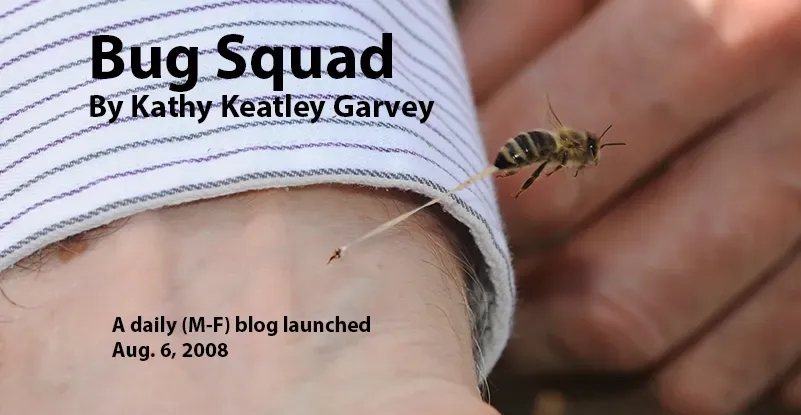
Bug Squad blog image depicts a honey bee sting in action.

Welcome to the Bug Squad blog! The Bug Squad blog was launched Aug. 6, 2008 and is a daily blog (Monday through Friday). It showcases entomologists and the work they do.  The blog focuses on scientists in the UC Davis Department of Entomology and Nematology, the Bohart Museum of Entomology, Harry H. Laidlaw Jr. Honey Bee Research Facility, the UC Davis Bee Haven, and assorted campuswide events, including UC Davis Picnic Day, UC Davis Biodiversity Museum Day, and Bohart Museum open houses. The blog spotlights insects, including bees, butterflies, dragonflies, and praying mantises, as well as arachnids such as jumping spiders and crab spiders. Author and photographer is Kathy Keatley Garvey, communications specialist, UC Davis Department of Entomology and Nematology, and a longtime journalist and community scientist with two degrees from Washington State University.  She is a member of the Entomological Society of America (ESA) and the Association for Communication Excellence (ACE). Her blog posts and images have won international awards from ACE and ESA and appeared on journal and magazine covers. She shoots primarily with a Nikon Z-8 mirrorless camera, a Nikon D500 and Nikon 800, with assorted macro lenses. Feedspot lists it as one of the top entomology blogs on the Internet. 
Primary Image
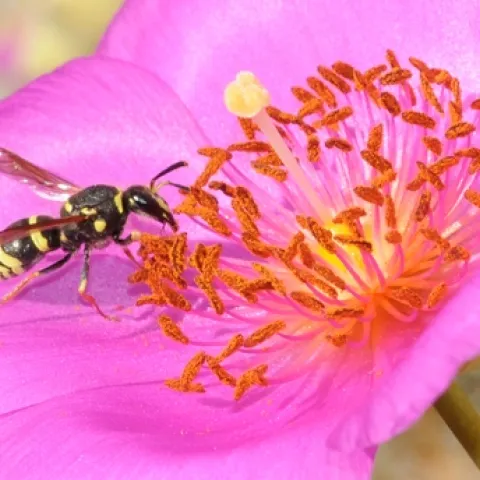
MASON WASP sipping nectar from a rock purslane. The wasp is from the family Vespidae and subfamily Eumeninae. It's probably from the genus Ancistrocerus, according to Robbin Thorp, emeritus professor of entomology at UC Davis. (Photo by Kathy Keatley Garvey)

Meet the Masons

December 1, 2009
By Kathy Keatley Garvey
Mason wasps are strikingly beautiful. The black and yellow patterns are intriguing, but even more intriguing are the mud nests they build. Makes sense that these wasps are called mason or potter wasps, named for what they do. Their human counterparts work with stone, brick, and concrete.
View Article
Primary Image
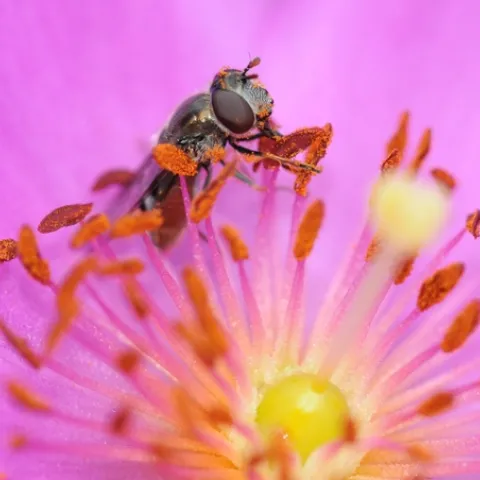
HOVER FLY, aka flower fly, nectars the rock purslane. The insect is from the family Syrphidae, and probably genus Platycheirus, according to native pollinator specialist Robbin Thorp, emeritus professor of entomology at UC Davis. (Photo by Kathy Keatley Garvey)

Hovering

November 30, 2009
By Kathy Keatley Garvey
The warmth of the sun and the lure of nectar beckoned the hover flies or flower flies to our bee friendly garden. We saw this one nectaring the rock purslane (Calandrinia grandiflora) last weekend.
View Article
Primary Image
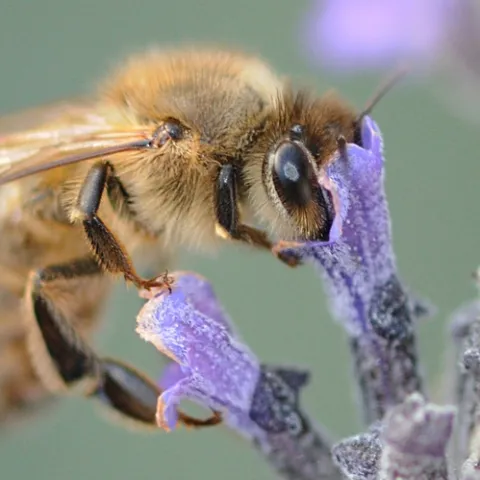
COMPOUND EYES of the honey bee are comprised of hundreds of single eyes (ommatidia). (Photo by Kathy Keatley Garvey)

Seeing Eye to Eye

November 27, 2009
By Kathy Keatley Garvey
Ever wonder how a honey bee sees? Its compound eyes are comprised of hundreds of single eyes (ommatidia), each with its own lens. It can distinguish colors, but can't see red, which it interprets as black.
View Article
Primary Image
HONEY BEE nectaring lavender. (Photo by Kathy Keatley Garvey)

Thanks Be to the Bee

November 26, 2009
By Kathy Keatley Garvey
Hap-bee Thanksgiving! If you're having cranberries, squash, pumpkins, carrots, cucumbers (and pickles) onions, grapefruit, oranges, apples, pears, cherries, blueberries, sunflowers and almonds, you can thank the honey bee.
View Article
Primary Image
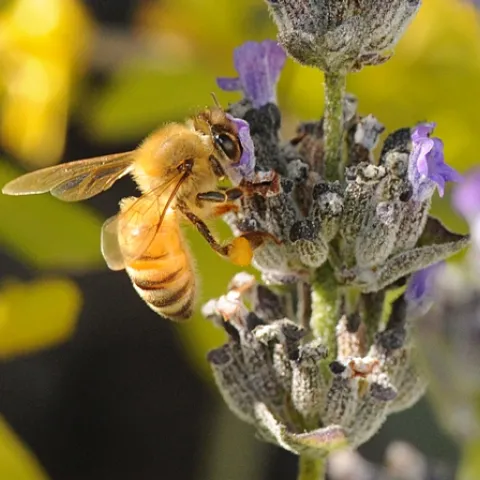
LOOKING like pure gold, an Italian bee nectars lavender. The yellow leaves of a pomegranate tree are in the background. (Photo by Kathy Keatley Garvey)

Thar's Gold in That Thar Lavender

November 25, 2009
By Kathy Keatley Garvey
I slipped into the back yard today to see how many honey bees were nectaring the lavender, one of the few plants still blooming. A few here. A few there. That's when I saw her. A bee the color of pure gold. And she was carrying a load of pollen that was equally pure gold.
View Article