Bug Squad Logo

Bug Squad

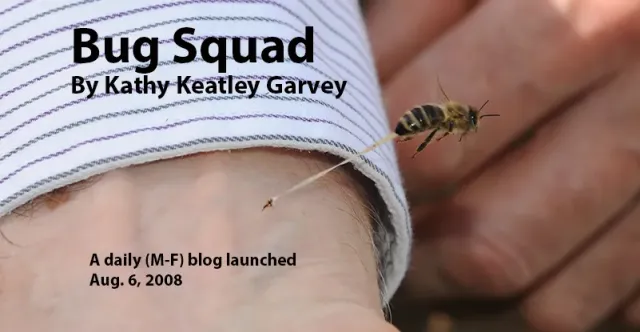
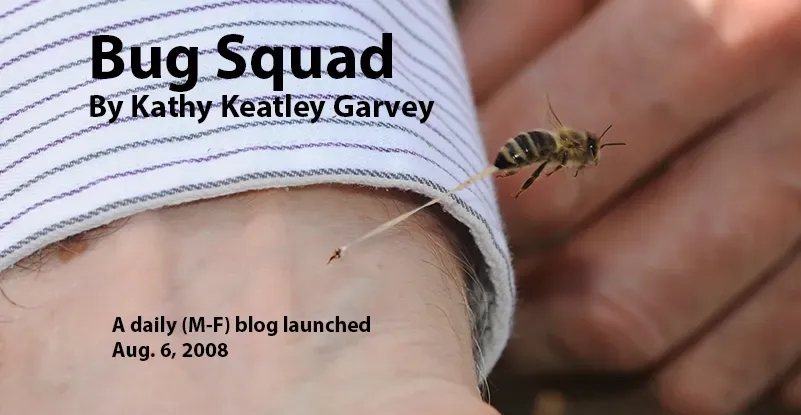
Bug Squad blog image depicts a honey bee sting in action.

Welcome to the Bug Squad blog! The Bug Squad blog was launched Aug. 6, 2008 and is a daily blog (Monday through Friday). It showcases entomologists and the work they do.  The blog focuses on scientists in the UC Davis Department of Entomology and Nematology, the Bohart Museum of Entomology, Harry H. Laidlaw Jr. Honey Bee Research Facility, the UC Davis Bee Haven, and assorted campuswide events, including UC Davis Picnic Day, UC Davis Biodiversity Museum Day, and Bohart Museum open houses. The blog spotlights insects, including bees, butterflies, dragonflies, and praying mantises, as well as arachnids such as jumping spiders and crab spiders. Author and photographer is Kathy Keatley Garvey, communications specialist, UC Davis Department of Entomology and Nematology, and a longtime journalist and community scientist with two degrees from Washington State University.  She is a member of the Entomological Society of America (ESA) and the Association for Communication Excellence (ACE). Her blog posts and images have won international awards from ACE and ESA and appeared on journal and magazine covers. She shoots primarily with a Nikon Z-8 mirrorless camera, a Nikon D500 and Nikon 800, with assorted macro lenses. Feedspot lists it as one of the top entomology blogs on the Internet. 
Primary Image
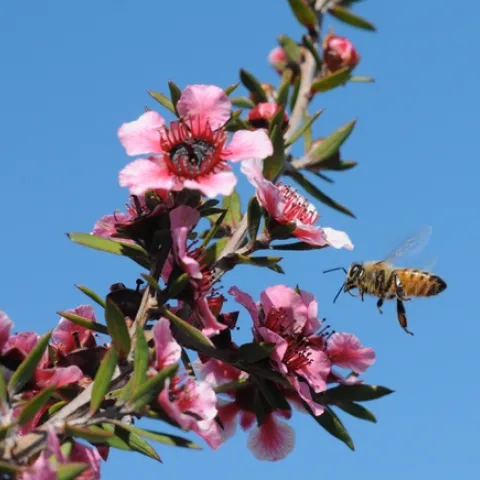
HONEY BEE heads for a Leptospermum scoparium keatleyi, also known as a "royal pink manuka." (Photo by Kathy Keatley Garvey)

Tea for Two

November 24, 2009
By Kathy Keatley Garvey
In a way, it's "tea for two." The New Zealand tea tree, Leptospermum scoparium, aka "manuka," "tea tree," and "Leptospermum," is a favorite of the light brown apple moth AND honey bees. We captured images of bees on Leptospermum scoparium keatleyi recently in Sausalito.
View Article
Primary Image
THREE GREEN APHIDS are sucking plant juices from a rock purslane, while a honey bee is sipping nectar. (Photo by Kathy Keatley Garvey)

Guess Who Came to Dinner?

November 23, 2009
By Kathy Keatley Garvey
Picture this. A light rainstorm strikes the garden, pummeling and shredding some of the blossoms. As the rain lets up, a honey bee buzzes into a rock purslane blossom for a sweet shot of nectar. She is not alone. If you look closely, you'll see three green aphids on an unopened blossom next to her.
View Article
Primary Image
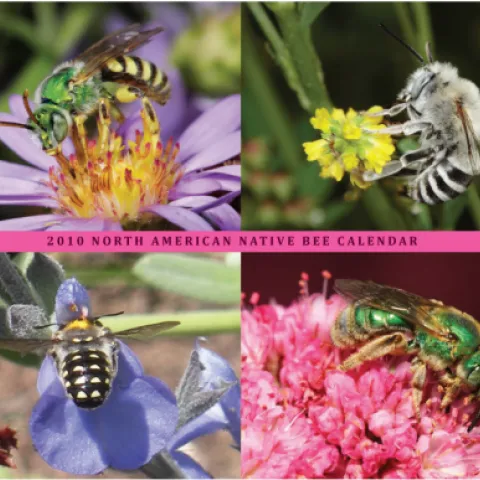
SPECTACULAR PHOTOGRAPHY of entomologist Rollin Coville, who received his doctorate in entomology from UC Berkeley, graces the 2010 Native Bees Calendar, a fundraising project of the Xerces Society and the Great Sunflower Project. (Photos courtesy of Rollin Coville)

Native Bee Calendar Focuses on 'Pin-Up Girls'--and Boys

November 20, 2009
By Kathy Keatley Garvey
Humans aren't the only calendar pin-up models. Think native bees. Think the 2010 Native Bees Calendar. The Xerces Society and the Great Sunflower Project have joined forces to produce a calendar showcasing 12 commonly found native bees.
View Article
Primary Image
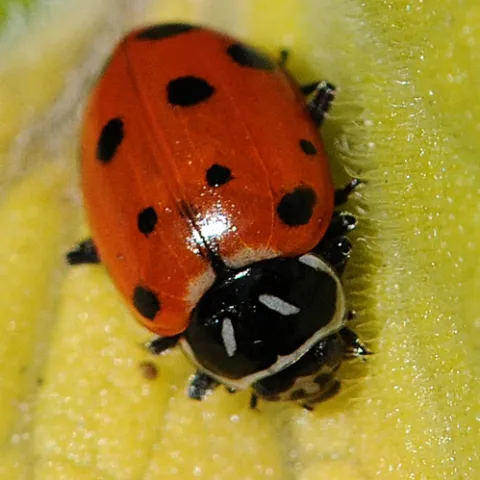
LADYBUG crawls on a leaf at the UC Berkeley Botanical Garden. (Photo by Kathy Keatley Garvey)

What's Bugging the Ladybug?

November 19, 2009
By Kathy Keatley Garvey
It probably bugs her but it doesn't kill her. But why? An entomologist at the University of Montreal is investigating why parasitic wasps (Dinocampus coccinellae) that lay their eggs on ladybugs (Coccinella maculata) do not kill them. Often a parasitic insect, such as a tachinid fly, kills its host.
View Article
Primary Image
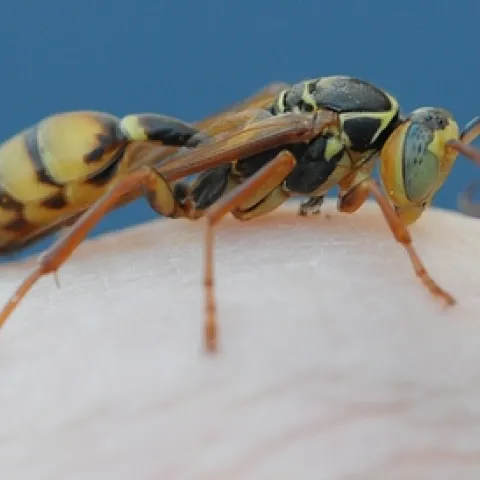
SLOW-MOVING yellow-legged paper wasp, Mischocyttarus flavitarsis. (Photo by Kathy Keatley Garvey)

Waist Not, Want Not

November 18, 2009
By Kathy Keatley Garvey
A buggy thing happened on the way to a meeting. As we left Briggs Hall, a three-story building on the UC Davis campus that houses the Department of Entomology, we noticed a wasp at our feet.
View Article