Bug Squad Logo

Bug Squad

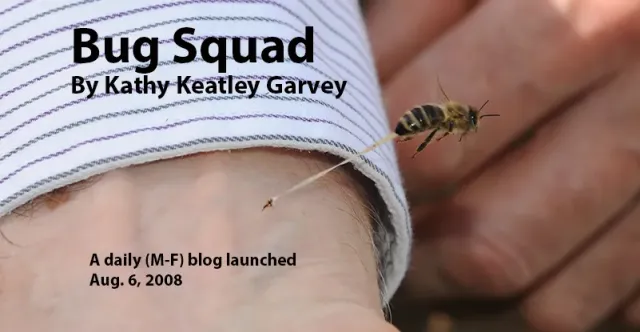
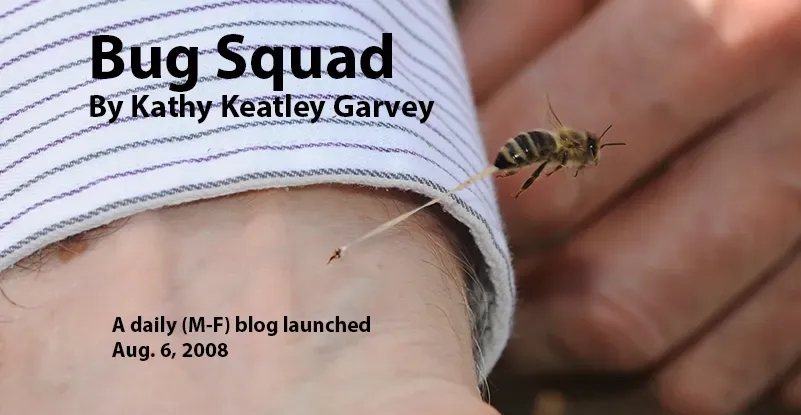
Bug Squad blog image depicts a honey bee sting in action.

Welcome to the Bug Squad blog! The Bug Squad blog was launched Aug. 6, 2008 and is a daily blog (Monday through Friday). It showcases entomologists and the work they do.  The blog focuses on scientists in the UC Davis Department of Entomology and Nematology, the Bohart Museum of Entomology, Harry H. Laidlaw Jr. Honey Bee Research Facility, the UC Davis Bee Haven, and assorted campuswide events, including UC Davis Picnic Day, UC Davis Biodiversity Museum Day, and Bohart Museum open houses. The blog spotlights insects, including bees, butterflies, dragonflies, and praying mantises, as well as arachnids such as jumping spiders and crab spiders. Author and photographer is Kathy Keatley Garvey, communications specialist, UC Davis Department of Entomology and Nematology, and a longtime journalist and community scientist with two degrees from Washington State University.  She is a member of the Entomological Society of America (ESA) and the Association for Communication Excellence (ACE). Her blog posts and images have won international awards from ACE and ESA and appeared on journal and magazine covers. She shoots primarily with a Nikon Z-8 mirrorless camera, a Nikon D500 and Nikon 800, with assorted macro lenses. Feedspot lists it as one of the top entomology blogs on the Internet. 
Primary Image
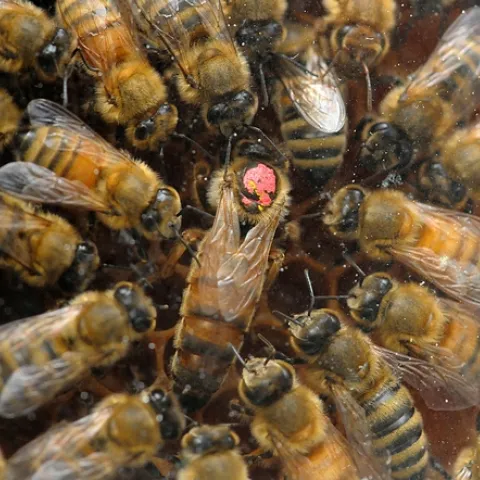
QUEEN BEE, marked with the dot, is circled by her royal attendants in a retinue. This was taken through the glass of an observation hive. (Photo by Kathy Keatley Garvey)

Life and Death in the Hive

October 14, 2009
By Kathy Keatley Garvey
Life and death in the bee observation hive... If you ever have the opportunity to check out a bee observation hive--a glassed-in hive showing the colony at work--you can easily spot the three castes: the queen bee, worker bees and drones.
View Article
Primary Image
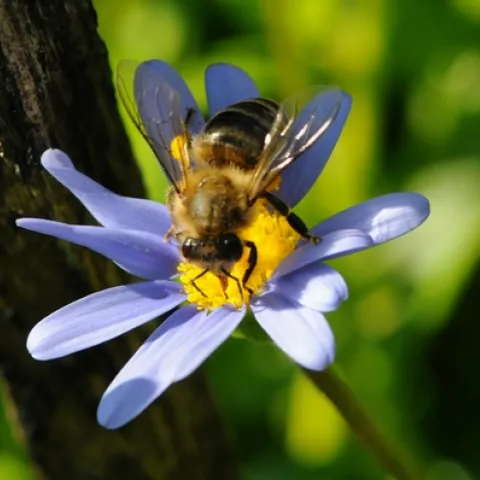
HONEY BEE nectars a blue marguerite daisy, a member of the sunflower family. (Photo by Kathy Keatley Garvey)

Blue Day for the Bees

October 13, 2009
By Kathy Keatley Garvey
It's a blue day for the honey bees. The massive Northern California storm--one of our worst-ever storms and marked by heavy rains and equally strong winds--means that bees are clustering inside their hives. No foraging today.
View Article
Primary Image
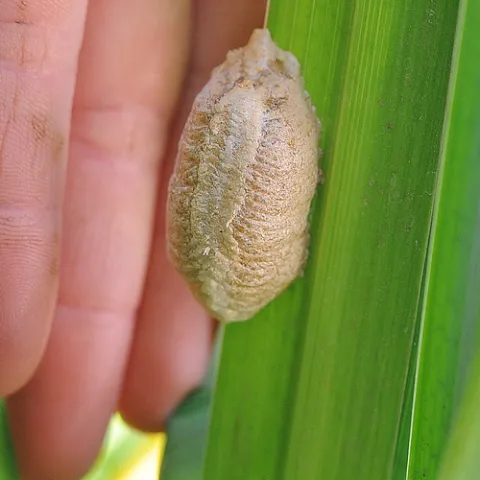
THIS EGG CASE on a potted plant outside the Harry H. Laidlaw Jr. Honey Bee Research Facility, UC Davis, will yield from 100 to 200 tiny mantises next spring when the weather warms. A praying mantis recently deposited her eggs on the plant. (Photo by Kathy Keatley Garvey)

Cold Case

October 12, 2009
By Kathy Keatley Garvey
Here's a "cold case" to investigate. Check your backyard or neighborhood park and see if a praying mantis has deposited an egg case on a tree limb, plant or fence. Case in point: Over at the Harry H. Laidlaw Jr.
View Article
Primary Image
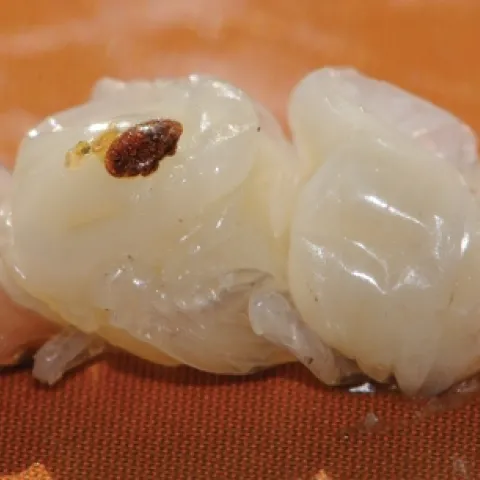
THIS VARROA MITE is feeding on a drone pupa. Varroa mites reproduce in the brood cells and attack the developing bees. (Photo by Kathy Keatley Garvey)

Not a Pretty Sight

October 9, 2009
By Kathy Keatley Garvey
It's not a pretty sight--the Varroa mite attacking a honey bee. Beekeepers are accustomed to seeing the reddish-brown, eight-legged parasite (aka "blood sucker") in their hives. UC Davis bee breeder-geneticist Susan Cobey, manager of the Harry H. Laidlaw Jr.
View Article
Primary Image
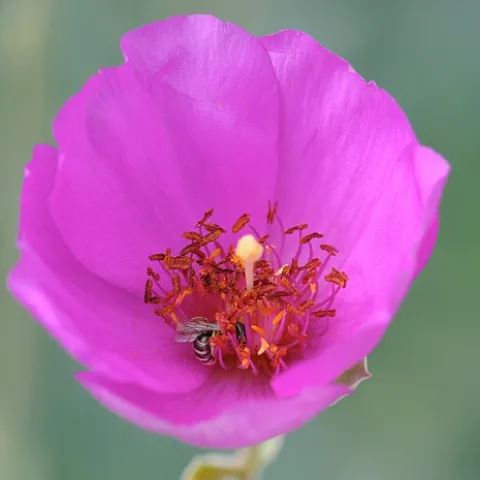
TINY female sweat bee (Halictus tripartitus) nectaring rock purslane. (Photo by Kathy Keatley Garvey)

Between a Rock and a...

October 8, 2009
By Kathy Keatley Garvey
Caught between a rock and a...soft place... You'll often see tiny sweat bees nectaring rock purslane (Calandrinia grandiflora) in urban gardens. This plant, a native of Chile, brightens landscapes with its pinkish magenta blossoms.
View Article