Bug Squad Logo

Bug Squad

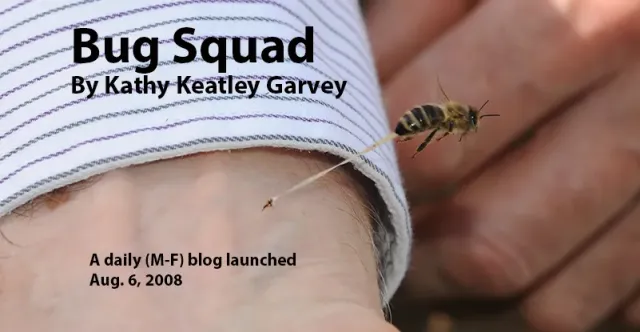
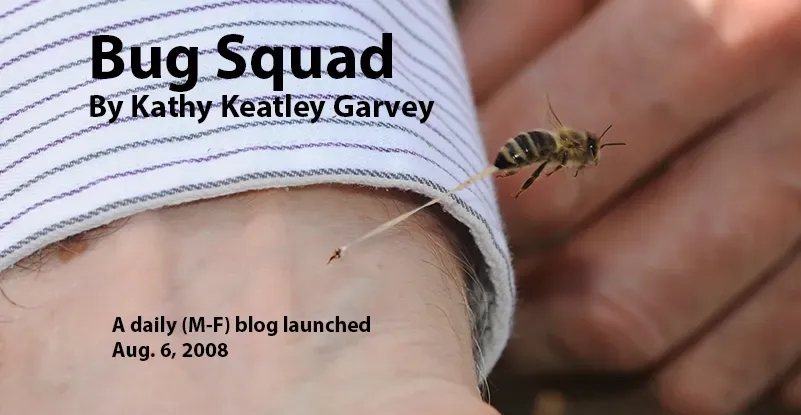
Bug Squad blog image depicts a honey bee sting in action.

Welcome to the Bug Squad blog! The Bug Squad blog was launched Aug. 6, 2008 and is a daily blog (Monday through Friday). It showcases entomologists and the work they do.  The blog focuses on scientists in the UC Davis Department of Entomology and Nematology, the Bohart Museum of Entomology, Harry H. Laidlaw Jr. Honey Bee Research Facility, the UC Davis Bee Haven, and assorted campuswide events, including UC Davis Picnic Day, UC Davis Biodiversity Museum Day, and Bohart Museum open houses. The blog spotlights insects, including bees, butterflies, dragonflies, and praying mantises, as well as arachnids such as jumping spiders and crab spiders. Author and photographer is Kathy Keatley Garvey, communications specialist, UC Davis Department of Entomology and Nematology, and a longtime journalist and community scientist with two degrees from Washington State University.  She is a member of the Entomological Society of America (ESA) and the Association for Communication Excellence (ACE). Her blog posts and images have won international awards from ACE and ESA and appeared on journal and magazine covers. She shoots primarily with a Nikon Z-8 mirrorless camera, a Nikon D500 and Nikon 800, with assorted macro lenses. Feedspot lists it as one of the top entomology blogs on the Internet. 

Primary Image
FIRST SPEAKER--Biological control scientist Madoka Nakai, associate professor, Tokyo University of Agriculture and Technology, will discuss biocontrol of tea pests in her talk, “A Novel Protein from Lepidopteran Virus Killing Endoparasitoid and Viral Control for Tea Pests in Japan,” at noon, Wednesday, Oct. 7 in 122 Briggs Hall, UC Davis. The lecture will be Webcast.

When Seminars Become Webinars

October 6, 2009
By Kathy Keatley Garvey
Like to know more about the biocontrol of tea pests? Aging of insects? What honey bee research is under way? If you can't physically attend the UC Davis Department of Entomology's fall seminars, starting Wednesday noon, Oct.
View Article
Primary Image
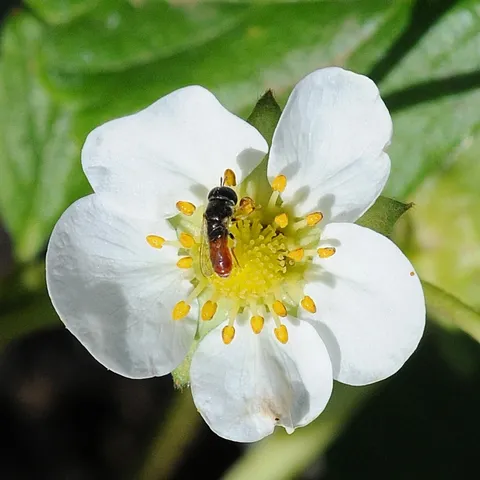
THIS TINY HOVER FLY is nectaring on a strawberry blossom at the Häagen-Dazs Honey Bee Haven, a half-acre bee friendly garden being developed on Bee Biology Road, UC Davis. This hover fly is most likely from the genus Paragus sp., said UC Davis emeritus professor and pollinator specialist Robbin Thorp. (Photo by Kathy Keatley Garvey)

Not Just the Bees

October 5, 2009
By Kathy Keatley Garvey
It's not just the honey bees that will be foraging in the half-acre Hagen-Dazs Honey Bee Haven on Bee Biology Road, UC Davis. Scores of native bees and other insects will be there, too. They already are. A weekend visit to the haven, a bee friendly garden being developed next to the Harry H.
View Article
Primary Image
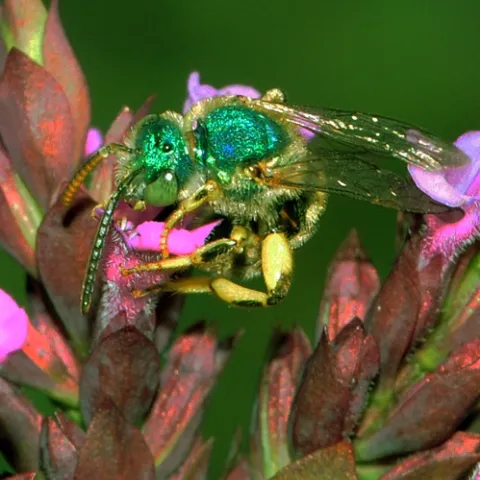
THIS MALE green metallic sweat bee, Agapostemon texanus, looks as if someone poured fluorescent paint on it. It's about one-fourth the size of a honey bee. (Photo by Kathy Keatley Garvey)

Color It Metallic Green

October 2, 2009
By Kathy Keatley Garvey
The green metallic sweat bee looks as if someone splashed green fluorescent paint on it. This uniquely colored bee is just one of some 1600 native bee species in California. It's about one-fourth the size of a honey bee and it's difficult to photograph because (1) it's tiny and (2) it moves fast.
View Article
Primary Image
MALARIA RESEARCHER Win Surachetpong in the Shirley Luckhart lab at UC Davis. (Photo by Kathy Keatley Garvey)

Attacking Anopheles

October 1, 2009
By Kathy Keatley Garvey
Anopheles gambiae, the mosquito that transmits malaria, has a new foe. And his first name is Win.
View Article
Primary Image
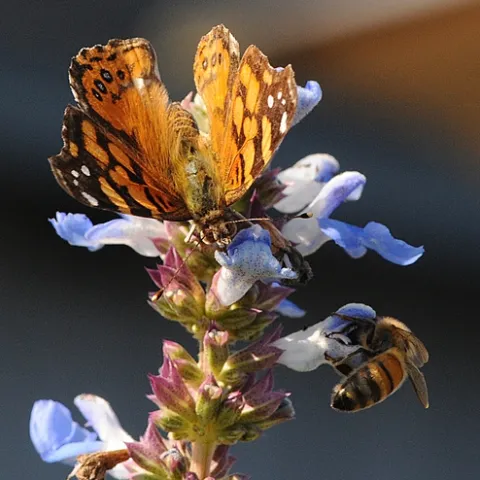
WEST COAST LADY (Vanessa annabella) and a honey bee share the same sage, Salvia uliginosa. (Photo by Kathy Keatley Garvey)

The West Coast Lady and the Bee

September 30, 2009
By Kathy Keatley Garvey
Summer is fading and the temperatures are dropping, too. You're more likely to see Vanessa. That would be Vanessa annabella, one of the Painted Lady butterflies.
View Article