Bug Squad Logo

Bug Squad

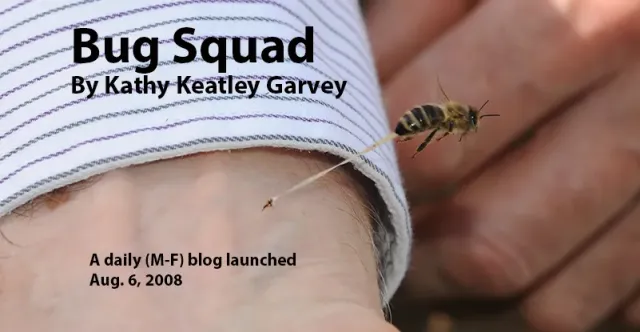
Bug Squad blog image depicts a honey bee sting in action.

Welcome to the Bug Squad blog! The Bug Squad blog was launched Aug. 6, 2008 and is a daily blog (Monday through Friday). It showcases entomologists and the work they do.  The blog focuses on scientists in the UC Davis Department of Entomology and Nematology, the Bohart Museum of Entomology, Harry H. Laidlaw Jr. Honey Bee Research Facility, the UC Davis Bee Haven, and assorted campuswide events, including UC Davis Picnic Day, UC Davis Biodiversity Museum Day, and Bohart Museum open houses. The blog spotlights insects, including bees, butterflies, dragonflies, and praying mantises, as well as arachnids such as jumping spiders and crab spiders. Author and photographer is Kathy Keatley Garvey, communications specialist, UC Davis Department of Entomology and Nematology, and a longtime journalist and community scientist with two degrees from Washington State University.  She is a member of the Entomological Society of America (ESA) and the Association for Communication Excellence (ACE). Her blog posts and images have won international awards from ACE and ESA and appeared on journal and magazine covers. She shoots primarily with a Nikon Z-8 mirrorless camera, a Nikon D500 and Nikon 800, with assorted macro lenses. Feedspot lists it as one of the top entomology blogs on the Internet. 
Primary Image
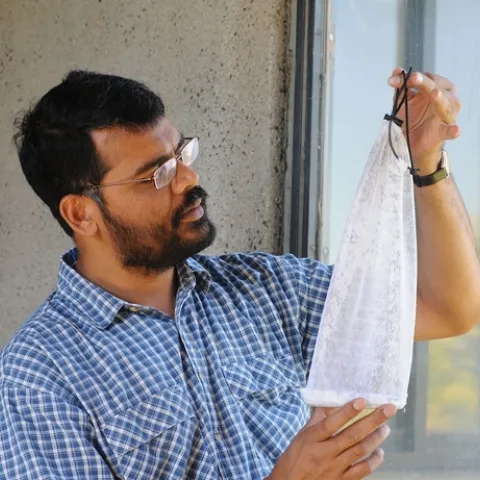
ZAIN SYED, chemical ecologist at UC Davis, holds a bag of 2000 Culex mosquitoes he trapped between Davis and West Sacramento. He is using them for his research. (Photo by Kathy Keatley Garvey)

Mosquito Heaven

July 29, 2009
By Kathy Keatley Garvey
Chemical ecologist Zain Syed of the Walter Leal lab, University of California, Davis, knows just where to find mosquitoes for his research. Rice fields. He's been collecting up to 3000 mosquitoes a night along the Yolo Causeway, located on Interstate 80 between Davis and West Sacramento.
View Article
Primary Image
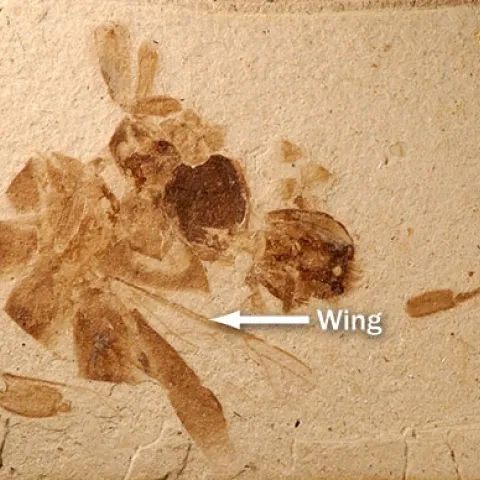
This 14-million-old fossil, unearthed in Nevada, is a honey bee, proving that North America did have a honey bee before colonists brought the European honey bee here in 1622. (Photo courtesy of Michael Engle)

First Native American Honey Bee

July 28, 2009
By Kathy Keatley Garvey
Amazing. An article posted on the ScienceNews Web site today indicates that North America did, too, have a honey bee. For nearly 400 years, we've been told that the honey bee (genus Apis) did not exist on this continent until 1622. That's when the colonists brought it over from Europe.
View Article
Primary Image
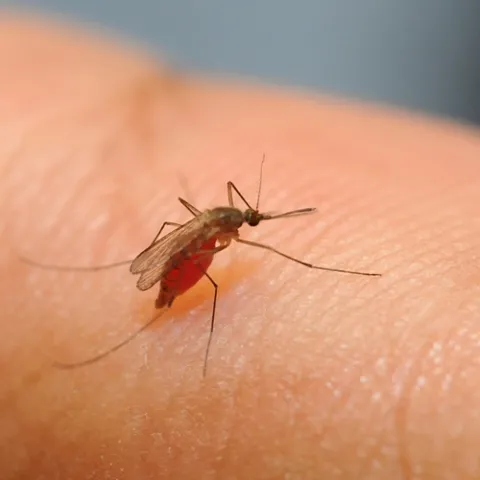
BLOOD-FED MOSQUITO--Culex quinquefasicatus after feeding on a non-treated DEET arm in the lab of chemical ecologist Walter Leal, UC Davis Department of Entomology. (Photo by Kathy Keatley Garvey)

Skeeter Season

July 27, 2009
By Kathy Keatley Garvey
Camping season is upon us, and with it came the news of California's first confirmed human case of West Nile virus (WNV). The San Diego County Health and Human Services Agency (HHSA) announced today that a 76-year-old man contracted WNV, but "he did not acquire the virus locally.
View Article
Primary Image
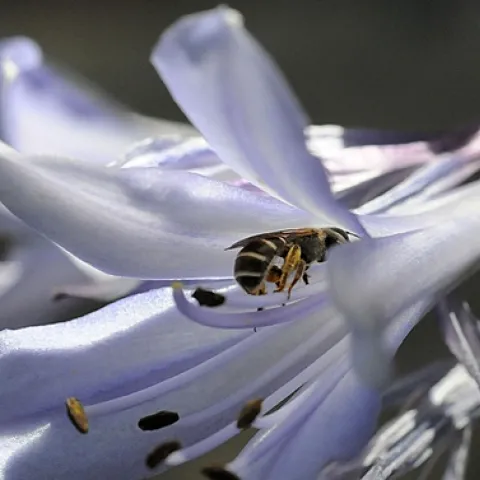
NATIVE BEE, a sweat bee (Halictus ligatus) nectars Agapanthus. This is a ground-nesting bee. (Photo by Kathy Keatley Garvey)

Ogling the Agapanthus

July 24, 2009
By Kathy Keatley Garvey
Seems like many folks assume that all bees are "honey bees." They're not. If you look around you, you'll see bees of all shapes, colors and sizes nectaring flowers.
View Article
Primary Image
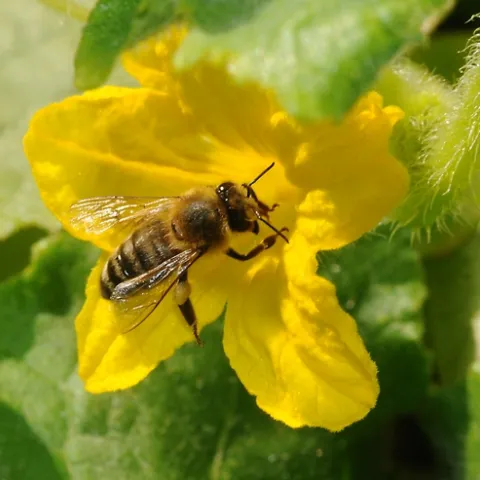
A HONEY BEE nectars a lemon cucumber blossom. (Photo by Kathy Keatley Garvey)

No Bees, No Cucumbers

July 23, 2009
By Kathy Keatley Garvey
Its the lemon law. When life hands you a lemon (cucumber), make honey. The lemon cucumber (Cucumis sativus) is an increasingly popular garden vegetable that doesn't look like your typical cucumber. The vegetable is round to oval in shape and is pale yellow to pale green in color.
View Article