Bug Squad Logo

Bug Squad

Bug Squad blog image depicts a honey bee sting in action.

Welcome to the Bug Squad blog! The Bug Squad blog was launched Aug. 6, 2008 and is a daily blog (Monday through Friday). It showcases entomologists and the work they do.  The blog focuses on scientists in the UC Davis Department of Entomology and Nematology, the Bohart Museum of Entomology, Harry H. Laidlaw Jr. Honey Bee Research Facility, the UC Davis Bee Haven, and assorted campuswide events, including UC Davis Picnic Day, UC Davis Biodiversity Museum Day, and Bohart Museum open houses. The blog spotlights insects, including bees, butterflies, dragonflies, and praying mantises, as well as arachnids such as jumping spiders and crab spiders. Author and photographer is Kathy Keatley Garvey, communications specialist, UC Davis Department of Entomology and Nematology, and a longtime journalist and community scientist with two degrees from Washington State University.  She is a member of the Entomological Society of America (ESA) and the Association for Communication Excellence (ACE). Her blog posts and images have won international awards from ACE and ESA and appeared on journal and magazine covers. She shoots primarily with a Nikon Z-8 mirrorless camera, a Nikon D500 and Nikon 800, with assorted macro lenses. Feedspot lists it as one of the top entomology blogs on the Internet. 
Primary Image
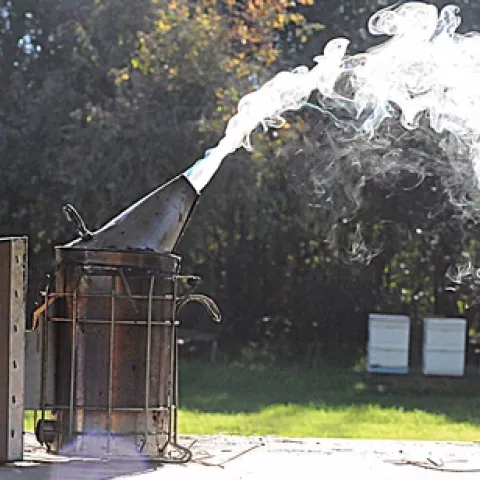
BLOWIN' SMOKE--Smoke shoots from a bee smoker at the Harry H. Laidlaw Jr. Honey Bee Research Facility at UC Davis. Bee hives are in the background.(Photo by Kathy Keatley Garvey)

Blowin' Smoke

January 13, 2009
By Kathy Keatley Garvey
If you've been around honey bee hives much, you know what a smoker is. It's a tool that beekeepers use to inspect, manipulate or handle a hive. They smoke a hive to check the health of the colony, to add a little food, and to take a little honey.
View Article
Primary Image
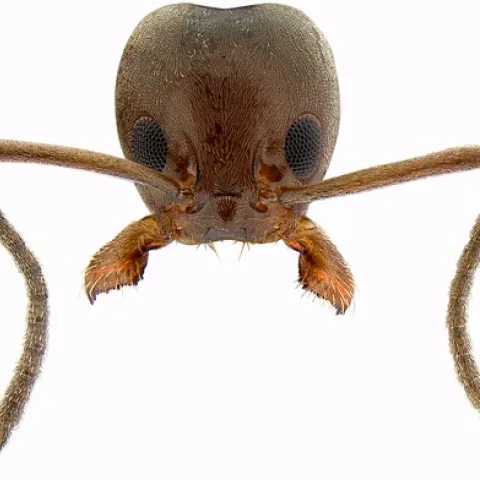
HEAD OF ARGENTINE ANT--This automontage of an Argentine ant is the work of Eli Sarnat at the University of California, Davis. Sarnat has just launched an interactive ant key to help professionals and non-professionals identify ants. See Web site at http://www.lucidcentral.org/keys/v3/PIAkey/index.html.

Know Your Ants

January 12, 2009
By Kathy Keatley Garvey
Know your ants. If you want to identify red imported fire ants and other invasive ants found in the Pacific Island region, a newly launched Web site by an entomology graduate student at the University of California, Davis, will help you do just that.
View Article
Primary Image
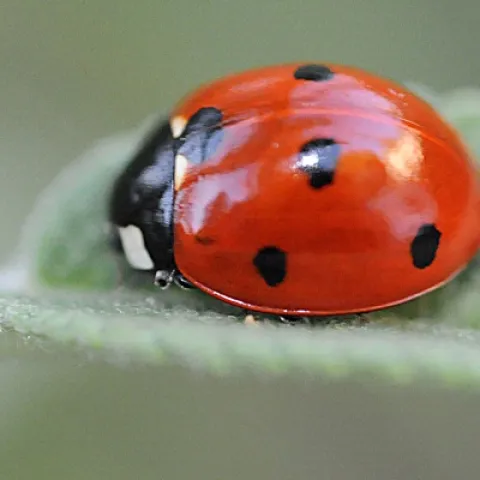
THE LADYBUG--The ladybug is an indicator of health and sustainability in olive orchards, scientists in Spain have found. (Photo by Kathy Keatley Garvey)

Another Good Reason

January 9, 2009
By Kathy Keatley Garvey
Heres another good reason to be kind to ladybugs. But we are, arent we? EurekAlert! alerted us Jan. 6 to a study relating that an abundance of ladybugs in olive orchards is an indicator of health and sustainability.
View Article
Primary Image
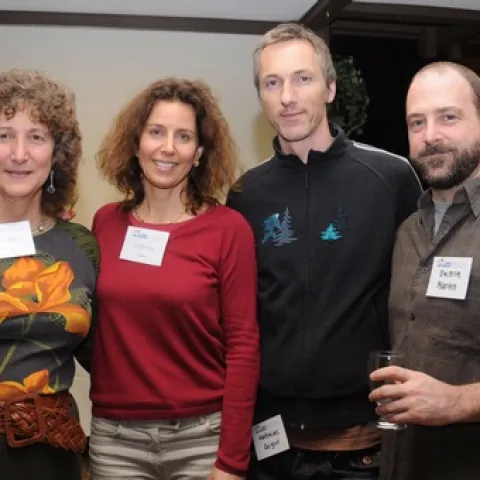
AT THE RECEPTION--From left are entomologist Diane Ullman, associate dean of Undergraduate Academic Programs, College of Agricultural and Environmental Sciences, and co-director of the UC Davis Art/Science Fusion experimental learning program; artist Catherine Chalmers; and UC Davis Department of Art faculty members Matthias Geiger and Darrin Martin. (Photo by Kathy Keatley Garvey)

The Insect We Love to Hate

January 8, 2009
By Kathy Keatley Garvey
Catherine Chalmers hates cockroaches. She said so at her presentation Wednesday night, Jan. 7, at UC Davis. The occasion: The Consilience of Art and Science centennial colloquium, sponsored by the UC Davis Art/Science Fusion experimental learning program. We have an adversarial relationship.
View Article
Primary Image
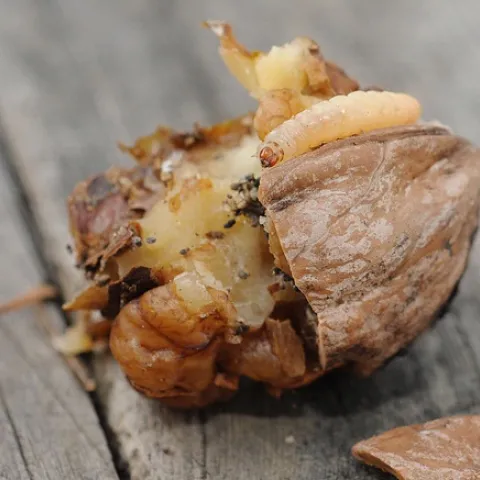
LARVAE INSIDE WALNUT--This fallen walnut contained three larvae. (Photo by Kathy Keatley Garvey)

Aw, Nuts!

January 7, 2009
By Kathy Keatley Garvey
Walnuts are packed with vitamins, minerals and antioxidants, right? Right. And sometimes a little protein. Protein, as in larvae. That's not a welcome sight. Sometimes you'll find two or three navel orangeworm (NOW) larvae inside a single walnut, along with copious amounts of webbing and frass.
View Article