Bug Squad Logo

Bug Squad

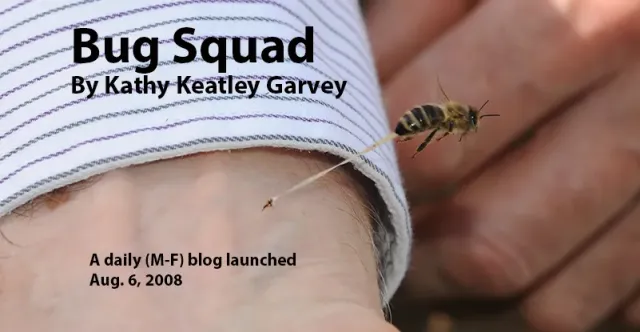
Bug Squad blog image depicts a honey bee sting in action.

Welcome to the Bug Squad blog! The Bug Squad blog was launched Aug. 6, 2008 and is a daily blog (Monday through Friday). It showcases entomologists and the work they do.  The blog focuses on scientists in the UC Davis Department of Entomology and Nematology, the Bohart Museum of Entomology, Harry H. Laidlaw Jr. Honey Bee Research Facility, the UC Davis Bee Haven, and assorted campuswide events, including UC Davis Picnic Day, UC Davis Biodiversity Museum Day, and Bohart Museum open houses. The blog spotlights insects, including bees, butterflies, dragonflies, and praying mantises, as well as arachnids such as jumping spiders and crab spiders. Author and photographer is Kathy Keatley Garvey, communications specialist, UC Davis Department of Entomology and Nematology, and a longtime journalist and community scientist with two degrees from Washington State University.  She is a member of the Entomological Society of America (ESA) and the Association for Communication Excellence (ACE). Her blog posts and images have won international awards from ACE and ESA and appeared on journal and magazine covers. She shoots primarily with a Nikon Z-8 mirrorless camera, a Nikon D500 and Nikon 800, with assorted macro lenses. Feedspot lists it as one of the top entomology blogs on the Internet. 

Primary Image
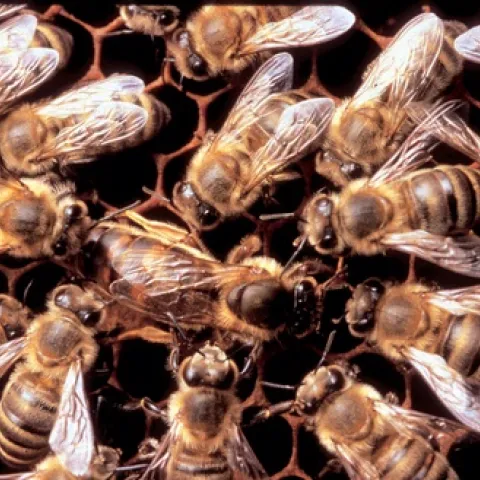
THE QUEEN--The queen bee (center) lays about 2000 eggs a day during the peak season. Here she's surrounded by worker bees (infertile females). (Photo courtesy of Susan Cobey, Harry H. Laidlaw Jr. Honey Bee Research Facility, UC Davis)

What Has Five Eyes, Six Legs and Two Pairs of Wings?

December 16, 2008
By Kathy Keatley Garvey
What has five eyes, six legs, two pairs of wings and can fly about 20 miles per hour? Got to be an insect, right? Right. But which one? More hints: Its been around for 30 million years. Its primary form of communication is a chemical called a pheromone. Well, that could be Okay, now it gets easier.
View Article
Primary Image
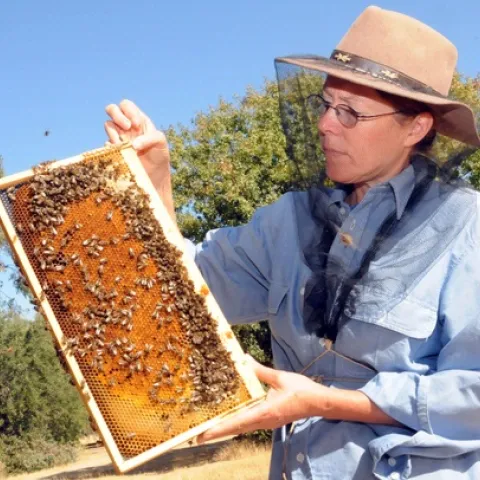
THE BEES--Honey bees are the good insects. Here UC Davis bee breeder-geneticist Susan Cobey looks at a healthy frame of bees. (Photo by Kathy Keatley Garvey)

We're Outnumbered

December 15, 2008
By Kathy Keatley Garvey
Were outnumbered. Plain as day. And theyre not going away. The estimated ratio of insects to humans is 200 million to one, say Iowa State University entomologists Larry Pedigo and Marlin Rice in their newly published (sixth edition) textbook, Entomology and Pest Management.
View Article
Primary Image
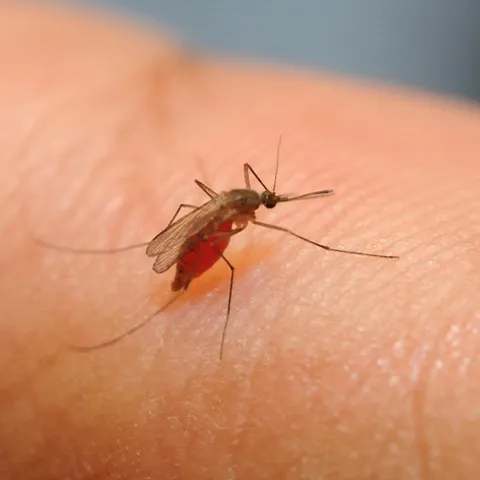
SEEING RED--A blood-fed mosquito on a researcher's arm. (Photo by Kathy Keatley Garvey)

Going Green, Seeing Red

December 12, 2008
By Kathy Keatley Garvey
We're in a recession, but the mosquitoes aren't. The mortgage meltdown and the resulting green swimming pools are perfect breeding sites for mosquitoes, which can transmit the deadly West Nile virus (WNV). So far this year WNV has sickened 411 Californians, killing 13.
View Article
Primary Image
POSTER CHILD--This poster, designed by UC Davis entomology doctoral candidate Fran Keller with photographs by Greg Kareofelas of Davis, shows the California state insect, the dogface butterfly. The male (top) is known as "the flying pansy." The female (bottom) is mostly yellow. The poster received praise from Gov. Arnold Schwarzenegger in April. Now it's received more acclaim. (See story above).

Poster Child

December 11, 2008
By Kathy Keatley Garvey
It's a high-flying butterfly--rarely seen and rarely recognized. Ironically, it's now down-to-earth, frequently seen, and frequently recognized, thanks to the Internet.
View Article
Primary Image
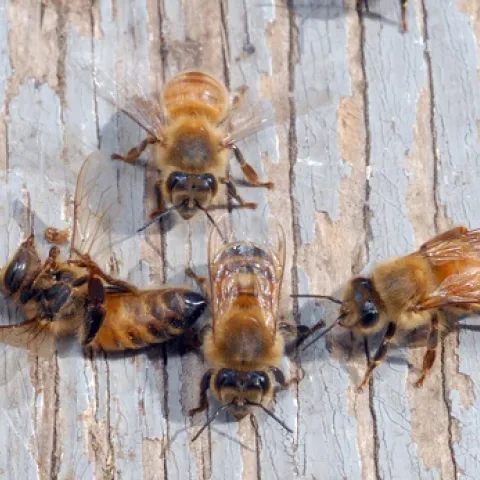
THE DEAD BEE--Worker bees prepare to remove their dead sister (far left) from the hive. (Photo by Kathy Keatley Garvey)

A Hymn for Her

December 10, 2008
By Kathy Keatley Garvey
Did you catch the "The Burns and the Bees" episode on The Simpsons Sunday night? Dead honey bees take over the otherwise animated TV show. Bart, on a dare from schoolyard bullies, knocks a bee's nest from a tree and it lands kerplop on the playground.
View Article