
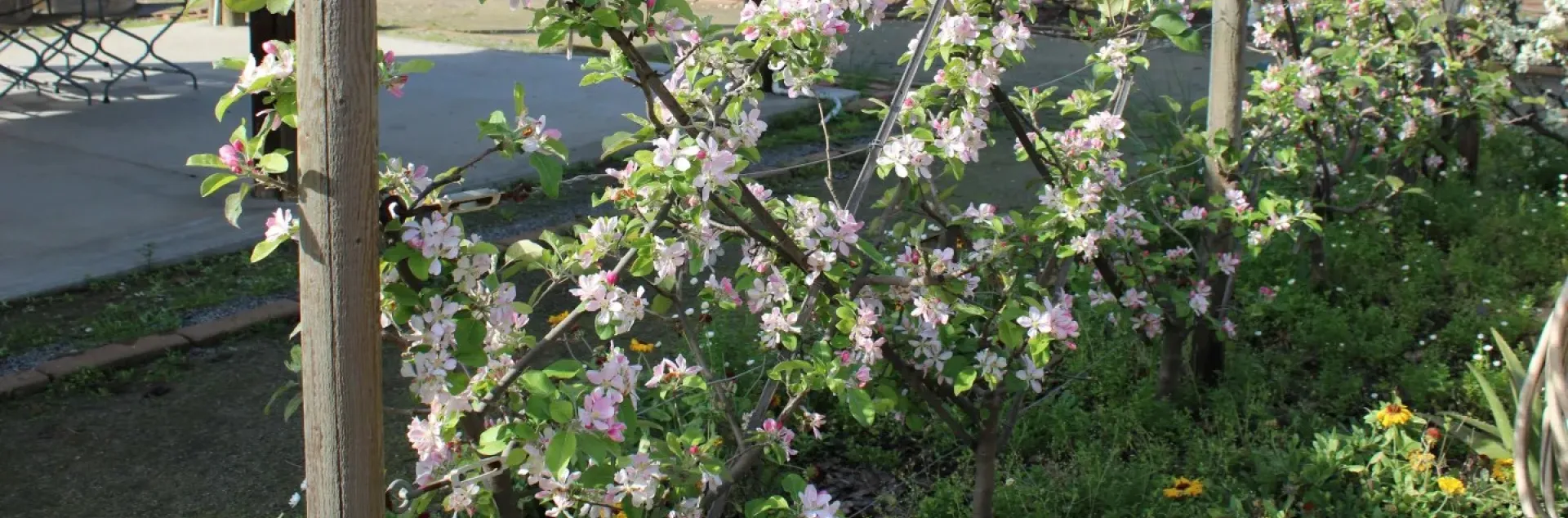

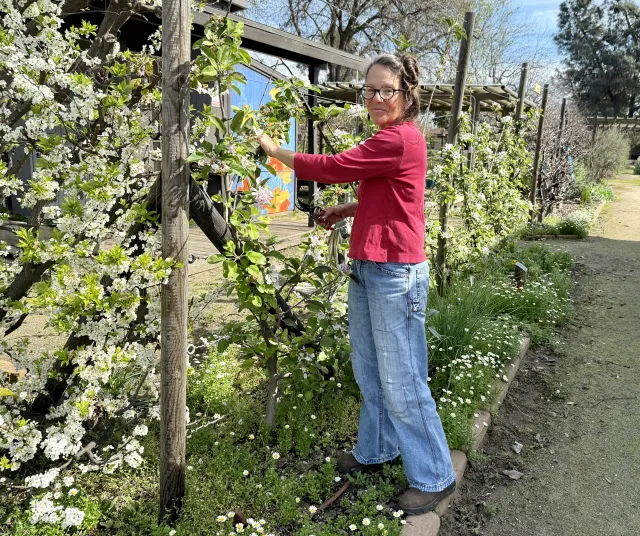
Espalier (ess-PAL-yay) - the practice of training fruit trees or shrubs to grow flat against a wall, fence or trellis - can be a practical and artistic feature in gardens. They may be adapted to conserve space, delineate a border, add interest or block an eyesore.
At the Fresno County Master Gardener's Garden of the Sun, 1750 N. Winery Ave., 17 trees have been trained on trellises surrounding a small office building and picnic area.
Depending on the species and variety, five or six espaliered trees can be planted in a space fit for just one standard mature tree, giving gardeners a diversified harvest and improving flowering.
Tree selection
Apples and pears are traditionally selected for espaliers, however other fruit trees can also make beautiful specimens, including plum, peach, fig and ornamental plants such as camelias, pyracantha and rhaphiolepis. Some trees are more suitable for espalier based on the climate or the nature of the species. For instance, an espaliered citrus wouldn’t be ideal in Fresno due to the extreme heat/sun exposure, unless you have an ideal location with enough, but not too much sun. The bark of citrus trees is thin and easily damaged by the sun.
Some species do not appreciate the degree of pruning required to espalier, such as persimmon. Select a fruit variety that is suited to your climate and, if possible, on a dwarf rootstock.
Pruning
Espalier requires more pruning than a standard tree form. Summer pruning is critical to fruit production. Winter pruning is to maintain the structure of the tree. The first pruning cut is the most difficult. You cut the sapling above the bud where you want the first branches of the espalier to begin, anywhere from 18 to 24 inches from the soil surface.
For winter pruning, follow general pruning guidelines by taking out dead, diseased or crossing branches. Next, prune back to keep growth in a relatively flat plane. This maintains a structure where you can promote fruit development (fruit is relatively heavy) closer to the main framework of the tree. In Fresno, winter prune in January or early February.
For summer pruning, cut back leafy development in order to promote fruiting buds close to the main framework of the tree that you established during winter pruning. This should be done in late July or early August.
Do not prune plums, cherries, apricots or other stone fruit when rain is forecast. Wet conditions promote fungal diseases. Prune stone fruit after harvest.
Other tips
- Generally, don’t cultivate below fruit trees. Root damage will often create suckers.
- Use ties made from organic fiber, it deteriorates reducing the likelihood of damage.
- Thinning cuts should be made just below the collar of the branch – be careful not to leave a stub.
- Heading cuts are often made at 3 inches or 3 buds from whorl.
- Check whether the variety you selected is self-fruiting or needs a pollinizer.
- Apple varieties suited to Central Valley include ‘Anna’, ‘Dorsett Golden’, ‘Fuji’, ‘Gala’, or ‘Granny Smith.'
Visit the Garden of the Sun to see examples of espaliered Pink Lady, Anna and Gala apples, Flavor King pluot, Emerald Beaut and Green Gage plum, and Fuyu Japanese Persimmon. The Garden is open to the public from 8 to 11 a.m. on Mondays, Wednesdays and Fridays.
Additional resource: How to espalier, Marin County UC Master Gardeners
_____________________
Written by UC Master Gardener Jill Lankford