
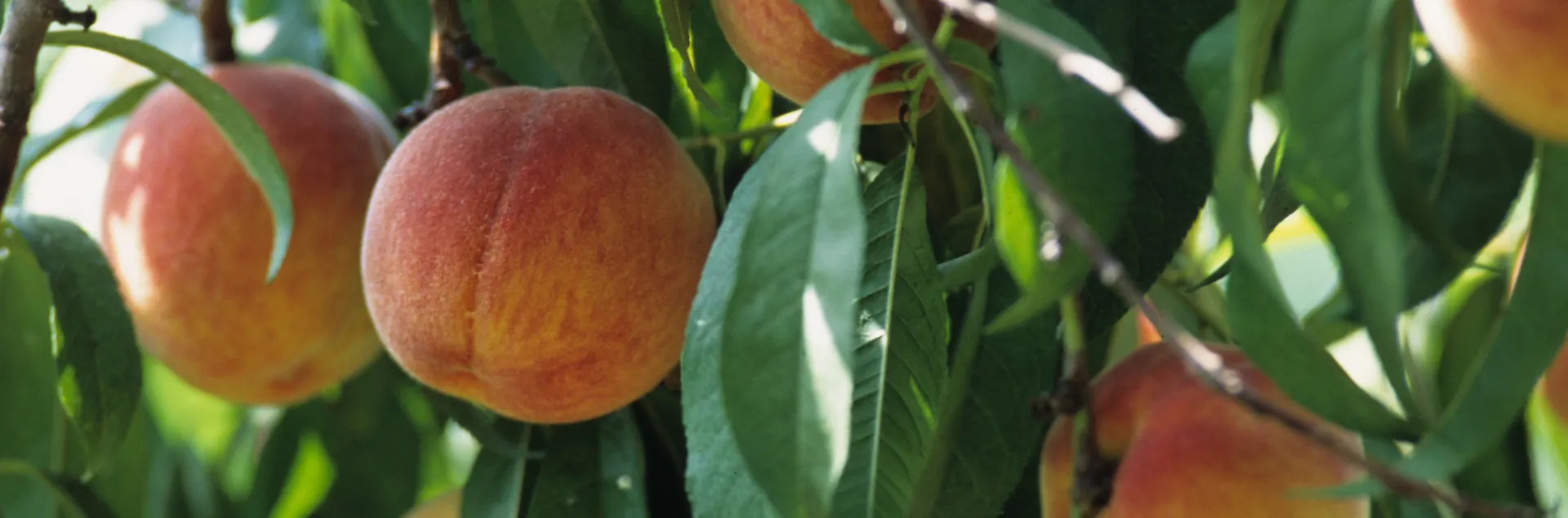

Some of the world’s best fruit tree hybridizers are located here in the Central Valley and the selection of fruit trees available to Central Valley gardeners as bare root stock in January is extensive. Fruit tree hybridizers are consistently developing new heat- and drought-tolerant varieties suitable for warming climates. Prices for bare root stock tend to be about one-third less than for container plants. Wholesale fruit tree nurseries do not usually sell to home gardeners but their websites list retail sources, most of which are local nurseries.
The labels on good quality bare root fruit trees provide a lot of very important information. Buyers should be able to see the varietal name, the root stock used, chill hours needed, water and fertilization needs, any cross-pollination requirements, date to maturity or ripening dates, size at maturity and disease resistance codes.
The most important information is the number of chill hours. The term ‘chill hours’ refers to the cumulative number of hours of temperatures between 45 degrees F and 32 degrees F measured annually in the time between Nov. 1 and Feb. 28/29. As temperatures drop and sunlight hours are reduced in the fall, deciduous trees begin to produce growth inhibitor hormones that help force dormancy. Without a good rest or a sufficient period of dormancy, fruit trees do not produce well, they leaf out and blossom later, and their buds and flowers drop early or do not develop properly.
The average number of chill hours in the Central Valley during the winter dormancy season falls between 600 and 900. As of Dec. 22, 2025, the number of chill hours for this winter season in the Fresno/Madera area was 624.
Low-chill fruits that do well with less than 300 chill hours annually include figs, pomegranates, persimmons, olives and apriums. Moderate-chill fruits (from 300-700 chill hours) include peaches, plums and nectarines, which is why these fruits do so well here in the Central Valley. Apples, pears and cherries need more than 700 chill hours.
The second most important attribute to check when selecting trees is the ripening dates. Planting several varieties that ripen in succession can extend the harvest season. Fruit trees with several varieties of the same fruit grafted onto a single trunk were once popular but over the years results were disappointing. The variety that ripened first dominated water and nutrient uptake so that the other varieties were less vigorous and less productive. Instead, research has shown that planting 2 or 3 tree varieties (grown on separate trunks but on the same or similar rootstock, if possible) in the same hole saves space while maintaining good crop production.
Finding enough space for fruit trees in small urban/suburban gardens can be challenging. Dwarf and semi-dwarf trees don’t always remain smaller. Summer pruning as well as dormant-season pruning will help maintain a more manageable tree size. Summer pruning done in mid-summer reduces leaf production and tree vigor before the tree becomes dormant in late fall which also reduces growth energy in the following spring.
________________________________
Written by UC Master Gardener Elinor Teague