
This blog contains archived digital materials published or created by the Tulare County Cooperative Extension prior to April 24, 2026 that are not digitally accessible.
Late March through mid-April marks the time of pistachio bloom in California’s Central Valley. The dynamics at bloom not only determine the anticipated yield of the crop but also offer predictors of nut quality at harvest. Although many factors affecting bloom are outside of a grower’s control, there are some orchard management techniques that can be employed to enhance pollination success and minimize blanks. Understanding the fundamental processes that occur during bloom may save growers money and enhance the economic potential of the crop.
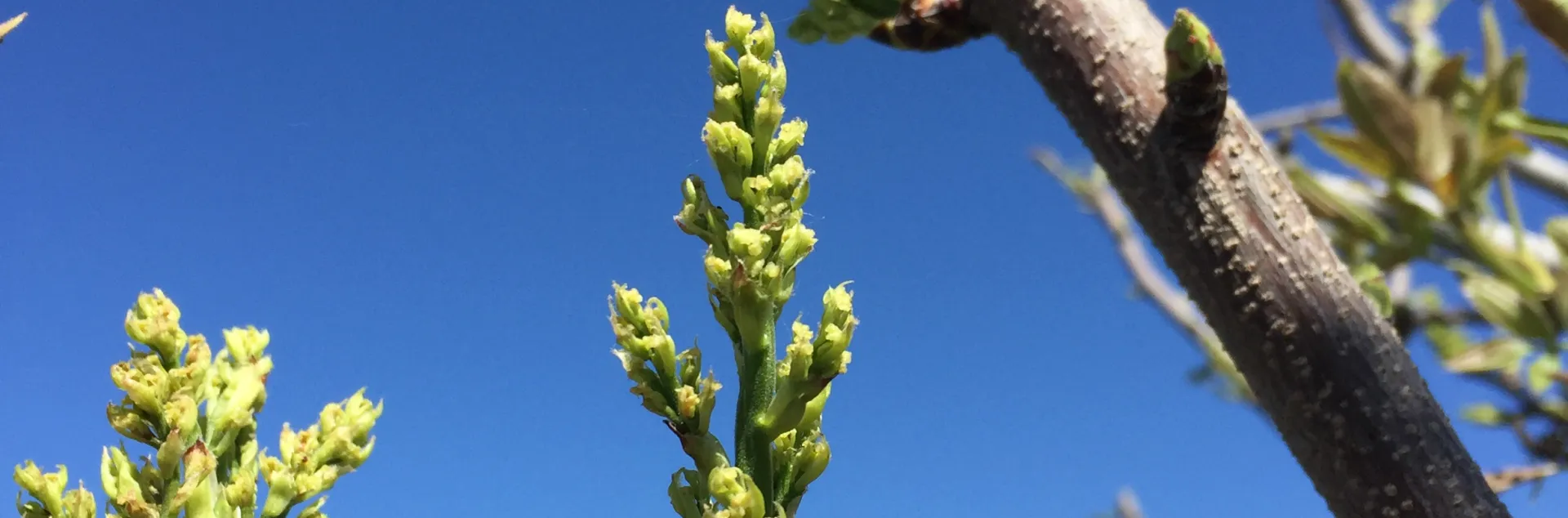
This dioecious crop produces male and female flowers (Figure 1) on separate trees (Figure 2). Male pollenizer cultivars are selected for synchrony of bloom with coordinating female cultivars. The pollen is disseminated by wind and pollenizer trees should be located within 66 ft (20 m) of female trees for adequate pollination. As a result, male trees are typically planted every fifth tree in every fifth row, establishing a ratio of 1:24 male to female trees while maintaining minimum optimal distance between female trees and pollenizers.
The key to successful pollination and subsequent fertilization is the timely deposition of viable pollen on a receptive pistil. Most pollen is shed over a 7- 8 day period; however, the overall duration of pollen shed is around 2 weeks. Daily pollen release is highest in the morning, from 9-11am, and once released, the pollen remains viable for hours. Pollen viability drops markedly in the first hour after release, and only 10% of pollen grains remain viable 24 hours later. Successful fertilization relies on pollen deposition on receptive stigmas. Peak pistil maturity lasts for up to two days. Pollination of pistils beyond peak receptivity may result in higher proportions of misshapen or abscised nuts prior to maturity.
Pollen quality and quantity are both determinants of nut set and quality. Too much pollen deposited on a stigma may cause flower abscission. Research studies suggest that deposition of just 15 pollen grains on the stigmatic surface is ideal for fertilization of an individual ovule. Although the pollen germinates about 2 hours after deposition, the migration of the pollen tube to the nucellus takes approximately two days. Fruit set and the percent splits at harvest are directly related to pollen viability. Pollen viability is also essential for minimizing the percentage of blanks at harvest.
Orchard management practices that cause excessive dust should be avoided at bloom. Research studies conducted at UC Davis demonstrated that dust deposition on the stigmatic surface impacts nut production.