Biological products continue to attract interest as potential tools to improve crop performance, nutrient efficiency, and resilience under stress. However, responses to these products can vary widely depending on crop, environment, and management intensity. To help clarify their performance under commercial conditions, a biological product evaluation trial was conducted during the late summer of 2025 in romaine lettuce near Soledad, California.
Trial overview
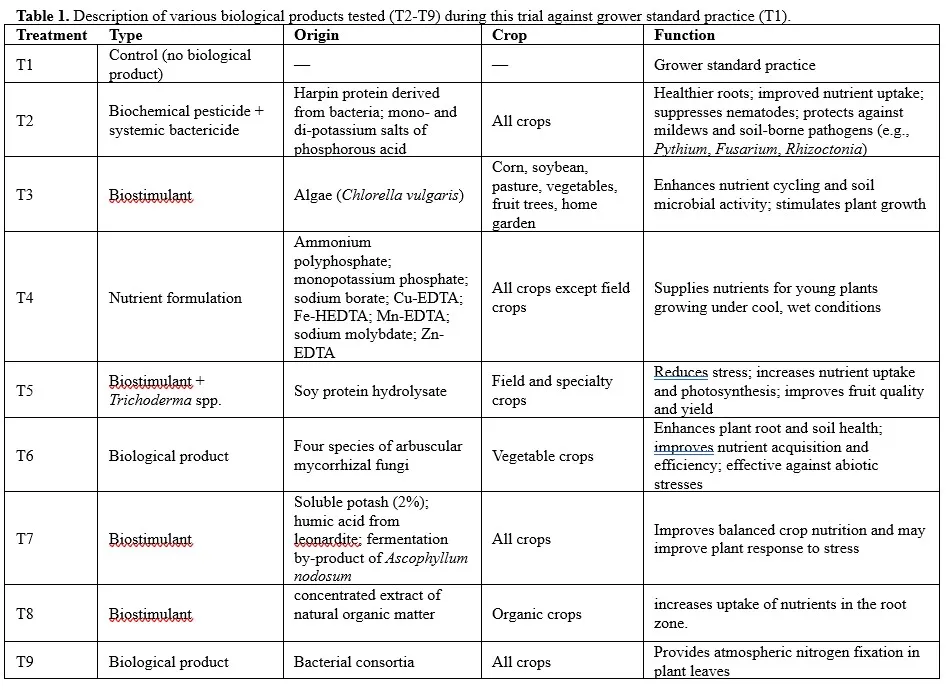
The trial was established on July 18, 2025, at Huntington Farms using standard commercial practices typical of romaine lettuce production in the Salinas Valley. Lettuce was planted in mid-July and managed with conventional irrigation and fertility practices, including a total of approximately 162 lb. N acre⁻¹ applied in multiple in-season applications. A total of 11.6 inches of irrigation was applied. Nine treatments were evaluated, including a grower standard control with no biological product application and eight biological product programs (Table 1). Treatments were replicated four times in a randomized complete block design to account for field variability.
Crop stand and plant condition were evaluated by quantifying marketable and unmarketable plants. Marketable plants (plants acre⁻¹) were determined by counting all the healthy, harvestable plants within each plot and converting counts to a per-acre basis. Fresh marketable yield (tonne acre⁻¹) was estimated by hand-harvesting 30 healthy plants randomly selected from a single row within each plot. Total fresh weight was recorded and scaled to an acre basis to provide marketable yield using healthy plant population per acre. Dry matter biomass yield (tonne acre⁻¹) was found by drying a small sample of the harvested plants in an oven until it weighed the same, which helped calculate how much dry matter was in the plants and estimate the total dry matter yield. This entire dataset was collected on September 18, 2026, two days prior to the harvest.
Crop stand and yield response
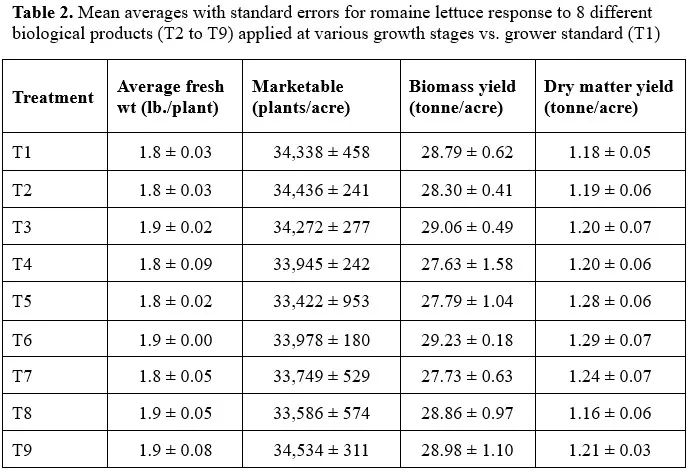
Marketable plant populations were uniform across all treatments, ranging from 33,422 to 34,534 plants acre⁻¹, representing only a 3.3% difference between the lowest and highest treatment means (Table 2). This narrow range indicates that none of the biological products influenced crop establishment or early-season stand survival under the conditions of this trial.
Yield components showed similarly limited variation. Average fresh weight per plant ranged from 1.79 to 1.90, a 6.1% difference across treatments. Marketable yield ranged from 27.63 to 29.23 tonne acre⁻¹, corresponding to a 5.8% difference between the lowest- and highest-yielding treatments. Dry matter yield ranged from 1.16 to 1.29 tonne acre⁻¹, the widest numerical spread observed (10.9% difference) (Table 2). Despite these numerical differences, none of the treatments were statistically different from the control or from one another. Drone-based NDVI imagery collected during the season also showed no consistent treatment-related differences in canopy vigor (data not shown), supporting the harvest results and suggesting similar crop growth trajectories across treatments.
What do these results mean for growers?
Results from this single site-year indicate that, under late-summer conditions with adequate fertility and irrigation, the evaluated biological products did not provide measurable benefits to romaine lettuce yield, and stand, compared with the grower standard practice. When nutrients and water are non-limiting, potential benefits of biological products may be difficult to detect. These findings are consistent with other field evaluations showing that biological product performance can be highly context dependent. Responses may be more likely under reduced-input systems, abiotic stress (e.g., heat, salinity, or limited water), or disease pressure, conditions that were not prominent during this trial.
Looking ahead
Biological products remain an area of active interest and continued on-farm and research trials are essential to identify situations where they may offer consistent agronomic value. Additional evaluations across multiple seasons, locations, and management scenarios will help refine recommendations and better define where biological products can fit into romaine lettuce production systems in the Salinas Valley.
In collaboration with California State University, Monterey Bay (CSUMB), UCCE will conduct another biological product evaluation trial this year. This year's experimental protocol is going to involve three tests. The first test involves a greenhouse screening test to find out the best-performing products. Then, the top 5 products would be field-evaluated at a grower or research field (depending on the availability). The final third test would again be a greenhouse test to validate the findings of the field test. In all three phases, products will be evaluated under three nitrogen rates: 100%, 80%, and 60% of the CropManage-recommended rate. We are currently seeking entries for the upcoming trial at a cost of $2,500 per treatment. Findings from the previous year will help us design improved experiments that provide biological products with a stronger platform to demonstrate performance under commercial production conditions.
For additional information or to participate in the trial, please reach out to Paramveer Singh at psbsingh@ucanr.edu or 831-214-8621