
This column is written by the UC Master Gardeners of Yolo County each month. It provides answers to selected questions recently asked by Yolo County gardeners.
Question: Help! My garden is full of weeds. What do I do?
Answer: There’s that saying in the horticultural world: A weed is simply a plant growing where you don’t want it to grow. In other words, one gardener’s weed is another gardener’s plant. And while each of us has definite ideas about which is, which, we’re not always sure how best to get rid of the weeds.
Often, the removal method depends on the number, location, and species of the weeds. There are several management options that don’t involve chemicals, the use of which should usually be reserved for the worst of the worst weeds, avoided in places like vegetable gardens, and always used as directed.
A couple of the most common control methods are the physical and the mechanical. The physical method involves using ground covers like mulch, weed mats, and black plastic. These controls can work well if the weeds have been cut close to the soil, and before they’ve gone to seed. Mechanical controls include hoeing, hand-pulling, cutting, and mowing. If mowing, make sure to do this before the weeds have gone to seed to avoid potentially distributing weed seeds over an even larger area.
You say that your garden is “full” of weeds. If so, then different controls might be called for in different places. In between vegetable plants, you might need to manually remove weeds by hand or with a hand cultivator or hand trowel. For larger spaces, you might want to use a weed mat, black plastic, or even sheets of cardboard.
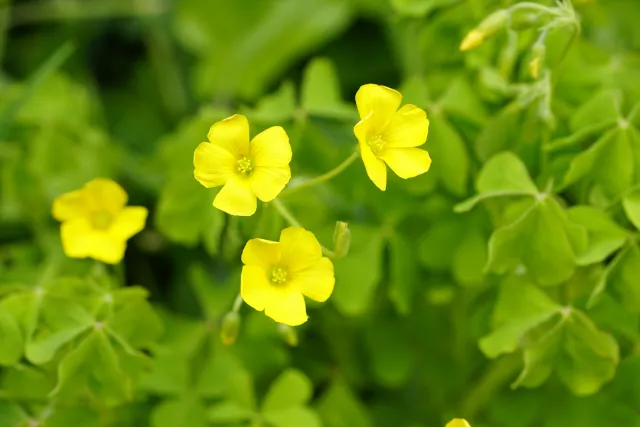
At this time of year, all kinds of weeds are starting to make their appearance, but a couple of species are worth mentioning. The Bermuda buttercup (Oxalis pes-caprae), which also goes by the aliases sourgrass, buttercup oxalis, or just plain oxalis, was originally introduced into California as an ornamental plant but is now considered an invasive species. Bermuda buttercup spreads insidiously via underground bulblets and rhizomes. When weeding Bermuda buttercup, beware that for every white or brown bulblet uprooted with the plant, there are probably a half dozen or more bulblets remaining in the soil. A transplanting trowel or weed knife can help with the extraction, but if the weed infestation is significant, the process becomes less like weeding and more like an archaeological dig. This and Oxalis corniculata (creeping wood sorrel) are two of the most persistent garden weeds. Many gardeners choose to use herbicides on these to prevent them from getting out of control.
For a less sinister weed, consider the dandelion (Taraxacum officinale). In fact, you may want to let this particular plant linger for a time in your garden before removing it. You could add the leaves to your salads, and the yellow flowers act as an early source of nectar for bees and other pollinators until flowers from other plants come into bloom later. If you want to limit the spread of dandelions, remove the white, round seed head before kids blow it around the yard while making a wish.
And here’s wishing you the best of luck in getting your garden’s weed problem under control.
For more information, see UC IPM’s webpage on Creeping Woodsorrel and Bermuda Buttercup.
Have a gardening question? Send it to jmbaumbach@ucanr.edu, with “Ask MGs” in the subject line. Include as much detail as possible and pictures if you have them.