
Article by Tanya Kucak -
This year’s lineup for the tomato seedling sale includes nine new-to-the-sale varieties, two heirlooms from previous years, and twenty-five varieties carried over from last year.
'Rosebud', 'Rosedale', and 'Texwine' were bred by Bill Jeffers in Indiana. He specializes in vigorous, heat-tolerant, disease-resistant varieties. Moreover, he has collaborators in other parts of the United States, especially where heat is more intense, who make selections and help refine his original crosses. These varieties are all open-pollinated, which means that you can save seed from your tomato and, as long as a rare bee cross did not occur, it will breed true. It also means that it has taken at least seven years to develop a true-breeding variety. The first year, the original cross is made, which produces F1 seed. Many seeds collected from the F1 fruits are grown the next year, the F2 generation, to find promising variants. The best of the F2s, selected for different qualities, are then each grown out the following year, and the best of these are each selected as F3s. It takes seven or eight generations (F7 to F8) for a variety to be stable, that is, breed true, with selections made each year for each variant.
So, for example, Jeffers made the original cross of 'Brandywine' and 'Neves Azorean Red'. Susan Anderson segregated and advanced these lines in Texas, and the final result was 'Texwine'. Its flavor has been described as “true old-fashioned tomato taste,” “strong, well-balanced,” and sweet and fruity. Texwine’s flavor is reputed to get even better in hot, dry weather.
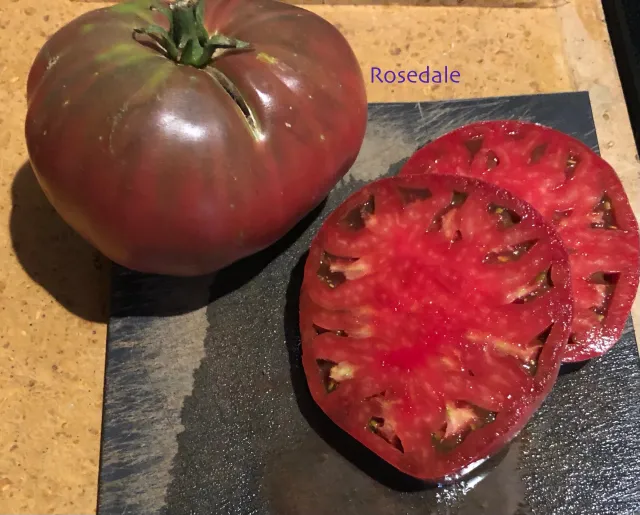
'Rosebud' and 'Rosedale' are “sister” varieties, both derived from the original cross of 'Cherokee Purple' and 'Summerpink F1'. Jeffers wanted to “improve the shape and conformation of Cherokee” by crossing it with a “fabulous” determinate early pink hybrid, 'Summerpink F1' (a Stokes exclusive, no longer available). His goal was either a compact indeterminate vine or a determinate bush. Jeffers shared F2 and F3 seeds of this cross, which were all regular leaf, with other tomato growers. Donald Hudgens of Missouri found a potato-leaf pink beefsteak, which he returned to Jeffers as 'Missouri Pink'. Jeffers, in turn, grew out the seed. One plant was a potato-leaf purple beefsteak with green shoulders, which he named Rosedale “to honor a small town in the Mississippi delta near where I grew up.” 'Rosebud', the sister variety, is a regular-leaf plant. Both are semi-determinate. Try both to see if you prefer the regular-leaf or potato-leaf variety.
To speed up the process of creating an open-pollinated variety, you could grow one or two generations in a greenhouse or in a warmer climate. Or in the southern hemisphere, where it is summer during our winter months! A couple of decades ago, when it was more possible to send tomato seeds between Australia and the United States, Patrina Nuske-Small of New South Wales and Craig LeHoullier of North Carolina, respectively, came up with the idea of creating “delicious tomatoes of all flavor and size variations on compact, easy-to-maintain dwarf tomato plants.” They were inspired by 'New Big Dwarf', listed in a 1915 seed catalog. Patrina made the first crosses of dwarf and heirloom tomatoes in 2005, and to date, more than a hundred varieties have been released by the Dwarf Tomato Project (DTP). It is an all-volunteer project, with many participants from tomato forums worldwide growing out and selecting varieties.
Two DTP varieties are in this year’s tomato seedling sale: 'Dwarf Golden Tipsy' is a heat-tolerant yellow beefsteak with an intense flavor, and 'Tasmanian Chocolate' is a richly flavored purple tomato. Both of these top out at about three to four feet. Though dwarf varieties usually have a single stout stem, they still need a stake or a small cage because the weight of the tomatoes may cause them to fall over. The crinkly, rugose foliage is often so dense that it may need to be trimmed a bit later in the season for better airflow. The smaller stature of the plants makes them more amenable to container growing, although a bigger container -- ten gallons instead of five gallons -- may yield a larger harvest.
Two heirloom beefsteaks are back, both of them wonderful sandwich tomatoes: 'Rose', a luscious pink variety, and 'Kellogg’s Breakfast', a juicy orange variety.
Friends and neighbors have been touting 'Nova F1', 'Principe Borghese', and 'Celebrity' for several years. Try them and see what you think. 'Nova F1' is a sweet orange grape tomato, perfect for snacking in the garden, prolific enough to fill a bowl for all to enjoy. Principe Borghese is an Italian heirloom famous for sun-drying in the summer and hanging from the rafters to ripen at the end of the season. It’s versatile enough to be used fresh in salads or cooked in sauces. 'Celebrity Plus F1' is a standard red tomato that grows on compact, disease-resistant vines. It can be prone to sunscald, so the fruits need to be shaded during heat waves and perhaps protected from the afternoon sun.
Finally, 'Fire Plum F1' is an incredibly prolific plum or paste tomato that can be eaten fresh or cooked. My plant lasted until the end of the season and produced almost eight hundred small plums, which got smaller as the season progressed.
The 2026 Tomato Chart by Color and Size, lists all the tomato varieties that will be available at the Spring 2026 UC Master Gardeners of Yolo Plant Sale.
2026 Spring Plant Sale Information -
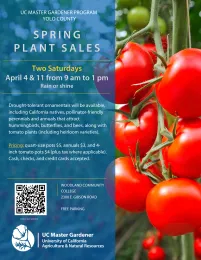
This spring’s sale will be on April 4th and 11th, between 9am and 1pm.
For a list of the California natives, drought tolerant perennials, and pollinator friendly annuals that will be available click Spring 2026 Ornamental Plant Sale List.
For a list of the tomato varieties that will be available click Spring 2026 Tomato Varieties Plant Sale List.
Tanya Kucak has written another article, Tomato Leaf Shapes and Sunscald which will also help you decide which tomatoes you would like to try in your garden this year.