

Article by Diana Herrera -
When I began working in regional and city parks two years ago, I started to look at parks differently. I had always enjoyed seeing stretches of freshly cut lawn dotted with trees. I associated that with being outdoors in a space that was well cared for. As I began to take care of those spaces, I realized how problematic many of our landscaping practices are, especially for agencies like parks which often promote values of sustainability and conservation. While I love my job and working for agencies that provide open, green spaces for the public, I believe that we could do better in providing spaces that are also welcoming to the flora and fauna that keep our ecosystems whole and healthy.
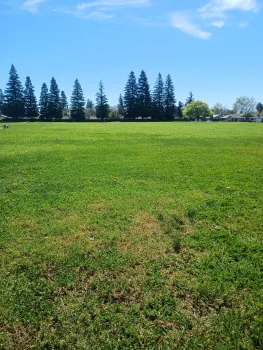
What I have noticed in parks is a lack of diversity in plants, an abundance of invasive species, and an overreliance on irrigation, herbicides, and pesticides. Although grass is terrific for picnics and sports, it creates a food desert for wildlife, and it is resource-intensive when it comes to water and labor. The chemicals that are sprayed to control the grass, weeds, and pests pose further issues for the health of the environment. Around the time I started my first park job, I also joined a local conservancy that taught me about habitat restoration. I started wondering: How could I change the way we landscape parks to celebrate our amazing native plant diversity? What could I do to inspire people to reimagine what a beautiful park looks like? When one of our fellow Master Gardeners reached out to us to inform us that Rotary Club member, Rich Marovich, was on a mission to plant butterfly gardens for monarch butterflies I was instantly captured by the idea of installing these in parks.
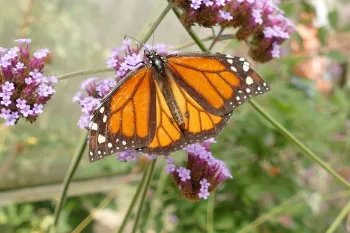
Monarch butterflies (Danaus plexippus) are native to North America, with both Western and Eastern subpopulations. Western monarchs overwinter along the Pacific coast from Mendocino County down to Baja California, beginning as early as September until March. They can travel up to one hundred miles per day to reach their overwintering sites as much as one thousand miles away. Once they arrive, they gather in dense clusters on the branches, leaves, and trunks of Monterey pines (Pinus radiata), Monterey cypress (Cupressus macrocarpa), Western sycamore (Platanus racemosa), coast redwood (Sequoia sempervirens), and coast live oak (Quercus agrifolia) trees. Although many winter roosts are found on invasive eucalyptus trees, studies suggest that the butterflies prefer native trees. They typically go into a reproductive diapause in the winter and begin mating again in spring as they migrate to the interior of California, Oregon, Washington, Nevada, Arizona, and Utah.
Last year, during the mid-season peak from November to December, roughly 12,260 monarchs were recorded across nearly 250 sites. By January 2026, population numbers dropped by forty-seven percent, with just 6,464 butterflies across 193 sites. This decline could be attributed to seasonal mortality or perhaps early dispersals. Although it is not uncommon for insect populations to fluctuate annually, there has been a declining trend in the monarchs' numbers. Butterflies migrating to the California coast have declined by about ninety-seven percent overall in recent years due to habitat loss of both overwintering and breeding sites, pesticide exposure, and climate change.
As monarch butterflies fan out to the western states in the spring to return to flower-rich areas, they lay their eggs on milkweed plants (Asclepias spp.), which are the host plants for the caterpillars. While the adult butterflies are able to feed on the nectar of a wide variety of flowers, they can only breed where there is milkweed available, which is what the larvae eat once they have hatched. The toxins present in milkweed make the caterpillars poisonous to predators and even protect them into adulthood. The bright coloration of both caterpillars and butterflies acts as a warning sign to predators that they are poisonous if ingested. There are more than one hundred species of milkweed in North America, with around twenty-five percent of them documented as host plants for monarch butterflies.
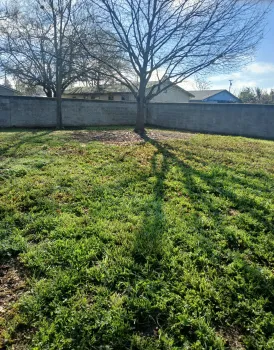
We can restore monarch habitats by creating waystations that provide food for the butterflies throughout their life cycle. Planting a few milkweeds with some nectar-rich plants is an easy way to get involved in the monarch conservation efforts. Gardeners can even register a monarch waystation with the Monarch Watch, an organization that has been contributing to monarch population tracking and habitat conservation. Monarch Watch recommends making waystations at least one hundred square feet, although there is no minimum or maximum size limitation. Butterflies and their food sources love sunshine so planting in areas that get at least six hours of sunlight every day will ensure the insects are happy. Planting the nectar plants and milkweeds closely without overcrowding will allow the plants to have enough space to grow while providing shelter. Five species grow here in the Sacramento Valley–California milkweed (A. californica), Heart Leaf Milkweed (A. cordifolia), Woollypod Milkweed (A. eriocarpa), Narrow Leaf Milkweed (A. fascicularis), and Showy Milkweed (A. speciosa). Planting at least ten milkweeds made up of two species or more creates more resources for the butterflies as the plants flower at different times. When choosing nectar plants, providing a variety of plants such as perennials, annuals, and biennials that bloom continuously ensures that the adults have food throughout the breeding and migration seasons.
I believe that our parks can play an important role in helping preserve some of our native flora and fauna. As more and more cities encourage residents to remove their thirsty lawns in favor of climate-ready landscaping, it is time for cities and other public agencies to consider how they can join the sustainability efforts as well. Although I would love to see many parks radically reimagined as nature preserves, I think a lot of people would have a hard time giving up the classic turf and trees of most modern parks. Installing monarch waystations at parks seems like an excellent way to introduce park visitors to habitat restoration and show them just how beautiful and full of life a native landscape can be. Currently, I have submitted a project proposal for installing a waystation at Bill Bean Jr. Memorial Park in Sacramento. Meetings are scheduled to discuss how and when our park staff will complete the project, and I am hopeful that this is just the beginning of many conservation projects in Sacramento’s city parks.
Photos by Diana Herrera unless otherwise noted.