
With a dryer-than-average winter, warm nighttime temperatures, and record-breaking high daytime temperatures in March, 2026 is off to a warm start.
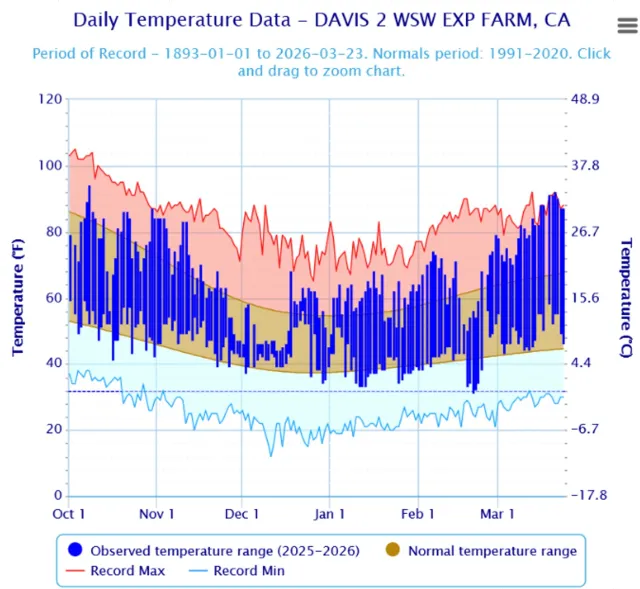
Figure 1. Recorded temperatures (blue bars) between 10/01/2025 and 10/23/2026 for Davis, CA, compared to our normal temperature range (beige shaded area) and recorded minimum and maximum temperatures for the area. Source: https://www.weather.gov/wrh/Climate?wfo=sto
Thrips outlook
The warm March weather has accelerated thrips development. We’re currently about two weeks ahead of where we were in 2025. 1st generation adults have already hatched and are laying their eggs, with generation 2 eggs predicted to hatch around April 1st. By comparison, in 2025 the second generation did not emerge until the third week of April.
Generation | Predicted date | 2025 comparison |
Gen 1 peak egg hatch | 2/24 | 2/24 |
Gen 1 peak adults | 3/17 | 4/1 |
Gen 2 peak egg hatch | 4/1 | 4/24 |
Gen 2 peak adults | 4/23 | 5/10 |
Gen 3 peak adults | 5/26 | 6/8 |
Current generation | Gen 1 peak adults |
|
Thrips generations are predicted using a growing-degree day model, current local weather data and forecasts, and long term local temperature averages. I generate the predictions I show here using data from a weather station at UC Davis. Last year, an easy-to-use interface was developed. Users can click on a field on a map, and the site will select the appropriate weather stations and display growing degree days and current and predicted thrips generations. Try it out here: https://qbelabgroup.shinyapps.io/WFT_dd/
Management implications
- For thrips to spread TSWV, they need to acquire it as juveniles from infected plants. Important overwinter weed hosts include little mallow (cheeseweed), sowthistle, and prickly lettuce.
- For fields in areas where you have had TSWV issues in the past, controlling these weeds may help reduce viral loads. Spraying for thrips is usually not recommended until the 3rd or 4th generation, as earlier generations of thrips are less likely to have acquired the virus.
- Notice early symptoms. Symptoms can vary by variety. In both tomato and pepper, early symptoms include visible stunting, as well as distortion and necrosis on new leaves. In tomatoes, a very common and distinctive symptom is a light bronzing on very new leaves.
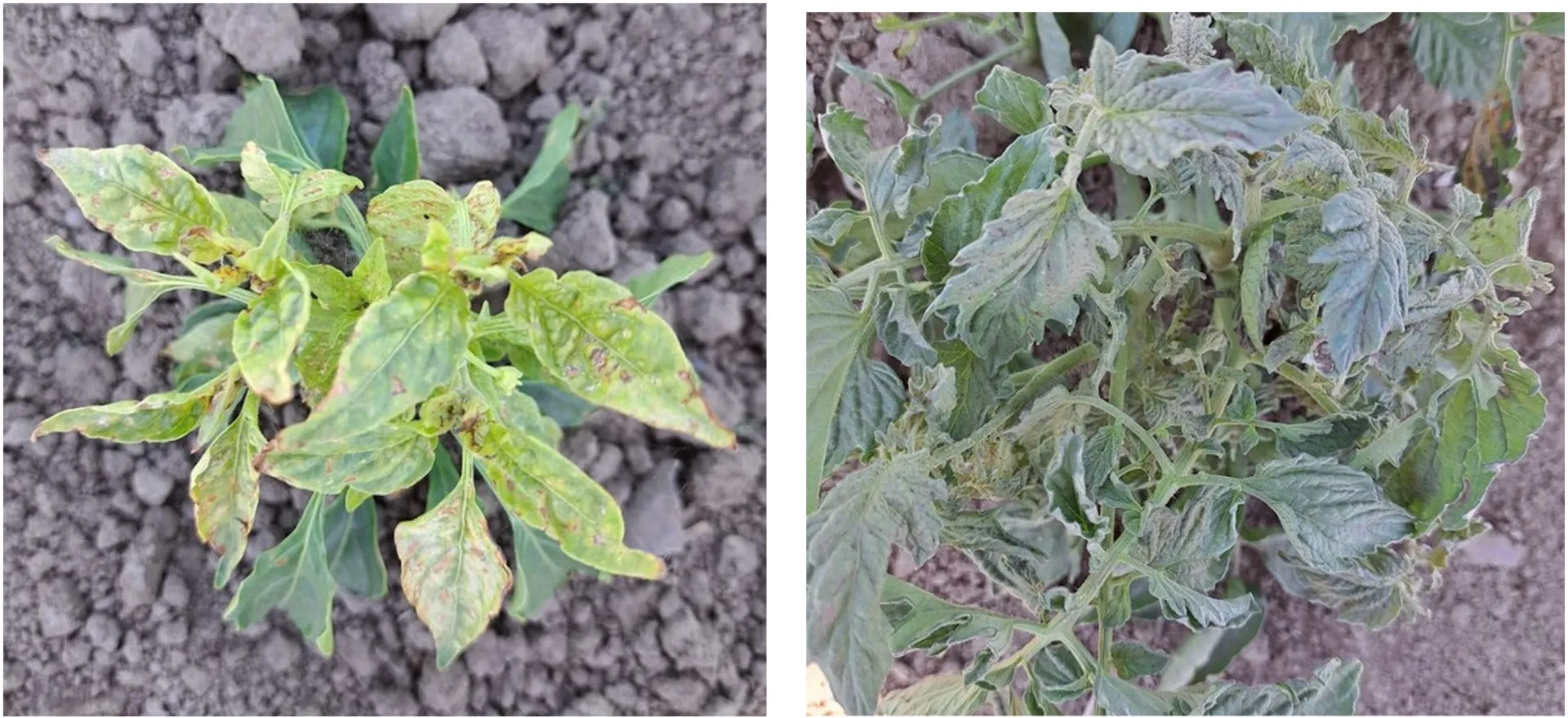
Figure 2. Early TSWV symptoms in young pepper (left) and tomato (right). Plants infected this early will not produce fruit, and if thrips larvae feed on them, they can serve as a source of inoculum to infect other plants. .