Interest in drill-seeded no-till rice has increased in recent years; however, the most comprehensive herbicide research in drill-seeded rice systems was conducted before 2015, more than 10 years ago. Transitioning from water-seeded to drill-seeded rice, whether tilled or no-till, substantially alters weed emergence patterns, resulting in systems dominated by grass species, particularly sprangletop and watergrass. In contrast, aquatic weeds, including broadleaves and sedges, are generally reduced, making drill-seeding a viable option for fields with historically high broadleaf or sedge pressure.
This system (no-till drill-seeded) should not be repeatedly used over multiple years. When rice systems transition from continuous flooding with tillage to a flooded no-till system, there is potential for selection of perennial weed species, including ricefield bulrush and cattails (tules). This selection pressure increases and can result in the establishment of these species (if used repeatedly).
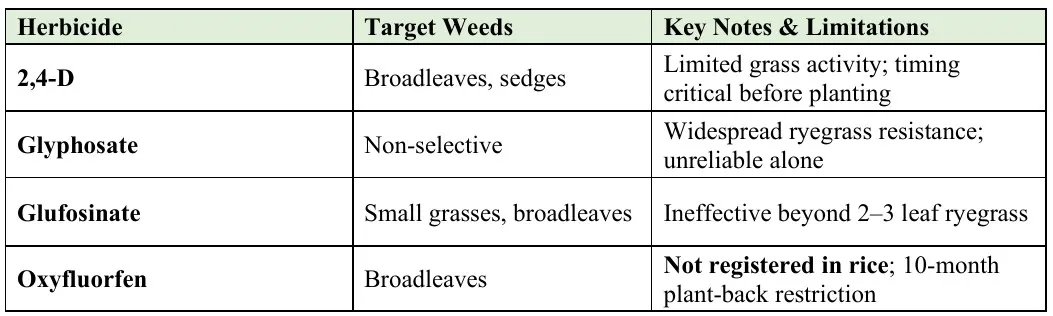
Other weed issues include winter weeds not normally found in rice systems. The absence of fall tillage increases pressure from weeds such as Panicum species and ryegrass (Lolium spp.), which must be effectively managed. Winter weeds are most prevalent in unflooded fields, but can also emerge following winter drainage. Herbicide options for winter weed control are currently limited. Registered products include 2,4-D for broadleaves and sedges, glufosinate for small grasses and broadleaves, and glyphosate as a non-selective option. However, widespread glyphosate resistance in ryegrass and the reduced efficacy of glufosinate beyond the 2–3 leaf stage limit control reliability. Oxyfluorfen is not registered for use in rice and, due to a 10-month plant-back restriction, is not a viable winter weed management option.
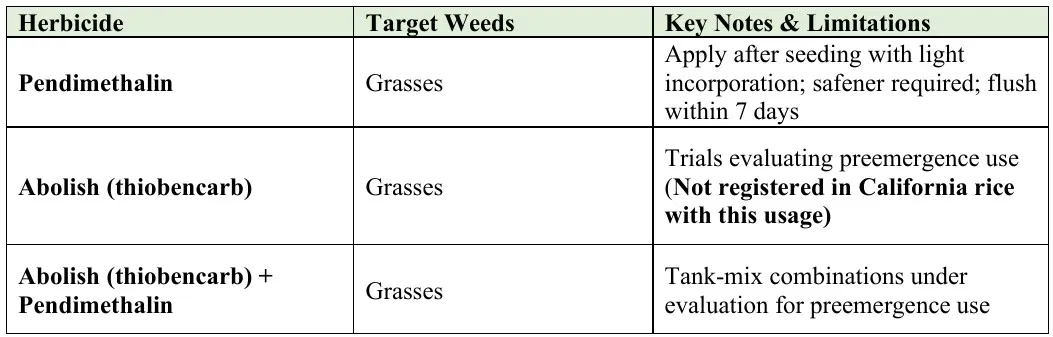
Early-season herbicide options in drill-seeded rice systems are limited because several commonly used products, including Butte and Cliffhanger (benzobicyclon), Cerano (clomazone), and Zembu (pyraclonil), are not permitted due to their granular formulations. For preemergence weed control, pendimethalin may be applied preflood in drill- or dry-seeded rice following seeding and light incorporation. Applications must include a safener adjuvant, and fields should be flushed with water within seven days of treatment to ensure efficacy and crop safety. Trials are underway to evaluate the efficacy of Abolish (thiobencarb) as a preemergent treatment, and combinations such as Abolish with pendimethalin in a tank mix are being tested. Abolish as a preemergent application is currently not registered for use in California rice.
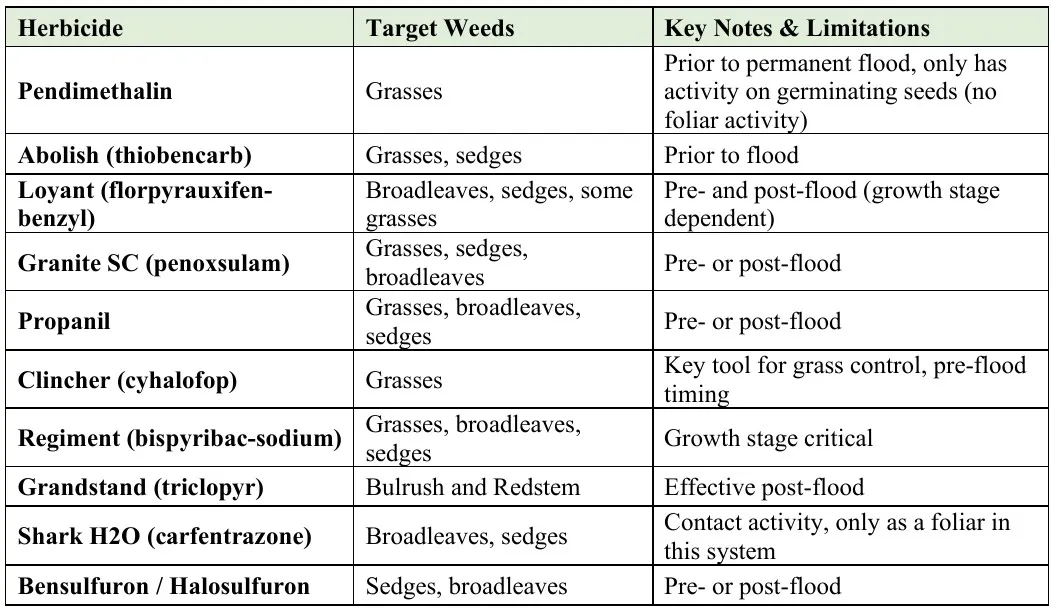
During the 2-4 leaf stage of rice, prior to permanent flooding, herbicide options include pendimethalin (only for use on germinating seeds, not for control of emerged weeds), Abolish (thiobencarb), Loyant (florpyrauxifen benzyl), Granite SC (penoxsulam), propanil, Clincher (cyhalofop), Regiment (bispyribac-sodium), Grandstand (triclopyr), Shark H2O (carfentrazone), and bensulfuron/halosulfuron. After flood establishment (tillering), several of these options can still be used, depending on rice leaf stage: Loyant, Granite SC, propanil, Clincher, Regiment, Grandstand, and Shark H2O. However, they should not be used multiple times in one season, so carefully planning an herbicide program from the beginning is key.
It is essential to plan for sprangletop control in these herbicide programs, as few effective options are available for this species. The only effective herbicides are pendimethalin as a preemergent, and Abolish (thiobencarb) and Clincher (cyhalofop) as foliar options.
Winter Weed Control (Fallow/Pre-Plant)
Preemergence
Postemergence (2-4 Leaf to Tillering)