
Delayed transplanting suppresses branched broomrape in California processing tomatoes
Arpan Bhusal, Rohith Vulchi, Matt Fatino and Brad Hanson
Branched broomrape (Phelipanche ramosa) has been reported in tomato fields in Yolo, Solano and San Joaquin counties in recent years and continues to challenge processing tomato production. Broomrapes are obligate root parasites, and the seeds require a chemical signal from the tomato root to germinate. In addition, broomrape seeds require specific soil moisture and temperature conditions as part of a pre-conditioning phase before they become receptive to the signal from the host plant. After germination, the broomrape seedlings attach to the tomato roots, where they grow and take nutrients and water from the host, which leads to yield loss.
Why Planting Date Matters?
Pre-conditioning of broomrape seeds requires moist soil and temperature of approximately 59–68°F for 5–21 days in the field. Other researchers have suggested that warmer soil temperatures can cause broomrape seeds to enter secondary dormancy and makes them unresponsive to the chemical signal from tomatoes. In regions currently affected by branched broomrape in California, tomato transplanting typically occurs from late March to late May. In previous field experiments conducted at one location within this region, broomrape density varied dramatical among years with different planting dates. We hypothesized that since seed pre-conditioning and secondary dormancy are dependent on soil temperature, delayed tomato transplanting in some years may have exposed broomrape seeds to higher soil temperatures, inducing secondary dormancy and reduced parasitism of the tomato.
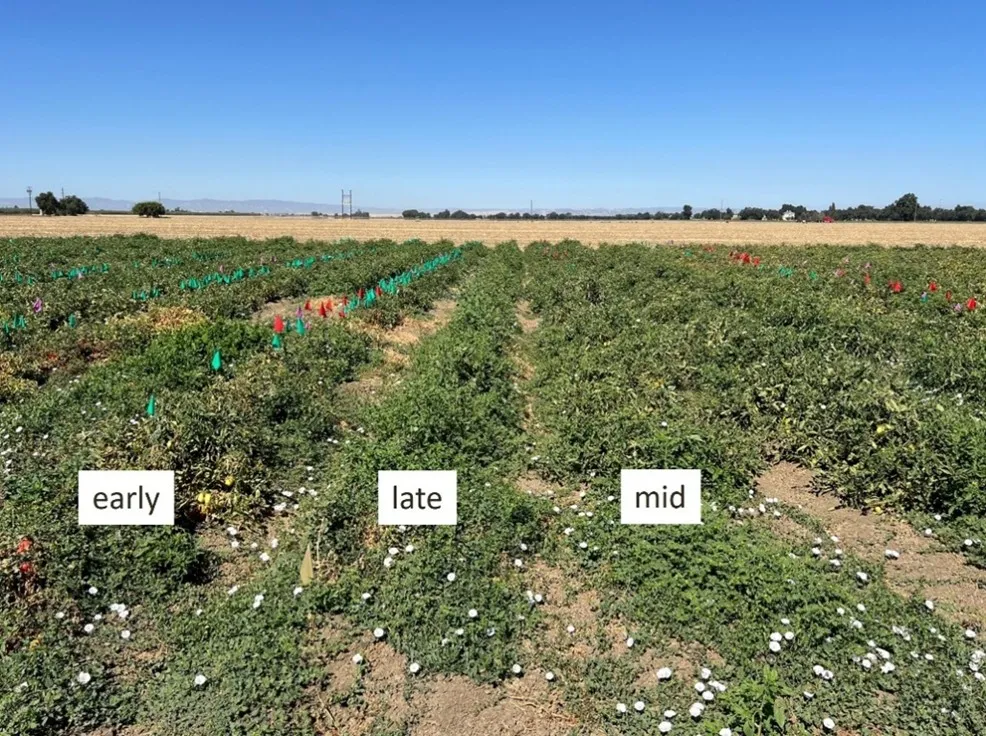
To evaluate this hypothesis, field studies were conducted during 2024 and 2025 near Woodland, CA, to determine the effect of three planting dates on broomrape parasitism. In 2024, the field study included three transplanting dates – April 9 (a typical transplant timing in the broomrape affected region), May 1 (delayed transplanting by a few weeks), and June 10 (hypothetical very late but still feasible commercially acceptable late transplant), on 120-ft long plots with a single line of tomato variety ‘H58841’. Results indicate delaying the transplanting by a few weeks into the summer to early May reduced broomrape emergence by nearly 90% compared to the typical transplant timing of early April, and no broomrape was observed in June planting (Figures 1 and 2).
In 2025, a follow-up study was conducted at the same location with transplant dates of April 9 (similar to 2024), May 13 (similar to 2024) with and without chemigated rimsulfuron (to see if the additional 10% control that was missed in 2024 can be achieved with standard herbicide treatment), and June 2 (commercially acceptable late transplant), on 120-ft long plots with a single line of tomato variety ‘HM8237’. Consistent with 2024, the early April transplant had substantial broomrape parasitism, while both mid-May (with and without chemigated rimsulfuron treatments) and June plantings had no broomrape emergence (Figure 2). These results indicate transplanting timing can have an important impact on branched broomrape parasitism of processing tomato in California.
Practical Takeaways for Growers
- Prioritize planting clean/low-risk fields at normal transplant timings.
- Schedule planting in high-risk fields a few weeks later in the transplanting season.
- Apply chemigated rimsulfuron according to label guidelines in high-risk fields.
- Consider making chemigated rimsulfuron applications in low-risk fields as well. This will act as a proactive strategy rather than a reactive response and will reduce the long-term risk of broomrape establishment in low-risk fields.
- Growers can implement these practices, as early as the 2026 growing season using existing transplant schedules and chemigation programs.
EXTERNAL IMAGE
Figure 1. Visual comparison of branched broomrape emergence under different transplanting dates (clusters within 120-ft plots are marked with flags) in processing tomato in a field experiment conducted near Woodland, CA, in 2024.
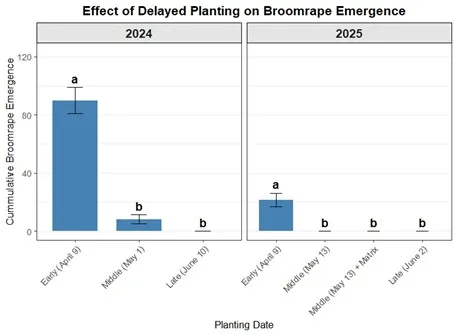
Figure 2. Effect of delayed transplanting on branched broomrape emergence (clusters per 120 ft plot) in processing tomato in a field experiment conducted near Woodland, CA, in 2024 and 2025.