
Article by Pam Muick
Black oak, our tall, dark and handsome deciduous native oak, grows naturally in Solano and Yolo counties. Few original stands of black oak remain due to its tough strong wood that was wood was useful for construction and small tools. Acorns of black oaks are prized by many species, including humans. The acorns are tasty, rich in oils and preferred by many indigenous peoples in California.
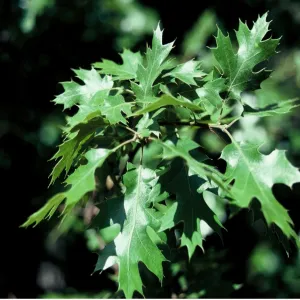
You may have heard about keystone species. These are species that are useful in the lifecycle of a very large number of other species. Oaks are keystone species due to their size, longevity, production of acorns and surface area that can house a host of large and small critters.
If you are fortunate enough to have a black oak on your property, or if you plant a black oak, you are guaranteed to have decades of enjoyment. Each spring, vibrant young leaves emerge tinged with crimson, the pendulous golden catkins (male oak flowers) dangle on branches weeks before the bright green leaves expand.
In nature, black oaks are mostly found on well-drained soils. Their floral companions are native plants accustomed to dry shade. This is a large list! In a landscape, avoid summer watering since it increases the likelihood of diseases, particularly fungi.
Before you begin your black oak landscape, make a plan. Be sure to remove your lawn. Minimize hardscape under the oak canopy (define canopy?). Instead of pavement, use stepping stones, DG – decomposed granite or gravel, or permeable paving. Be sure to use mulch to reduce weeds.
We have compiled a short list of native plants compatible with black oaks. They are grouped by form: shrubs (low and tall), groundcovers, bulbs and wildflowers. All of those listed are available at native plant nurseries and/or California Native Plant Society sales. CalScape is an excellent reference to use for locating plants.
As you plan, remember that the black oak landscape is considered DRY SHADE. Some compatible species are evergreen, some are deciduous. Making a plan before planting will facilitate your enjoyment. Please note that most deep-rooted plants should be planted several feet away from the tree trunk, even as far out as the edge of the tree’s canopy.
Grasses & Ferns: Native perennial grasses and some ferns do well in dry shade. Deer grass (Muhlenbergia) is a favorite perennial. It grows two to three feet in height and forms a large clump, large enough for a deer to hide. Lower growing perennial grasses include Torrey’s Mellicgrass (Mellica torreyana), and California Fescue (Festuca). California Sword Fern (Polystichum californicum or P. munitum) is a drought-tolerant native fern.
Many small shrubs will thrive along the canopy edge. Both California fuchsia and buckwheat are pollinator favorites. California fuchsia’s tubular red or orange flowers attract hummingbirds. Other small shrubs are the sages, prostrate coyote bush, and prostrate manzanita and ceanothus species.
My favorite tall shrub is Pitcher Sage (Lepechinia), which has fragrant leaves and large, dramatic flowers. The tall shrubs will be happier near the canopy edge. Other taller shrubs include gooseberries (Ribes), manzanitas and Ocean Spray or Creambush (Holodiscus discolor).
Spreading Ground covers: wild strawberries (Fragaria), California fuchsia, hummingbird sage, Yarrow, coyote mint.
Perennial Herbs and Bulbs: Wild hyacinth (Dichelostemma multiflorum), native iris (Iris specias), Blue-eyed grass (Sisyrinchium bellum and Ithuriel’s Speak (Triteleia laxa) will do well in the understory. I wouldn’t plant them next to the trunk, but they will do well within a few feet. Yarrow (Achillea millefolium).
Wildflowers: Since the black oak is deciduous, there will be more light in the early part of the year. Sow native annual wildflower seeds and you will find that many reseed themselves.
Would you like online help with a plan? https://bayarea.calscape.org/wp-content/uploads/2022/10/111022_Woodland-1.pdf
Resources
How to Grow California Oaks
https://oaks.cnr.berkeley.edu/how-to-grow-california-oaks/
Growing Oaks from Acorns
https://ucanr.edu/sites/ccmg/files/123756.pdf
Planting Under Oaks, UC Master Gardener Program of Sonoma County
http://sonomamg.ucanr.edu/Planting_Under_Oaks
California Oaks, a project of the California Wildlife Federation
https://californiaoaks.org/
https://ucanr.edu/site/uc-master-gardener-program-contra-costa-county/article/gardening-under-oaks
For more information, you can visit the Oak section of the UCANR IPM website at ipm.ucanr.edu, the californiaoaks.org website
Full banner photo: "Stunted oak trees in Black Tor Copse" by Philip_Goddard is licensed under CC BY-NC 2.0.