
Blog by Sharon Leos
We walk through our neighborhood nearly every day and are fortunate to experience the abundant flora and fauna of Solano County. We have lived here for thirty-plus years and every so often, we come across a novel observation. Today’s “WOW! What is THAT?!?” was the Tent Caterpillar, most likely the Pacific tent caterpillar (Malacosoma constrictum). We noticed several large, webbed “tent” formations in the branches of the Oak trees along our path. Upon closer inspection of the webbing, we observed some large (one inch long), hairy caterpillars hanging out on the outside of their silky tents. These caterpillars have been quietly camping out in the trees as we walked by, unaware of their existence until their tents were large enough to see. COOL! Yes, I'm a bug nerd!
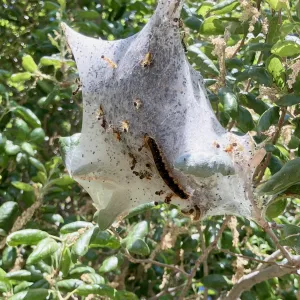
Tent caterpillars are the larvae (immature forms) of moths belonging to the Lasiocampidae Family. The adult moth is relatively large, having a 1 to 1.5 inch wingspan and is usually a dull brown in color. The eggs are laid in clusters on a twig or in the bark of the host plant. The eggs hatch and the caterpillars produce silk, which they use to create a webbed tent structure. The caterpillars feed on the host plant’s leaves outside of the tent and return to the safety of the tent to molt (shed their exoskeletons as they grow). Many plants are hosts for tent caterpillars, including: ash, birch, fruit and nut trees, madrone, oak, poplar, redbud, toyon, and willow. Generally, tent caterpillars do not cause significant damage to healthy plants and usually do not require management. If they are a concern, the tents may be pruned out of the host plant.
You can find more information on tent caterpillars, photos, and their management from the UC IPM website: Tent caterpillars