UC ANR is committed to providing an accessible and inclusive web experience for all users. If you encounter an accessibility barrier or need content in an alternative or remediated accessible format, please contact anraccessibility@ucanr.edu.
It is not a good time to be a butterfly. Especially if you're a monarch butterfly that eclosed on Jan. 5 in cold and rainy Vacaville, Calif. while all--or most--of your counterparts are overwintering along coastal California or in central Mexico.
John Madsen shared the following information. AQUATIC PLANT MANAGEMENT SOCIETY, Inc. Center for Aquatic and Invasive Plants 7922 NW 71st Street Gainesville, FL 32653 www.apms.
In the past year, the California rice industry has begun to deal with a new pest: weedy rice, also known as red rice. Weedy rice is a common weed in rice-growing regions of the world, and when infestations are high, it can significantly reduce yields.
In the past year, the California rice industry has begun to deal with a new pest: weedy rice, also known as red rice. Weedy rice is a common weed in rice-growing regions of the world, and when infestations are high, it can significantly reduce yields.
We remember hearing Bruce Hammock, distinguished professor of entomology at the University of California, Davis, present a seminar on From Butterflies to Blood Pressure and Beyond." He marveled at how a caterpillar turns into a butterfly and said that "science is full of surprises.
From honey bees to flower thrips to Asian longhorned beetles... From a beneficial insect to pests... It's good to see the wide diversity of topics in the UC Davis Department of Entomology and Nematology's winter seminar schedule.
Nice to see you! That's how we greeted our very last bumble bee of 2016. The yellow-faced bumble bee, Bombus vosnesenskii, apparently came out of hibernation and started nectaring on mallow Nov. 14 at the Natural Bridges State Park, Santa Cruz.
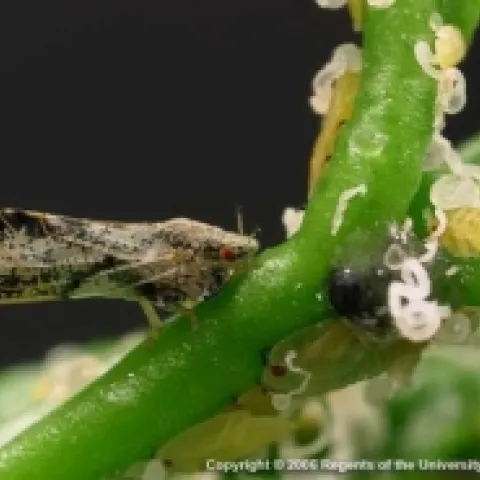
[News release from the Citrus Pest & Disease Prevention Program] An intensive risk survey in Cerritos, Los Angeles County, resulted in the discovery of Huanglongbing in a single orange tree.