UC ANR is committed to providing an accessible and inclusive web experience for all users. If you encounter an accessibility barrier or need content in an alternative or remediated accessible format, please contact anraccessibility@ucanr.edu.
When we think about weed control in crop production, we often think about 'short-term' result, i.e. weed control after 30 days, weed control after 60 days, weed control at harvest, etc.
Irrigation timing can be determined more precisely using a tensiometer. These water-filled tubes with a pressure gauge accurately reflect the amount of energy a plant needs to extract water from the soil. The pressure gauge measures tension values in centibar units (cbars).
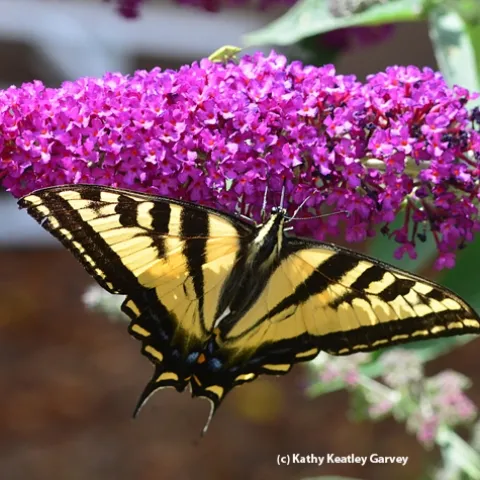
It's sort of like "The Beauty and the Beast." Or "The Pollinator and the Pest." A gorgeous Western Tiger swallowtail (Papilio rutulus), seeking nectar from a butterfly bush, touched down and began to feed. It didn't take long for the butterfly to spot a stink bug crawling on top of the blossom.
In the past year IGIS worked with the staff from the UCCE Marin County to develop a new web mapping application that will display current community garden sites in Marin County. This application was developed with ease of use and ease of updating in mind.
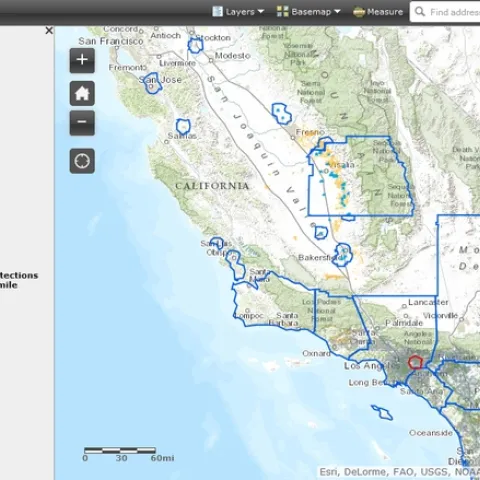
Over the past several years, the Asian citrus psyllid (ACP), a serious invasive pest, has established a population in California and presents a major threat to the California citrus industry.
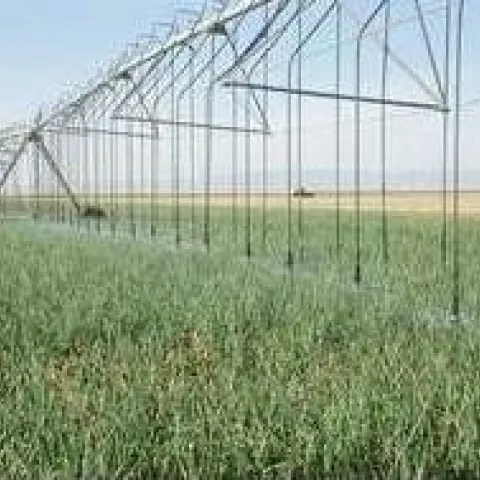
The Issue The need to produce more food, feed, fiber, and fuel with less water now looms as perhaps the greatest challenge ever faced by farmers worldwide. Our ability to meet this challenge may well determine not only our overall quality of life, but also our very survival in the future.
Over the last several months, IGIS has been working to collect, digitize and spatially reference historical project data from the RECs. Recently, we were given some very detailed data for projects at the Hopland REC dating back to 1952.
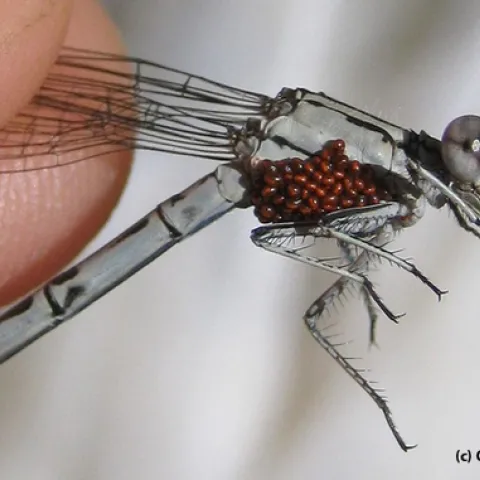
If you've ever been "up close and personal" to a damselfly, you might have seen the water mites. Naturalist Greg Karofelas of Davis, an associate of the Bohart Museum of Entomology, has not only seen them, he has photographed them. See his truly spectacular photo below.