UC ANR is committed to providing an accessible and inclusive web experience for all users. If you encounter an accessibility barrier or need content in an alternative or remediated accessible format, please contact anraccessibility@ucanr.edu.
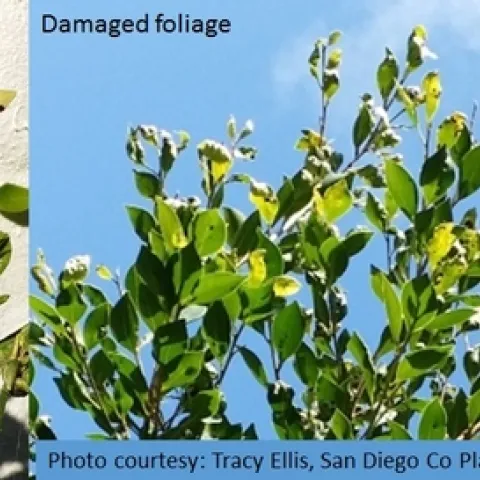
Deformed and yellowing foliage of Indian laurel fig infested with the ficus eye-spot midge. Photo: Tracy Ellis. San Diego County entomologist, Tracy Ellis recently reported the occurrence of a small gall midge in Rancho Santa Fe and La Jolla.
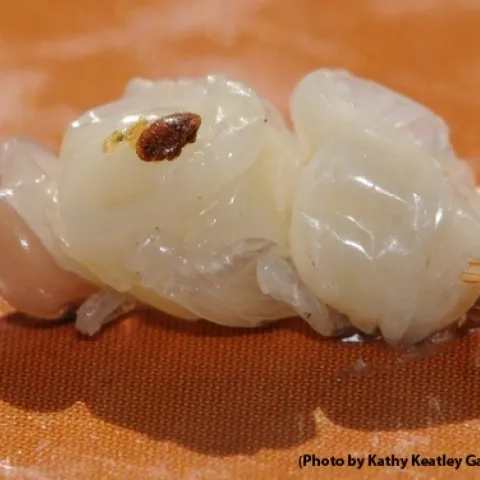
Newly published research by a Michigan State University-led team indicates that one of the reasons why the varroa mite is so destructive is because it infiltrates hives by smelling like a bee. The parasitic mite, or Varroa destructor, is a "blood sucker" that feeds on bees.
From the Cooperative Extension Monterey County Crop Notes newsletter :: Mar-Apr 2015 The Apiaceae or carrot family includes important vegetable crops such as carrots, celery, cilantro, dill, fennel and parsley. All of these crops have a distinctive inflorescence known as an umbel.
This deadline to submit an abstract for the California Invasive Plant Council (CAL-IPC) Symposium is June 15, a week from Monday! Land managers who have great on-the-ground projects but don't normally think about presenting at conferences and researchers are especially encouraged to submit an abstra...
A couple of weeks ago, I was fortunate enough to attend the Spatial Data Science Bootcamp at UC Berkeley. This three-day training event focused on all aspects of GIS and spatial data from an open source perspective.
Spray and pray? Squirt and look? Burn baby burn? Besides the Beavis and Butthead laughs (Heh. Heh-heh. Heh) that usually come when you tell someone you are a weed scientist, is the expectation that you advocate for the use of herbicides as the sole weed management strategy in any given system.
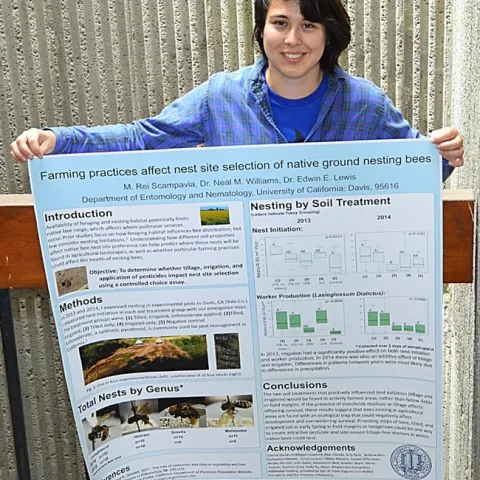
Let's hear it for Rei! Margaret Rei Scampavia, a doctoral candidate who studies with major professors Neal Williams and Edwin Lewis of the Department of Entomology and Nematology, won first place for her research poster at the recent UC Davis Bee Symposium, held in the Robert Mondavi Center for Wine...
This is a great website to view plant nutrient symptoms by plant or by nutrient. It is of ornamental plants, but hey, once you can see it on one plant you will something very similar on avocado, lemon, apple, almond, lychee or whatever alphabetic fruit you work with. Kudos to University of Florida.