UC ANR is committed to providing an accessible and inclusive web experience for all users. If you encounter an accessibility barrier or need content in an alternative or remediated accessible format, please contact anraccessibility@ucanr.edu.
In this issue: Last New Leader Orientation Date coming up!! Enrollment system shuts down Nov 1st! Make it, Take it Craft Expo Nov 1st! and many, many more articles.
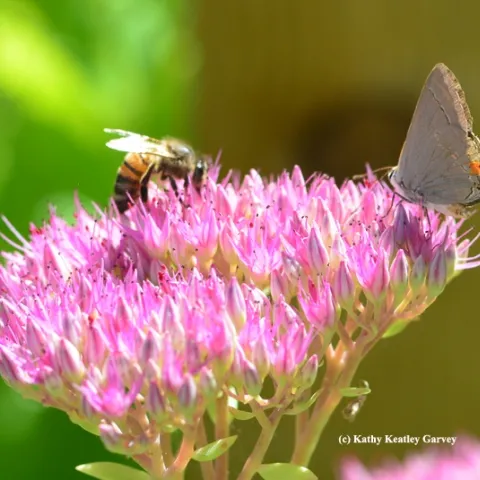
If you've ever watched a Gray Hairstreak butterfly (Strymon melinus) nectaring a sedum, and then watched a honey bee (Apis mellifera) land on the same flower, it's a study in sharing. "I was here first," says the Gray Hairstreak, sipping nectar. "I was here second," says the honey bee.
I was recently in an avocado orchard and saw the rounded fruit and small leaves typical of zinc deficient trees. I asked the grower if there were recent leaf analysis of the orchard, and so we looked at them. The leaves were running at 20 ppm which is low. Sufficiency runs at 50 ppm.
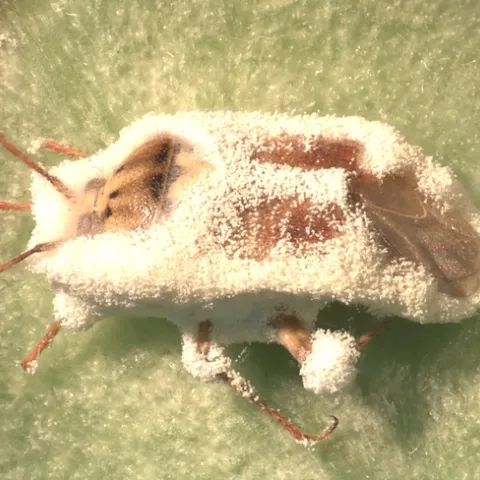
Western tarnished plant bug (Lygus hesperus) killed by the entomopathogenic fungus, Beauveria bassiana (Photo by Surendra Dara) Beneficial fungi such as Beauveria bassiana are pathogenic to insect and mite pests and are commercially available for use in organic and conventional farming.
Technical Tidbits From Spatial Analysis & Data Science. This nice blog highlights many technical aspects of web mapping: Leaflet, D3, R... lots of neat examples.
Follow that buzz! When the California State Beekeepers' Association, founded in 1889, meets Nov. 18-20 in Valencia for its 2014 convention, it will mark a milestone: 125 years of beekeeping. Not so coincidentally, the theme is "Celebrating 125 Years of California Beekeeping.
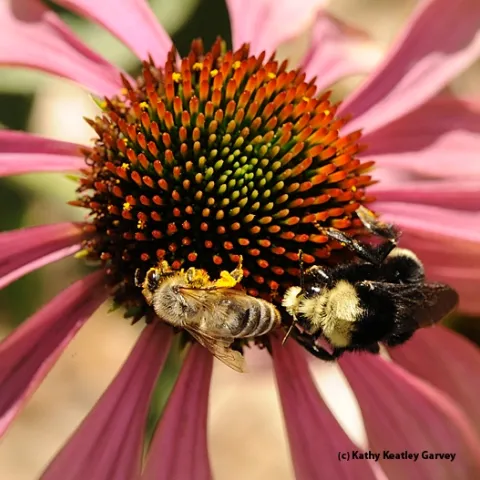
Bees 'n blooms. Blooms 'n bees. Add "California" to it and you have California Bees and Blooms: A Guide for Gardeners and Naturalists. It's a book that's well-planned, well-executed, well-written and well-photographed. Bees are hungry.