UC ANR is committed to providing an accessible and inclusive web experience for all users. If you encounter an accessibility barrier or need content in an alternative or remediated accessible format, please contact anraccessibility@ucanr.edu.
Its that time of year again when hot weather fuels the creation of ozone, or smog. Some herbicides emit volatile organic compounds (VOCs) that contribute to ozone formation. Using herbicides that release VOCs may be restricted in certain California locations between May 1 and October 31.
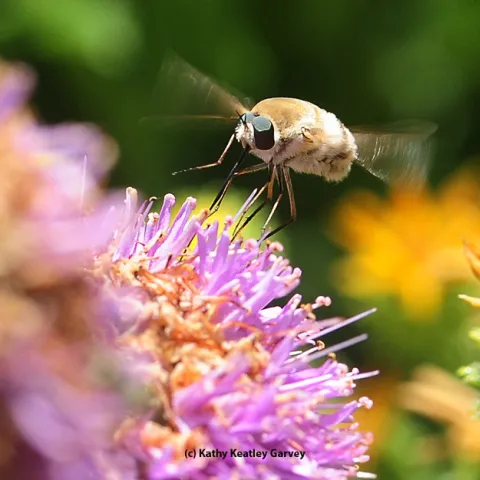
Have you ever seen a bee fly, a member of the family Bombylidae? It's about the size of some bees. It buzzes like a bee. But you can quickly tell it's not a bee by its behavior.
Poor air quality It's that time of year again when hot weather fuels the creation of ozone, or smog. Some pesticides emit volatile organic compounds (VOCs) that contribute to ozone formation.
Its that time of year again when hot weather fuels the creation of ozone, or smog. Some pesticides emit volatile organic compounds (VOCs) that contribute to ozone formation. Using pesticides that release VOCs may be restricted in certain California locations between May 1 and October 31.
Its that time of year again when hot weather fuels the creation of ozone, or smog. Some pesticides emit volatile organic compounds (VOCs) that contribute to ozone formation. Using pesticides that release VOCs may be restricted in certain California locations between May 1 and October 31.
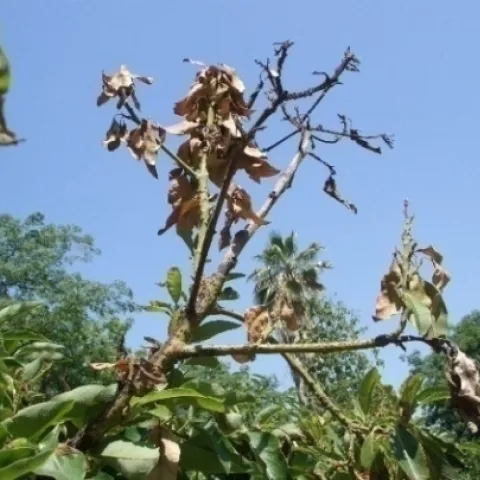
Branch and trunk canker on avocado was formerly attributed to Dothiorella gregaria, hence the name Dothiorella canker. So far Botryopshaeria dothidea (anamorph: Fusicoccum aesculi) is the only known species causing Dothiorella canker on avocado in California.
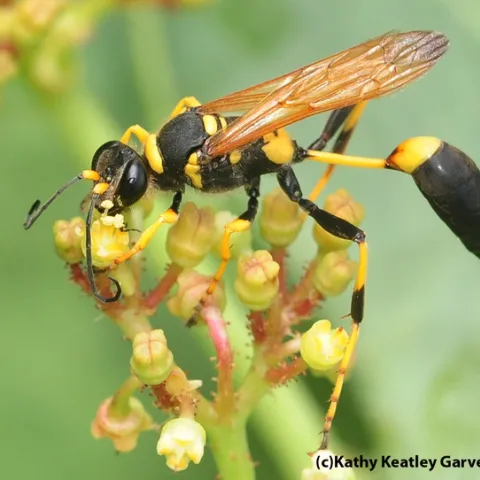
You've heard the expression, "wasp waist," in reference to someone's tiny waist? Well, all you need do is look at the waist of the mud dauber wasp, Sceliphron caementarium, and you'll see where that expression originated.
Threespike goosegrass is a warm season perennial grass which is a problem weed in some almond orchards around Orland, California. It is easily identified by its distinctive (see photo) seed heads (spikes). It is usually a problem during the first years of an orchard.