UC ANR is committed to providing an accessible and inclusive web experience for all users. If you encounter an accessibility barrier or need content in an alternative or remediated accessible format, please contact anraccessibility@ucanr.edu.
Weeders, I thought I'd make a quick post this morning to share some highlights from the Western Society of Weed Science. I've attached the Spring 2012 WSWS Newsletter that summarizes some of the things that happened at the 65 Annual WSWS meeting held in Reno NV last month.
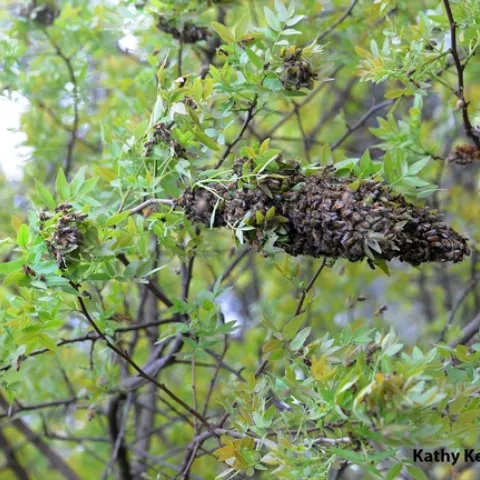
It happened on Friday the 13th. It was the first swarm of the season at the Harry H. Laidlaw Jr. Honey Bee Research Facility on Bee Biology Road, University of California, Davis. The bees swirled, darkening the sky, and then swarmed from one of bee breeder-geneticist Susan Cobey's hives around 2 p.
The most effective, economical, and ecologically sound method of managing invasive plants is to prevent their invasion in the first place. Resources can be spent most efficiently on proactive activities that focus on stopping the movement of plant seeds and other reproductive parts to new areas.
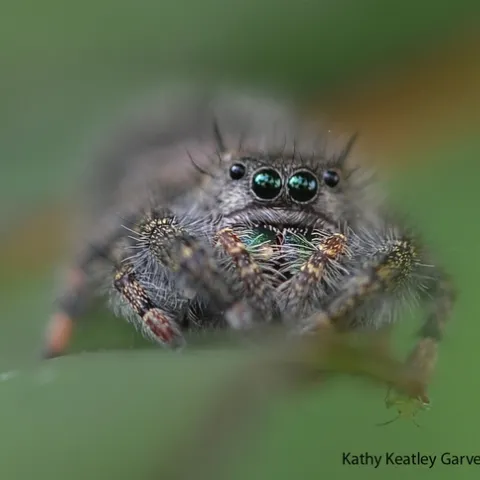
They're there. If you walk slowly into your garden or backyard, and observe your surroundings, you'll find them. A jumping spider perched on a rose leaf. A soldier beetle climbing out of a tulip. A syrphid fly, aka flower fly or hover fly, foraging on a poppy blossom.
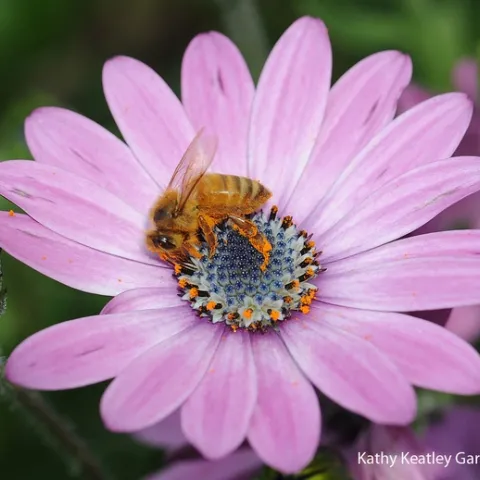
You've heard of "Got milk?" With honey bees, it's "Got pollen?" We spotted a lone honey bee on an African daisy last weekend. It was clear she'd been foraging for pollen. Pollen covered her legs and antennae and rimmed her head. And it was clear where it came from.
Maggots and termites and cockroaches, oh my! And ants, honey bees, bumble bees, beetles, and skeeters, oh yes! Don't see "Ewww!" Say "Wow!" Those are just a few of the bugs that will be part of the UC Davis Department of Entomology's activities during the 98th annual campuswide UC Davis Picnic Day o...
Research to fight Huanglongbing (HLB), the deadly citrus disease carried by the Asian citrus psyllid, is taking place throughout our nation and the world. Industry-wide urgency is funding a variety of research in search of a solution.
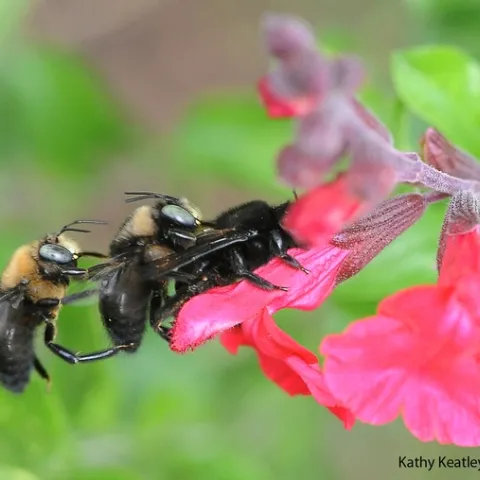
Spring has definitely sprung. The carpenter bees (Xylocopa tabaniformis orpifex) of the Central Valley have emerged and are creating their own little Lovers' Lane on the salvia. More males than females. More buzzing than foraging. More chasing than capturing.