UC ANR is committed to providing an accessible and inclusive web experience for all users. If you encounter an accessibility barrier or need content in an alternative or remediated accessible format, please contact anraccessibility@ucanr.edu.
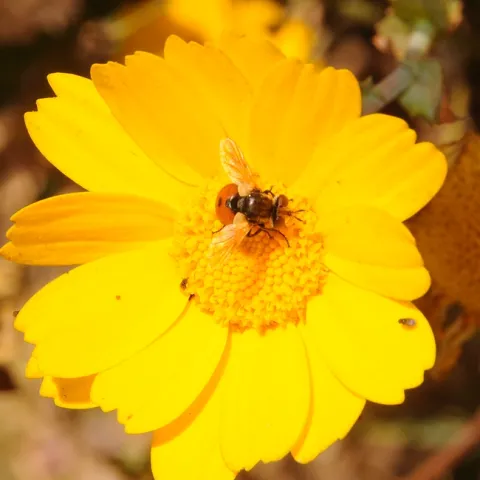
Oh, to go through life being called a "short fat fly." Such is the case with a specific tachinid fly (family Tachinidae, genus Gymnosoma), which we spotted on a coreopsis (aka tickseed) growing along a Fort Bragg cliff. It's an odd-looking fly. Its abdomen resembles a ladybug or lady beetle.
An article was posted a couple days ago on the Scientific American blog in which the author deconstructed what she saw as common myths about organic agriculture.
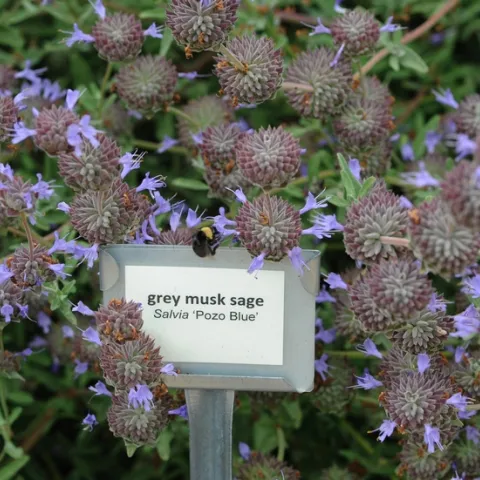
Every once in a while you see it. And it's a real treat--especially when it's a bee garden that's synonomous with treat. We tracked the black-faced bumble bee (Bombus californicus) in the Hagen-Dazs Honey Bee Haven, a half-acre bee friendly demonstration garden at the Harry H. Laidlaw Jr.
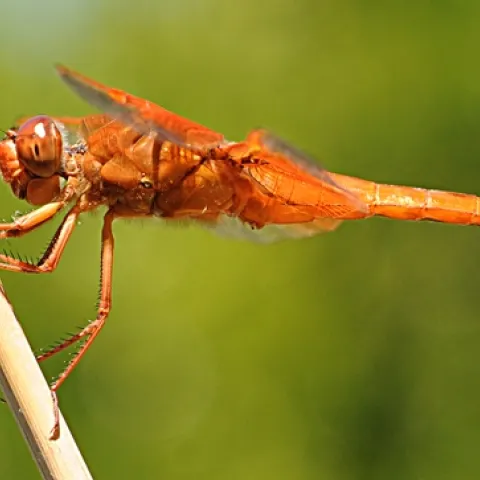
For at least three days, he visited our yard. He swooped over our fish pond and swimming pool and returned each time to perch on a tomato stake in the vegetable garden. We nicknamed him "Big Red." Big Red? Actually, a flame skimmer dragonfly (Libellula saturata), native to western North America.
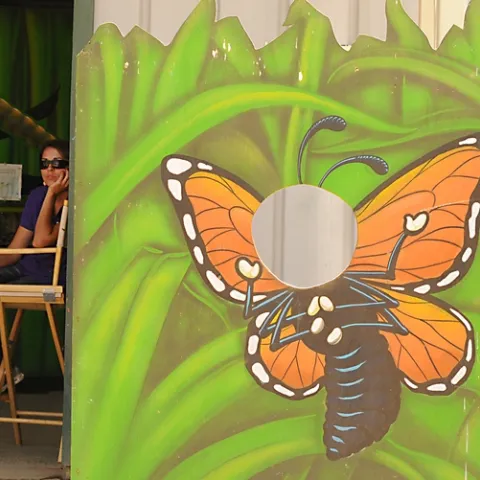
If you head over to the California State Fair, which opened July 14 and continues through July 31, be sure to check out the Insect Pavilion at "The Farm." It's a treasure house of not only insects, but spiders and assorted other critters.
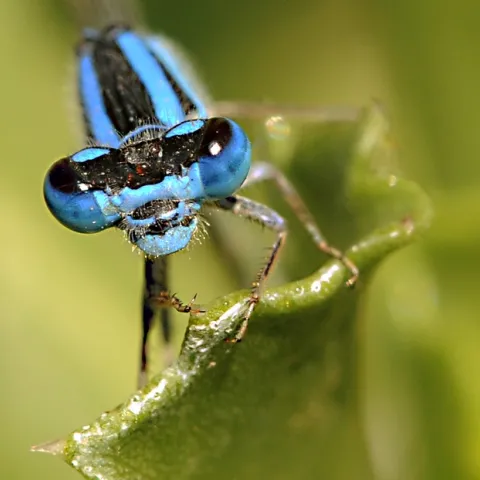
Blue damselflies should be on "Dancing with Stars." Because, in many respects, they ARE the stars--the stars of the insect world. They're slender, delicate and beautiful dancers that look like blue-stick diamonds.
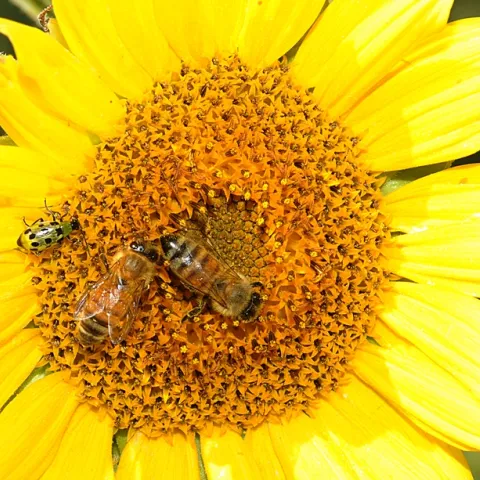
Two's company, three's a crowd? Yes, when a spotted cucumber beetle tries to share a sunflower with two honey bees. That was the scene Sunday in a sunflower field along Pedrick Road, Dixon, Solano County. The spotted cucumber beetle is a pest. Honey bees are beneficial.
The adage "a picture is worth a thousand words" can apply to pesticide safety, too! When I was at Colorado State University in 2006, Sandra McDonald of Mountain West PEST led an effort to teach pesticide safety through the use of photos.
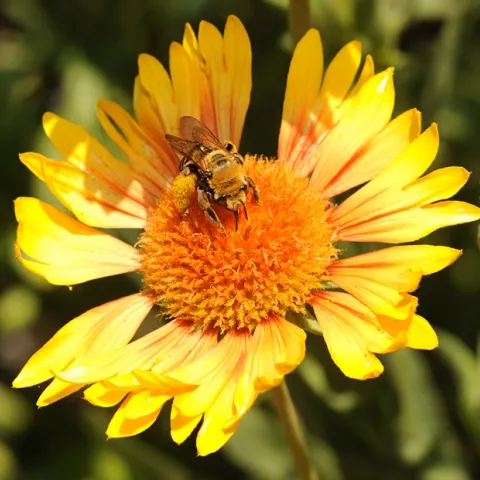
It's often mistaken for the honey bee. But it's not a honey bee (Apis mellifera). It's a different species of bee. Specifically, it's a long-horn sunflower bee. We spotted this sunflower bee July 11 in the Hagen-Dazs Honey Bee Haven at the Harry H. Laidlaw Jr.