UC ANR is committed to providing an accessible and inclusive web experience for all users. If you encounter an accessibility barrier or need content in an alternative or remediated accessible format, please contact anraccessibility@ucanr.edu.
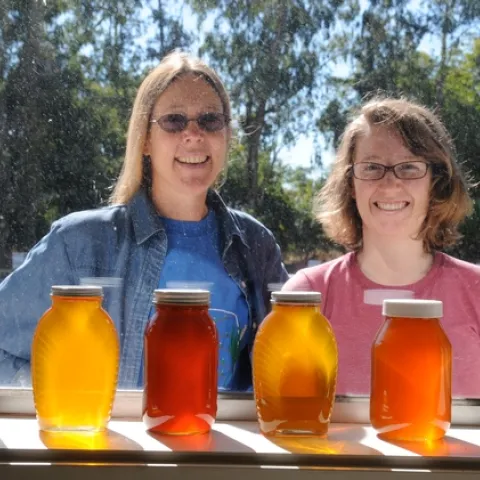
Youngsters like to joke about what a honey bee says when she returns to the hive: "Honey, I'm home!" Honey...what is it? The National Honey Board defines honey as "the substance made when the nectar and sweet deposits from plants are gathered, modified and stored in the honeycomb by honey bees.
Hear the buzz? That's the sound of a honey bee's wings moving at about 11,400 times per minute. As a field bee, the worker bee lives only several weeks during the peak nectaring season. She can fly four to five miles a day, at a speed of about 15 miles per hour.
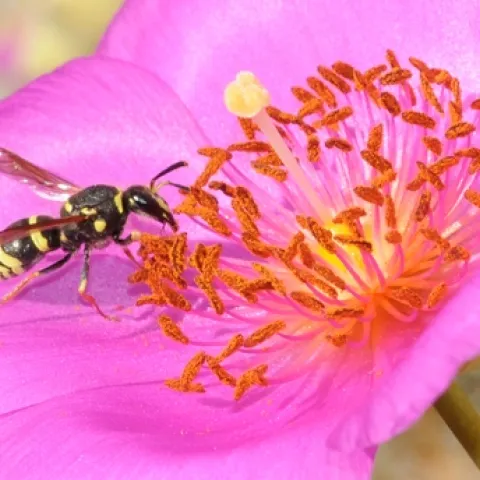
Mason wasps are strikingly beautiful. The black and yellow patterns are intriguing, but even more intriguing are the mud nests they build. Makes sense that these wasps are called mason or potter wasps, named for what they do. Their human counterparts work with stone, brick, and concrete.
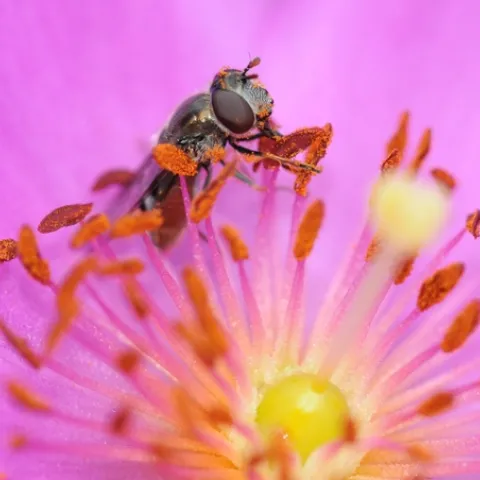
The warmth of the sun and the lure of nectar beckoned the hover flies or flower flies to our bee friendly garden. We saw this one nectaring the rock purslane (Calandrinia grandiflora) last weekend.
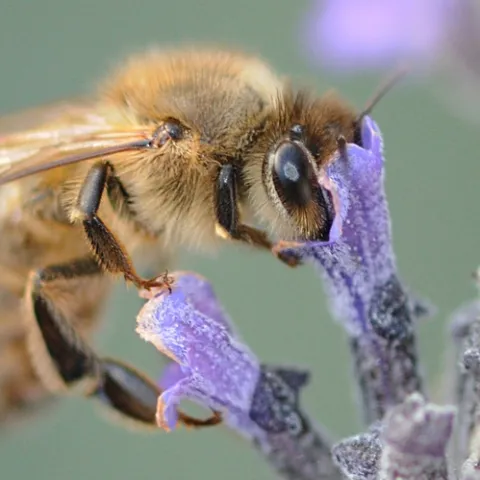
Ever wonder how a honey bee sees? Its compound eyes are comprised of hundreds of single eyes (ommatidia), each with its own lens. It can distinguish colors, but can't see red, which it interprets as black.
Hap-bee Thanksgiving! If you're having cranberries, squash, pumpkins, carrots, cucumbers (and pickles) onions, grapefruit, oranges, apples, pears, cherries, blueberries, sunflowers and almonds, you can thank the honey bee.
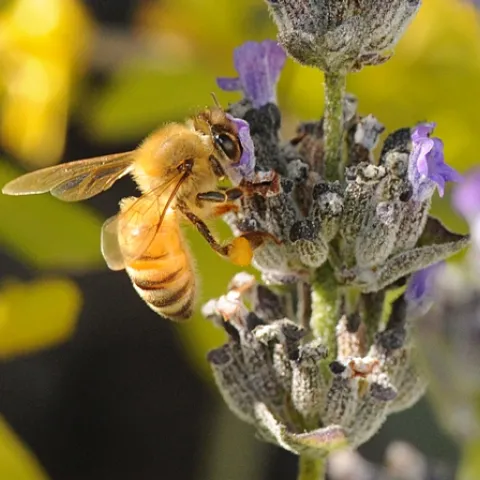
I slipped into the back yard today to see how many honey bees were nectaring the lavender, one of the few plants still blooming. A few here. A few there. That's when I saw her. A bee the color of pure gold. And she was carrying a load of pollen that was equally pure gold.
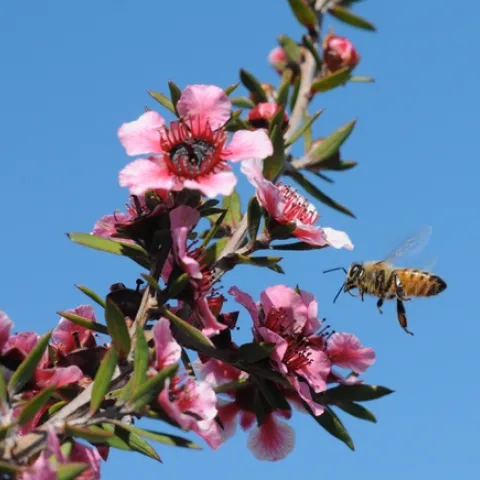
In a way, it's "tea for two." The New Zealand tea tree, Leptospermum scoparium, aka "manuka," "tea tree," and "Leptospermum," is a favorite of the light brown apple moth AND honey bees. We captured images of bees on Leptospermum scoparium keatleyi recently in Sausalito.
Picture this. A light rainstorm strikes the garden, pummeling and shredding some of the blossoms. As the rain lets up, a honey bee buzzes into a rock purslane blossom for a sweet shot of nectar. She is not alone. If you look closely, you'll see three green aphids on an unopened blossom next to her.