A Natural Solution for California's Herds: African Catfish Peptides

California's cattle producers and agricultural communities are all too familiar with the rising challenge of antibiotic resistance, making common bacterial infections harder to treat in livestock. But imagine a future where we could tackle these infections with a natural, powerful alternative. Our research points to just that: antimicrobial peptides (AMPs) found in African catfish.

We're really excited about these peptides because African catfish thrive in pathogen-rich freshwater, naturally producing these robust immune compounds in their skin mucus as a defense. This natural origin makes them highly appealing alternatives to synthetic drugs.

Predicted Safety and Potent Action

One of the most compelling aspects of these AMPs is their predicted safety for mammals. Our initial computer analyses suggest that various catfish AMPs are generally recognized as safe (GRAS). We predict they'll be absorbed in the human intestine without causing liver, brain, or heart toxicity. Furthermore, lab tests on a promising peptide, NACAP-II, confirmed it was non-hemolytic, meaning it didn't damage rabbit red blood cells—a strong indicator of its potential safety for mammalian cells.

Beyond safety, these peptides demonstrate effectiveness against problematic bacteria. One study revealed NACAP-II's strong activity against Extended-Spectrum Beta-Lactamase (ESBL)-producing Escherichia coli—a critical concern for both animal and human health due to its resistance to many common antibiotics. Another peptide, ACAP-IV, also showed antibacterial activity against E. coli and Staphylococcus aureus. We believe these AMPs work by directly disrupting bacterial cell membranes, a mechanism that makes it harder for bacteria to develop resistance compared to how they resist traditional antibiotics.
ANR Adventures: Article

UC ANR's future stars

April 25, 2019
By Wendy Powers
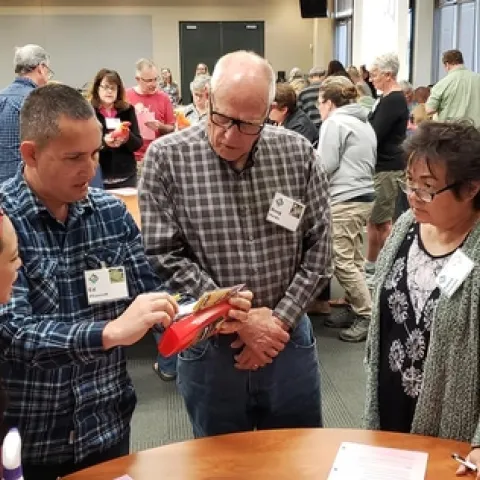
I had no idea that Marcel's training was in organizational wellness. This information may come in handy in the future. Marcel gave a great presentation at the Programmatic Orientation meeting that was held at the Kearney REC this week.
View Article
Primary Image
Doctoral candidate Brendon Boudinot answers questions about insects in the Bug Doctor booth at Briggs Hall. (Photo by Kathy Keatley Garvey)
Bug Squad: Article

The Bug Doctor Is In! Ask Me a Question!

April 25, 2019
By Kathy Keatley Garvey
The doctor is in. The Bug Doctor, that is. If you attended the 105th annual UC Davis Picnic Day and headed for Briggs Hall, home of the Department of Entomology and Nematology, you encountered a booth lettered with "Bug Doctor" and a sign that read: Ask Me About Insects.
View Article
Article

UCPath paychecks to start October 1

April 25, 2019
By Pamela S Kan-Rice
The systemwide UCPath Steering Committee has decided the new launch date for UCPath at UC ANR, UC Davis and UC Davis Health will be October 1, with cutover activities happening in September.
View Article
Primary Image
UCANR UCPath logo
ANR Employee News: Article

UCPath paychecks to start Oct. 1

April 25, 2019
By Pamela S Kan-Rice
The systemwide UCPath Steering Committee has decided the new launch date for UCPath at UC ANR, UC Davis and UC Davis Health will be Oct. 1, with cutover activities happening in September. The decision for UC ANR to launch UCPath on Oct.
View Article
Primary Image
Cooking with Herbs Class
Hansen News: Article

Cooking with Herbs

April 25, 2019
By Susana Bruzzone-Miller
Cooking is one of my greatest joys. So, when Master Gardener lead, Susan Carter asked me to teach a Cooking with Herbs class for fellow gardeners last year, I jumped at the chance. I was even more thrilled to be invited back for a command performance.
View Article
Glenn County: Article

Prune- Spring 2019

April 25, 2019
In this issue: The Advantages of Tighter Spacing and Greater Light Interception in California Prune Orchards Thinning Prunes Prune Management Considerations: Spring - Summer 2019 IPM Breakfast Meetings...
View Article
Colusa County: Article

May 2019 4-H News

April 25, 2019
In this issue, you will find: Small Animal Field Day results Colusa County Fair information Reminders from the 4-H Office Butte County Summer Camp invitation! and much, much more!...
View Article
Primary Image
Slide 1: Rain data from CIMIS station #111 for March and April 2019. Red arrows mark spray dates.
Strawberries and Caneberries: Article

Blowout Beginning for Botrytis Trial

April 25, 2019
By Mark P Bolda
Those of you familiar with my program of research and extension are aware of my rising interest in developing a protocol for consistent treatment separation in Botrytis gray mold fungicide work.
View Article
Primary Image
Oleander
UC Master Gardeners- Diggin' it in SLO: Article

Oleanders

April 25, 2019
Nerium oleander Planting Zone: Sunset zones 8-16, 18-23; USDA 8-10 Size: 8-12 feet tall and wide. However, plants can be as small as 3-4 feet or as tall as 20 feet. Bloom Season: May or June to October Exposure: Most varieties thrive in heat and strong light, even reflected heat from pavement.
View Article