A Natural Solution for California's Herds: African Catfish Peptides

California's cattle producers and agricultural communities are all too familiar with the rising challenge of antibiotic resistance, making common bacterial infections harder to treat in livestock. But imagine a future where we could tackle these infections with a natural, powerful alternative. Our research points to just that: antimicrobial peptides (AMPs) found in African catfish.

We're really excited about these peptides because African catfish thrive in pathogen-rich freshwater, naturally producing these robust immune compounds in their skin mucus as a defense. This natural origin makes them highly appealing alternatives to synthetic drugs.

Predicted Safety and Potent Action

One of the most compelling aspects of these AMPs is their predicted safety for mammals. Our initial computer analyses suggest that various catfish AMPs are generally recognized as safe (GRAS). We predict they'll be absorbed in the human intestine without causing liver, brain, or heart toxicity. Furthermore, lab tests on a promising peptide, NACAP-II, confirmed it was non-hemolytic, meaning it didn't damage rabbit red blood cells—a strong indicator of its potential safety for mammalian cells.

Beyond safety, these peptides demonstrate effectiveness against problematic bacteria. One study revealed NACAP-II's strong activity against Extended-Spectrum Beta-Lactamase (ESBL)-producing Escherichia coli—a critical concern for both animal and human health due to its resistance to many common antibiotics. Another peptide, ACAP-IV, also showed antibacterial activity against E. coli and Staphylococcus aureus. We believe these AMPs work by directly disrupting bacterial cell membranes, a mechanism that makes it harder for bacteria to develop resistance compared to how they resist traditional antibiotics.

Primary Image
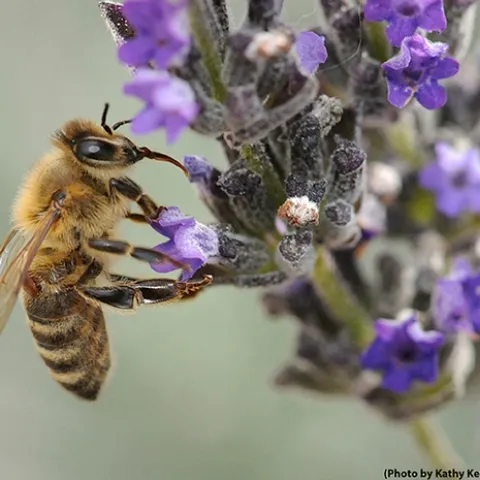
Honey bee foraging in a flowering quince. (Photo by Kathy Keatley Garvey)
Bug Squad: Article

Why Spring Doesn't Seem So Distant

January 21, 2015
By Kathy Keatley Garvey
The honey bees are hungry. Those venturing out from their colonies as the temperatures edge toward 55 degrees or more aren't finding much. It's the dead of winter. Spring seems so distant. But wait, the flowering quince is blooming.
View Article
Primary Image
Honey bee foraging on a tulip. (Photo by Kathy Keatley Garvey)
Bug Squad: Article

Marla Spivak's Keynote Speech: 'Helping Bees Stand on Their Own Six Feet'

January 20, 2015
By Kathy Keatley Garvey
"Helping Bees Stand on Their Own Six Feet." Yes, honey bees have six feet, and that's the title of a keynote speech to be presented May 9 at the University of California, Davis by Distinguished McKnight Professor and 2010 MacArthur Fellow Marla Spivak of the University of Minnesota.
View Article
IGIS: Article

VTM data helps us understand changes to California forests

January 20, 2015
By Maggi Kelly
Some press on our PNAS paper: Twentieth-century shifts in forest structure in California: Denser forests, smaller trees, and increased dominance of oaks. Berkeley News http://newscenter.berkeley.edu/2015/01/20/warmer-drier-climate-altering-forests-statewide/ National Geographic http://news.
View Article
UC Weed Science (weed control, management, ecology, and minutia): Article

Herbicide control of distaff thistle

January 20, 2015
By Joseph DiTomaso
Over the past several years, land managers and ranchers in Marin and Sonoma counties have been concerned with the spread of woolly distaff thistle (Carthamus lanatus). However, there is very little research conducted on the control of this species.
View Article
UC Weed Science (weed control, management, ecology, and minutia): Article

JOB OPENING :: Deputy Director of the Australian Herbicide Resistance Initiative and Associate Professor

January 20, 2015
By Gale Perez
From Stephen Powles at the UNIVERSITY OF WESTERN AUSTRALIA Colleagues, One month from now (February 23rd 2015) is the closing date for applications for the position of Deputy Director of the Australian Herbicide Resistance Initiative and Associate Professor at the University of Western Australia.
View Article
Primary Image
This dead honey bee with a load of pollen was among dozens found outside the Robert and Margrit Mondavi Center for the Performing Arts on the UC Davis campus. (Photo by Kathy Keatley Garvey)
Bug Squad: Article

'Super Sleuth' Solves the Mystery of the Dead Bees

January 19, 2015
By Kathy Keatley Garvey
What's killing the honey bees? The email arrived in my UC Davis inbox at 9:10 a.m., Thursday, Jan. 8. An employee from the UC Davis Plumbing Shop wondered what was happening in front of the Robert and Margrit Mondavi Center for the Performing Arts on the UC Davis campus.
View Article
Primary Image
A male monarch nectaring Mexican sunflower (Tithonia). (Photo by Kathy Keatley Garvey)
Bug Squad: Article

The Real Skinny on Migrating Monarchs, Milkweed

January 16, 2015
By Kathy Keatley Garvey
A recent article in Science magazine, headlined Plan to Save Monarch Butterflies Backfires, is getting a lot of attention. And UC Davis butterfly expert Art Shapiro, distinguished professor of evolution and ecology, is getting a lot of inquiries.
View Article
Primary Image
Ag students
Topics in Subtropics: Article

Car Plates Supporting Ag Education

January 16, 2015
By Ben A Faber
SACRAMENTO The California Department of Food and Agriculture (CDFA) has awarded $215,670 for five projects that will promote and administer agricultural education and leadership programs for students, teachers and youth under the 2014 California Special Interest License Plate (CalAgPlate) grant pro...
View Article
Primary Image
Clegg collection
Topics in Subtropics: Article

The Clegg Collection: A Valuable Resource

January 16, 2015
By Ben A Faber
Department of Botany and Plant Sciences, University of California, Riverside An unusual population of avocado trees may soon suffer the same fate as many commercial orchards elsewhere in California: its water supply will be cut off and the trees fed to a wood chipper. And yet these trees (Fig.
View Article
Primary Image
Katharina Ullmann, who just received her doctorate in entomology from UC Davis and is now a pollinator conservation specialist for the Xerces Society, is co-coordinator of the workshop. (Photo by Neal Williams)
Bug Squad: Article

All About Crop Pollination

January 15, 2015
By Kathy Keatley Garvey
What's stressing our honey bees and how are they impacted? You'll learn more about honey bees if you attend the Crop Pollination Workshop next month.
View Article