A Natural Solution for California's Herds: African Catfish Peptides

California's cattle producers and agricultural communities are all too familiar with the rising challenge of antibiotic resistance, making common bacterial infections harder to treat in livestock. But imagine a future where we could tackle these infections with a natural, powerful alternative. Our research points to just that: antimicrobial peptides (AMPs) found in African catfish.

We're really excited about these peptides because African catfish thrive in pathogen-rich freshwater, naturally producing these robust immune compounds in their skin mucus as a defense. This natural origin makes them highly appealing alternatives to synthetic drugs.

Predicted Safety and Potent Action

One of the most compelling aspects of these AMPs is their predicted safety for mammals. Our initial computer analyses suggest that various catfish AMPs are generally recognized as safe (GRAS). We predict they'll be absorbed in the human intestine without causing liver, brain, or heart toxicity. Furthermore, lab tests on a promising peptide, NACAP-II, confirmed it was non-hemolytic, meaning it didn't damage rabbit red blood cells—a strong indicator of its potential safety for mammalian cells.

Beyond safety, these peptides demonstrate effectiveness against problematic bacteria. One study revealed NACAP-II's strong activity against Extended-Spectrum Beta-Lactamase (ESBL)-producing Escherichia coli—a critical concern for both animal and human health due to its resistance to many common antibiotics. Another peptide, ACAP-IV, also showed antibacterial activity against E. coli and Staphylococcus aureus. We believe these AMPs work by directly disrupting bacterial cell membranes, a mechanism that makes it harder for bacteria to develop resistance compared to how they resist traditional antibiotics.
Primary Image
The silver-spangled underside of the Gulf Fritillary, shown here nectaring lantana. (Photo by Kathy Keatley Garvey)

The Amazing Gulf Fritillary

October 3, 2012
By Kathy Keatley Garvey
The Gulf Fritillary is as fascinating as it is amazing. The showy reddish-orange butterfly (Agraulis vanillae) is making a comeback in the Sacramento-Davis area. In the early 1970s, it was considered extinct in that area.
View Article
Primary Image
A Gulf Fritillary butterfly in the process of laying an egg on a passion flower vine. (Photo by Kathy Keatley Garvey)

Ever Seen a Butterfly Laying an Egg?

October 3, 2012
By Kathy Keatley Garvey
Let's talk butterfly eggs. Have you ever seen a Gulf Fritillary butterfly laying an egg in the wild? The Gulf Frit (Agraulis vanillae), one of the showiest of all butterflies, is a flash of orange-red as it flutters toward its host plant (genus Passiflora) to lay its eggs.
View Article
Primary Image
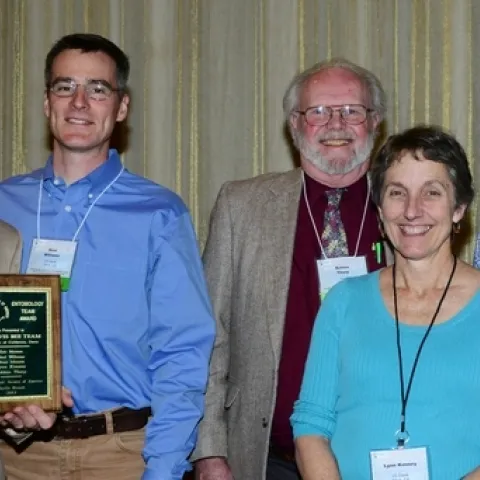
UC Davis research entomologist William Reisen. (Photo by Kathy Keatley Garvey)

When Harry (Hoogstraal) Met Bill (Reisen)

October 1, 2012
By Kathy Keatley Garvey
It's good to see UC Davis research entomologist William "Bill" Reisen named the recipient of the coveted Harry Hoogstraal Medal, to be awarded Nov. 11 in Atlanta, Ga. at the 61st annual meeting of the American Society of Tropical Medicine and Hygiene (ASTMH).
View Article
Cooperative Extension Ventura County: Article

October 2012 Clover Lines

September 29, 2012
In this issue... Trick Or Treat So Others Can Eat, Awards Night, Awards Overlooked at Fair, Volunteers Needed, Social Media, New Leader Trainings, Council Corner and much more.
View Article
Primary Image
Honey bee nectaring Mexican sunflower (Tithonia) at the Haagen-Dazs Honey Bee Haven, UC Davis. (Photo by Kathy Keatley Garvey)

What's That Buzz?

September 28, 2012
By Kathy Keatley Garvey
When the Onward California tour rolls into Davis next week, the Harry H. Laidlaw Jr. Honey Bee Research Facility will share the limelight. Here's why.
View Article
UC Weed Science (weed control, management, ecology, and minutia): Article

Sizing Up Wildland Weeds

September 28, 2012
By Chris J McDonald
I most often work with land managers in Southern California and one thing that surprises me is the size of restoration and management projects. One survey of land managers in Orange County found the average size of a restoration treatment is 6 ac.
View Article
Primary Image
Praying mantis hangs upside down on a zinnia. (Photo by Kathy Keatley Garvey)

Oh, the Life of a Praying Mantis...

September 27, 2012
By Kathy Keatley Garvey
Oh, the life of a praying mantis... You can hang upside down like an acrobat, shading yourself from the sun while waiting for prey and avoiding predators. You can crawl beneath dense leaves, the better to ambush, snatch and eat an unsuspecting bee.
View Article
Primary Image
Buckeye (Junonia coenia) spreads its wings on sedum. (Photo by Kathy Keatley Garvey)

The Buck (Eye) Stops Here

September 26, 2012
By Kathy Keatley Garvey
The buck stops here. The buckeye butterfly (Junonia coenia), that is. Whether it's doing the fandago on the plantago, the can-can on the lantana or the waltz on the sedum, it's easy to spot. That's because of its large eyelike circles on its wings.
View Article
Colusa County: Article

October 2012

September 26, 2012
Enroll now, new Leader Orientation, Countywide Acheivement night, Home Ec Leaders meeting, Scholarship workshop, Make-it and Take-it Craft Expo, State Leaders Conference, countywide projects...
View Article
UC Weed Science (weed control, management, ecology, and minutia): Article

Evaluation of pre-emergence herbicides in California almond orchards

September 26, 2012
By Brad Hanson
Several field experiments were conducted to evaluate the performance of pre-emergence herbicides, herbicide rates, and tankmix combinations at different locations in the Central Valley of California and to compare the efficacy of burndown herbicides in mixture with different pre-emergence herbicides...
View Article