A Natural Solution for California's Herds: African Catfish Peptides

California's cattle producers and agricultural communities are all too familiar with the rising challenge of antibiotic resistance, making common bacterial infections harder to treat in livestock. But imagine a future where we could tackle these infections with a natural, powerful alternative. Our research points to just that: antimicrobial peptides (AMPs) found in African catfish.

We're really excited about these peptides because African catfish thrive in pathogen-rich freshwater, naturally producing these robust immune compounds in their skin mucus as a defense. This natural origin makes them highly appealing alternatives to synthetic drugs.

Predicted Safety and Potent Action

One of the most compelling aspects of these AMPs is their predicted safety for mammals. Our initial computer analyses suggest that various catfish AMPs are generally recognized as safe (GRAS). We predict they'll be absorbed in the human intestine without causing liver, brain, or heart toxicity. Furthermore, lab tests on a promising peptide, NACAP-II, confirmed it was non-hemolytic, meaning it didn't damage rabbit red blood cells—a strong indicator of its potential safety for mammalian cells.

Beyond safety, these peptides demonstrate effectiveness against problematic bacteria. One study revealed NACAP-II's strong activity against Extended-Spectrum Beta-Lactamase (ESBL)-producing Escherichia coli—a critical concern for both animal and human health due to its resistance to many common antibiotics. Another peptide, ACAP-IV, also showed antibacterial activity against E. coli and Staphylococcus aureus. We believe these AMPs work by directly disrupting bacterial cell membranes, a mechanism that makes it harder for bacteria to develop resistance compared to how they resist traditional antibiotics.
UC Weed Science (weed control, management, ecology, and minutia): Article

Milestone (aminopyralid) applied preemergence can control medusahead

June 6, 2012
By Joseph DiTomaso
Medusahead (Taeniatherum caput-medusae) is one of the most problematic invasive grasses on many California rangelands. It is difficult to control selectively in grasslands. Prescribed burning, grazing, and herbicides have been tested with some success but are not practical in all situations.
View Article
Primary Image
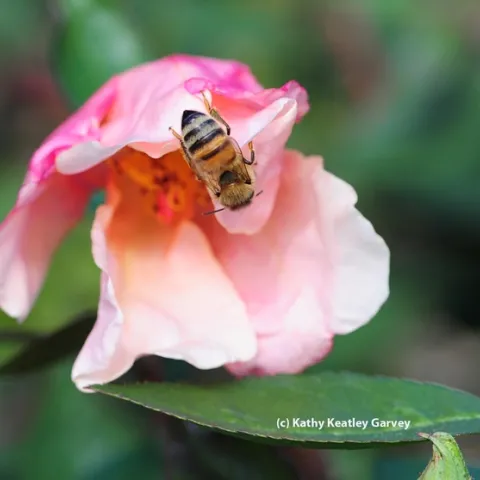
Sweat bee, Halictus farinosus, prepares to leave one flower for another. (Photo by Kathy Keatley Garvey)

In the Blink of an Eye

June 5, 2012
By Kathy Keatley Garvey
In the blink of an eye, they visit the rockpurslane (Calandrinia grandiflora). Now you see them, now you don't. They're a sweat bee, a little larger than most sweat bees, but a little smaller than a honey bee.
View Article
UC Weed Science (weed control, management, ecology, and minutia): Article

Yellow Nutsedge Invades My Perfect Tall Fescue Lawn!!

June 5, 2012
By Pamela M Geisel
The yellow nutsedge (Cyperus esculentus) took over the tall fescue turf during the night. I am sure of it. One day it wasnt there and the next day it was.
View Article
Primary Image
Honey bee packing red pollen from rockpurslane. (Photo by Kathy Keatley Garvey)

Getting the Red Out

June 4, 2012
By Kathy Keatley Garvey
"Where do bees get red pollen?" we were asked. "We've seen bees packing blood-red pollen at the entrance to a hive." Well, one flower that yields red pollen is rock purslane (Calandrinia grandiflora). It's a drought-tolerant perennial, a succulent.
View Article
Primary Image
CT
Conservation Agriculture: Article

Low-till forage production on dairies

June 4, 2012
By Jeannette Warnert
To fill their need for year-round, inexpensive forages, California dairy producers typically plant and harvest a series of forage crops small grains, corn for silage, milo and sorghum sudan.
View Article
Primary Image
UNL professor Suat Irmak said California agriculture used to be very good about adopting new technologies. "Now Nebraska is No. 1," he said.
Conservation Agriculture: Article

Water for Food participants visit Nebraska research center

June 2, 2012
By Jeannette Warnert
The University of Nebraska, Lincoln, hosted a group of Water for Food Conference participants on a tour of the UNL South Central Ag Laboratory in Clay Center, Neb., June 2. At the 640-acre facility, research aims to develop and refine irrigated crop production practices for Nebraska agriculture.
View Article
Primary Image
Male European wool carder bee is very territorial. Front, lavender blossoms. Back: pomegranate blossoms. (Photo by Kathy Keatley Garvey

So Very Territorial!

June 1, 2012
By Kathy Keatley Garvey
Whether it's coming or going, you notice this pollinator's presence. The European wool carder bee (Anthidium manicatum), so named because the female collects or cards "plant hairs" or "plant fuzz" to line her nest, is strikingly beautiful. The bee is mostly black and yellow.
View Article
UC Weed Science (weed control, management, ecology, and minutia): Article

Mighty mite may prove too much for Scotch broom

June 1, 2012
By Scott R Oneto
A recent find in Oregon has weed scientists, botanists, land managers, and plant conservationists throughout the Pacific Northwest and California really excited over a tiny insect.
View Article
Primary Image
Dan Munk (left) and Michael Dowgert, the Fresno-based director of marketing for Netafim, an irrigation company.
Conservation Agriculture: Article

Insight and optimism as the Water for Food Conference wraps up

June 1, 2012
By Jeannette Warnert
Farmers, researchers, consumers and policy makers are making progress toward addressing the challenge of producing food to feed a world population of 9 billion in 2050. The optimistic signs were everywhere on the closing day of the fourth annual Water for Food Conference in Lincoln, Neb., June 1.
View Article