A Natural Solution for California's Herds: African Catfish Peptides

California's cattle producers and agricultural communities are all too familiar with the rising challenge of antibiotic resistance, making common bacterial infections harder to treat in livestock. But imagine a future where we could tackle these infections with a natural, powerful alternative. Our research points to just that: antimicrobial peptides (AMPs) found in African catfish.

We're really excited about these peptides because African catfish thrive in pathogen-rich freshwater, naturally producing these robust immune compounds in their skin mucus as a defense. This natural origin makes them highly appealing alternatives to synthetic drugs.

Predicted Safety and Potent Action

One of the most compelling aspects of these AMPs is their predicted safety for mammals. Our initial computer analyses suggest that various catfish AMPs are generally recognized as safe (GRAS). We predict they'll be absorbed in the human intestine without causing liver, brain, or heart toxicity. Furthermore, lab tests on a promising peptide, NACAP-II, confirmed it was non-hemolytic, meaning it didn't damage rabbit red blood cells—a strong indicator of its potential safety for mammalian cells.

Beyond safety, these peptides demonstrate effectiveness against problematic bacteria. One study revealed NACAP-II's strong activity against Extended-Spectrum Beta-Lactamase (ESBL)-producing Escherichia coli—a critical concern for both animal and human health due to its resistance to many common antibiotics. Another peptide, ACAP-IV, also showed antibacterial activity against E. coli and Staphylococcus aureus. We believe these AMPs work by directly disrupting bacterial cell membranes, a mechanism that makes it harder for bacteria to develop resistance compared to how they resist traditional antibiotics.
UC Weed Science (weed control, management, ecology, and minutia): Article

Weed Science School 2011 date change

March 24, 2011
By Gale Perez
**EVENT DATE CHANGE** Event: Weed Science School 2011 Date: Sept. 6-8, 2011 (not Sept. 19-21, 2011) Location: UC Davis More information will be posted on the UC Weed Research & Information Center website (http://wric.ucdavis.edu.
View Article
Colusa County: Article

Walnut News

March 24, 2011
2011 Spring Sac Valley Valley Walnut News from Janine Hasey, UC Farm Advisor, Sutter & Yuba Counties. Contains meeting announcements and very useful information on walnuts.
View Article
Primary Image
ANTENNAE of a honey bee as she emerges from her cell at the Harry H. Laidlaw Jr. Honey Bee Research Facility. (Photo by Kathy Keatley Garvey)

Hello, World!

March 23, 2011
By Kathy Keatley Garvey
When honey bees make the transition from egg to larva to pupa to adult, it's magical. Today we watched bees chew through their cell cappings, flex their antennae, crawl out, and immediately look around for work to do.
View Article
UC Weed Science (weed control, management, ecology, and minutia): Article

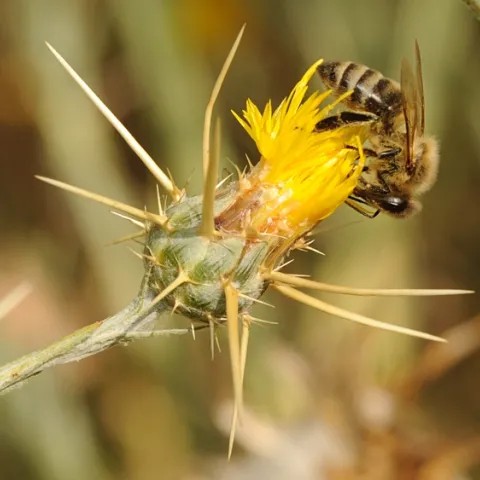
Artichoke thistle in the Delta region

March 23, 2011
By Guy Kyser
Last week I visited one of my favorite experimental sites: the SMUD wind farm in the Montezuma Hills, at the south edge of Solano County. The site overlooks the Sacramento River where its a half-mile wide.
View Article
Primary Image
CALIFORNIA AG DAY at the state capitol last year. The annual event heralds in spring. This year's event takes place March 23. (Photo by Kathy Keatley Garvey)

All Hail California Ag Day

March 22, 2011
By Kathy Keatley Garvey
If you head over to the California State Capitol tomorrow (Tuesday, March 23) don't be too surprised if there's a John Deere tractor on the west steps. March 23 is Ag Day when the state's urban and rural folks come out in force to celebrate the state's $34.8 billion ag industry.
View Article
Primary Image
GERMAN-BORN physicist Albert Einstein (left), shown here accepting American citizenship in 1940, never said “If the bee disappears from the surface of the earth, man would have not more than four years to live," his biographers say. At right is Judge Phillip Forman. (Photo Courtesy of Wikipedia Commons)

Einstein Didn't Say It

March 21, 2011
By Kathy Keatley Garvey
If the bee disappears from the surface of the earth, man would have not more than four years to live." That comment, widely attributed to physicist Albert Einstein, is all over the web.
View Article
Primary Image
CAMPERS in the Bio Boot Camp may see this dragonfly, a flame skimmer, on the UC Davis campus or at the Sagehen Creek Field Station. (Photo by Kathy Keatley Garvey)

This Is a 'Bio Boot Camp'

March 18, 2011
By Kathy Keatley Garvey
You may have heard about the "Bug Boot Camp" that ant specialist Phil Ward, professor of entomology at the UC Davis Department of Entomology, conducts for graduate and undergraduate students every other summer.
View Article
Primary Image
GRADUATE STUDENT Kelly Hamby, who is studying for her doctorate in entomology at UC Davis, works in the Frank Zalom lab on the spotted wing drosophila. (Photo by Kathy Keatley Garvey)

Tackling Spotted Wing Drosophila

March 17, 2011
By Kathy Keatley Garvey
Deep in the bowels of Briggs Hall on the UC Davis campus, entomology graduate student Kelly Hamby works on a pest that is giving growers fits: spotted wing drosophila (Drosophila suzukii).
View Article
UC Weed Science (weed control, management, ecology, and minutia): Article

UC Davis weed experts contribute to pioneering Encyclopedia of Biological Invasions

March 17, 2011
By Gale Perez
UC Davis weed experts contribute to pioneering Encyclopedia of Biological Invasions Cooperative Extension Weed Specialist Joe DiTomaso, Emeritus Professor Robert Norris, and Plant Physiologist Lars Anderson with USDA-ARS Exotic and Invasive Weeds Research are among the international experts who cont...
View Article
Primary Image
CHEMICAL ECOLOGISTS Walter Leal (foreground) and Zain Syed at work in the Leal lab in the UC Davis Department of Entomology. Leal is a professor and former chair of the department, and Syed is a postdoctoral researcher and the primary author of a paper published March 16 in PLoS One. (Photo by Kathy Keatley Garvey)

On the Trail of a Better Insect Repellent

March 16, 2011
By Kathy Keatley Garvey
Researchers in the Walter Leal lab, UC Davis Department of Entomology, are engaging in some exciting research. They just discovered a "generic insect repellent detector" in the fruit fly (Drosophila melanogaster)--research published today (March 16) in PloS One (Public Library of Science).
View Article