A Natural Solution for California's Herds: African Catfish Peptides

California's cattle producers and agricultural communities are all too familiar with the rising challenge of antibiotic resistance, making common bacterial infections harder to treat in livestock. But imagine a future where we could tackle these infections with a natural, powerful alternative. Our research points to just that: antimicrobial peptides (AMPs) found in African catfish.

We're really excited about these peptides because African catfish thrive in pathogen-rich freshwater, naturally producing these robust immune compounds in their skin mucus as a defense. This natural origin makes them highly appealing alternatives to synthetic drugs.

Predicted Safety and Potent Action

One of the most compelling aspects of these AMPs is their predicted safety for mammals. Our initial computer analyses suggest that various catfish AMPs are generally recognized as safe (GRAS). We predict they'll be absorbed in the human intestine without causing liver, brain, or heart toxicity. Furthermore, lab tests on a promising peptide, NACAP-II, confirmed it was non-hemolytic, meaning it didn't damage rabbit red blood cells—a strong indicator of its potential safety for mammalian cells.

Beyond safety, these peptides demonstrate effectiveness against problematic bacteria. One study revealed NACAP-II's strong activity against Extended-Spectrum Beta-Lactamase (ESBL)-producing Escherichia coli—a critical concern for both animal and human health due to its resistance to many common antibiotics. Another peptide, ACAP-IV, also showed antibacterial activity against E. coli and Staphylococcus aureus. We believe these AMPs work by directly disrupting bacterial cell membranes, a mechanism that makes it harder for bacteria to develop resistance compared to how they resist traditional antibiotics.
UC Weed Science (weed control, management, ecology, and minutia): Article

Herbicide Resistance, Herbicide Tolerance, Weed Shifts, and Super Weeds

January 9, 2011
By Brad Hanson
I've made a couple posts about herbicide resistant weeds but I thought today would be a good time to go back to the basics for a moment. Occasionally, there is some confusion about the definitions of a "resistant" weed versus a "tolerant" weed.
View Article
Primary Image
TARGETING MALARIA--This is the UC Davis team that co-authored research (with University of Arizona scientists) that made Time Magazine's "Top 50 Inventions of 2010"--the malaria-proof mosquito. In front, at the microscope, is entomology doctoral student Anna Drexler. In back (from left) are professor Edwin Lewis, postdoctoral scholar Nazzy Pakpour, and professor Shirley Luckhart. In the foreground: anopheline mosquitoes. (Photo by Kathy Keatley Garvey)
Bug Squad: Article

Malaria-Proof Mosquito Takes the Spotlight

January 7, 2011
By Kathy Keatley Garvey
Shirley Luckhart, Edwin Lewis, Anna Drexler and Nazzy Pakpour ought to be dancing. They're probably not, though. They're too busy doing research. They're the UC Davis scientists who worked on a malaria-proof mosquito that just made Time Magazines 50 Best Inventions of 2010. It's listed as No.
View Article
Primary Image
BEE BREEDER-GENETICIST Susan Cobey shows A. G. Kawamura, secretary of the California Department of Food and Agriculture, her line of New World Carniolans during his recent visit to the Harry H. Laidlaw Jr. Honey Bee Research Facility at the University of California, Davis. In his youth, Kawamura reared bees. (Photo by Kathy Keatley Garvey)

Honey, They're in Galveston

January 5, 2011
By Kathy Keatley Garvey
If you're looking for your favorite beekeepers, apiculturists and bee researchers, odds are you won't find them. Unless you're in Galveston, Texas. The 2011 North American Bee Conference and Trade Show is taking place Jan. 4-8 in Galveston.
View Article
Primary Image
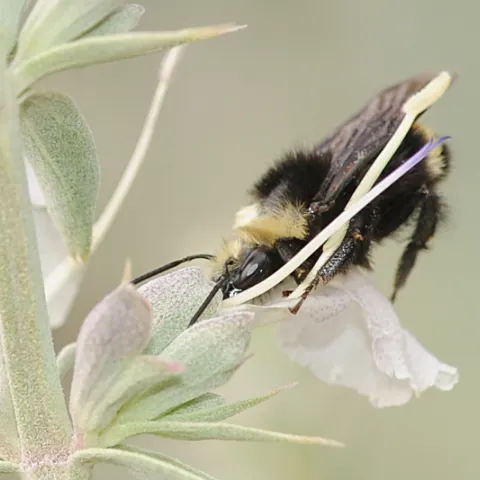
YELLOW-FACED BUMBLE BEE, Bombus vosnesenskii, gathers nectar from a tower of jewels. The Cameron study looked at three species of western bumble bees, including this species. (Photo by Kathy Keatley Garvey)

Declining Bumble Bees: Alarming

January 4, 2011
By Kathy Keatley Garvey
Some species of bumble bees are disappearing at an alarming rate. And that, in itself, is alarming. A three-year study published Jan.
View Article
Primary Image
HONEY BEE nectaring salvia. This one is Salvia leucantha or "Mexican sage." (Photo by Kathy Keatley Garvey)

Salivating the Salvia

January 3, 2011
By Kathy Keatley Garvey
Hmm, ever wonder why honey bees love salvia? Are they going for that nectar or are they going for something else? Salvia divinorum, which like all the salvias, is a member of the mint family, is gaining notoriety for its hallucinogenic effects.
View Article
Primary Image
2010 CHAMPIONSHIP LINNAEAN TEAM is Ohio State. From left are Joshua Bryant, Kaitlin Uppstrom, Nicola Gallagher and Glene Mynhardt, battling with UC Davis. Ryan Caesar (not pictured) later participated on the team. (Photo by Kathy Keatley Garvey)

Name That Bug!

December 31, 2010
By Kathy Keatley Garvey
Emcee Tom Turpin of Purdue University stood at the podium and acknowledged he might mispronounce an entomology student's name. "If it sounds anything like your name and Im looking at you, thats you.
View Article