Ongoing research

Primary Image
A JUST RELEASED ladybug prowls a rose bush for aphids. (Photo by Kathy Keatley Garvey)
Bug Squad: Article

Fly Away Home

March 26, 2010
By Kathy Keatley Garvey
"I'm a ladybug. Please, take me home. I want to live in your garden. I like to eat aphids. Aphids are tiny green insects that are harmful to plants." "Just like the Grange, I'm a friend to the farmer and you.
View Article
Colusa County: Article

April 2010

March 26, 2010
Home Ec Review Results, Camp Application, Fair Award Sponsor Form...
View Article
Primary Image
UC DAVIS BEEKEEPER Elizabeth "Liz" Frost tends bees at the Harry H. Laidlaw Jr. Honey Bee Research Facility. (Photo by Kathy Keatley Garvey)
Bug Squad: Article

Bees Still in Trouble

March 25, 2010
By Kathy Keatley Garvey
The news is not good. The honey bee crisis is worsening. Back in November of 2006, commercial beekeeper David Hackenberg of Pennsylvania sounded the alarm. Fifty 50 percent of his bees had collapsed in Florida.
View Article
Primary Image
CALIFORNIA SECRETARY OF AGRICULTURE A. G. Kawamura (center) greets Lynn Kimsey, director of the Bohart Museum of Entomology and professor and vice chair of the UC Davis Department of Entomology. At right is Extension apiculturist Eric Mussen, also a member of the UC Davis entomology faculty and parliamentarian of the California State Beekeepers' Association. (Photo by Kathy Keatley Garvey)

The Buzz on the State Capitol Lawn

March 24, 2010
By Kathy Keatley Garvey
When the annual California Agriculture Day took place yesterday on the state capitol grounds, thousands of visitors buzzed the booths learning more about the food they eat and the agriculturists that provide it. But that wasn't the only buzz.
View Article
Primary Image
VARROA MITE on a worker bee (see crab-shaped parasite near her head). These undertaker bees were trying to remove a drone larva from the hive. (Photo by Kathy Keatley Garvey)
Bug Squad: Article

Pain in the Neck

March 23, 2010
By Kathy Keatley Garvey
To a beekeeper, it's a four-letter word. Mite. Specifically, the varroa mite, also known as Varroa destructor. It's a small (think flea-sized) crab-shaped parasite that feeds on bees, either in the brood (immature bees) or on adult bees.
View Article
Primary Image
BLUE ON GREEN--A blue bottle fly (Calliphora vicinia) lands on the Mediterranean spurge (Euphorbia characias wulfenii). This species is important in forensic entomology. (Photo by Kathy Keatley Garvey)
Bug Squad: Article

Sugar High

March 22, 2010
By Kathy Keatley Garvey
Honey bees sip nectar from the Mediterranean spurge (Euphorbia characias wulfenii) planted in our bee friendly garden. So do flies. Last weekend several flies flashing colors as brilliant as those blue morpho butterflies landed on the evergreen shrub. It wasn't your basic green bottle fly.
View Article
Primary Image
QUEEN BEE (with the dot) is surrounded by worker bees (sterile females). (Photo by Kathy Keatley Garvey)
Bug Squad: Article

If I Had a Hammer...

March 19, 2010
By Kathy Keatley Garvey
The number of new housing developments throughout the country continues to shrink as we struggle with the throes of a deep recession. That's with human housing, not in a healthy honey bee hive. The bees are busy building up their colonies, just as they do every spring.
View Article
Primary Image
PATCH OF TIDY TIPS, California native wildflower, planted on the UC Davis campus, behind the Laboratory Sciences Building. If you look closely in the patch, you'll see scores of insects, including honey bees, hover flies, mason bees, ladybugs--and assassin bugs. (Photo by Kathy Keatley Garvey)

Assassins in the Tidy Tips

March 18, 2010
By Kathy Keatley Garvey
If you see a patch of California native wildflowers known as "Tidy Tips," look closely. The yellow daisylike flower with white petals (Layia platyglossa) may yield a surprise visitor. You may see an assassin. An assassin bug.
View Article
Primary Image
SEVEN-SPOTTED LADYBUG crawls along a leaf in a UC Davis flower garden. (Photo by Kathy Keatley Garvey)
Bug Squad: Article

The Hunters Are Back

March 17, 2010
By Kathy Keatley Garvey
The hunters are back. Ladybugs, aka ladybird beetles, are searching for aphids and other soft-bodied insects. If you see a ladybug (family Coccinellidae), odds are you'll see her prey, the plant-sucking aphids.
View Article
Primary Image
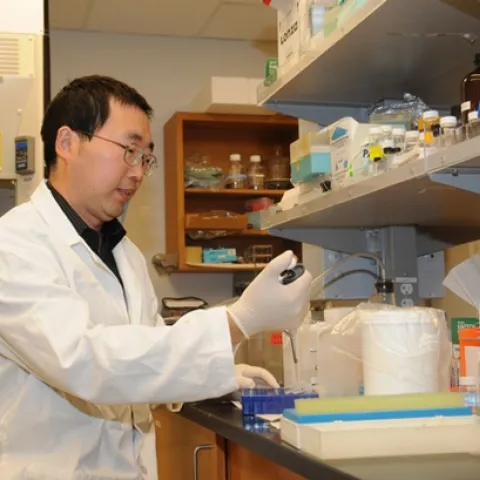
CHEMICAL ECOLOGIST Walter Leal working in his UC Davis lab. His lab revealed the secret mode of the insect repellent DEET in groundbreaking research published in 2008.(Photo by Kathy Keatley Garvey)
Bug Squad: Article

'The Treacherous Scent of a Human'

March 16, 2010
By Kathy Keatley Garvey
It's a killer, pure and simple. But the issue is as complex as it comes. The malaria mosquito, from the genus Anopheles, infects some 350 to 500 million people a year, killing more than a million. Most are young children in sub-Saharan Africa.
View Article