

Good air circulation in a crop canopy has many important positive impacts. As described in previous blogs, carbon dioxide utilization and consequently photosynthesis is improved. Moreover, temperatures within the leaf canopy and greenhouse are more uniform, and leaf temperature will be closer to the immediate surrounding air temperature. This has a profound impact on when and where condensation occurs as the greenhouse air temperature falls.
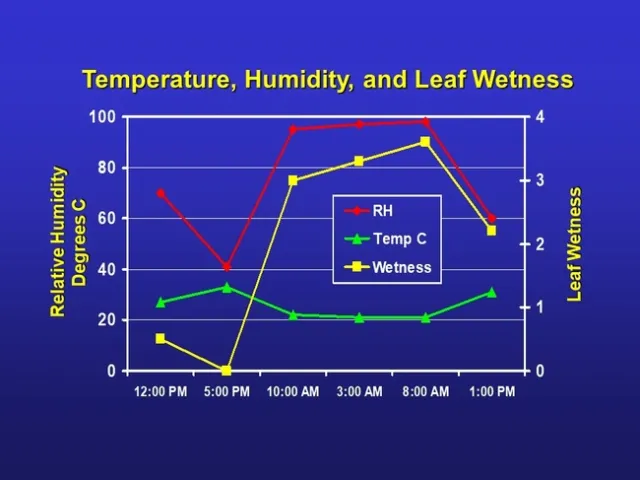
Above are actual temperatures, relative humidity and leaf wetness data I measured in a greenhouse in a 24 hour period. As temperature (green line) climbs in the day the relative humidity (red line) falls. As temperatures fall at night the relative humidity rises. The relative humidity is the amount of moisture in the air compared to what the air can "hold" at that temperature. When the air can't "hold" all the moisture, then it condenses as dew. Leaves get wet when water-laden air cools at night and falls to dew point temperatures. So you can see as relative humidity gets high, approaching 100%, then leaf wetness also increases as dew is formed.
Water condenses first on the coolest surfaces such as the greenhouse structure, and usually crop leaves and flower buds too. Greenhouse and plant surfaces that face the night sky are radiating and losing energy, and can become cooler than the ambient air temperature. Thus they are prone to become surfaces that support condensation as illustrated below.
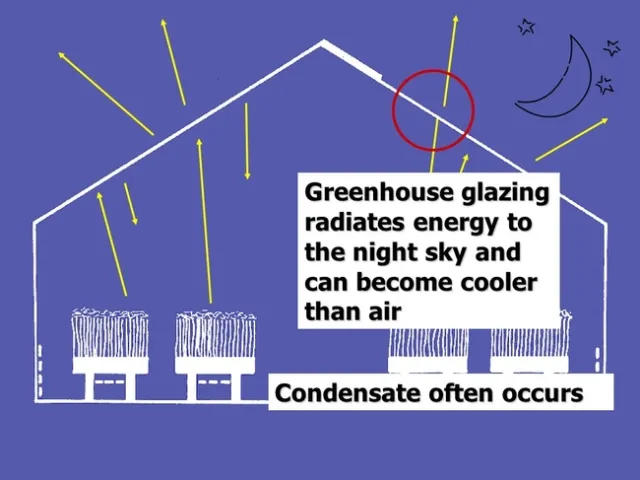
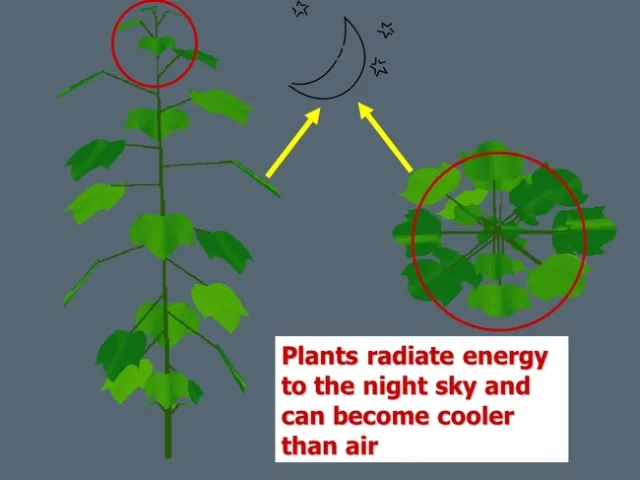
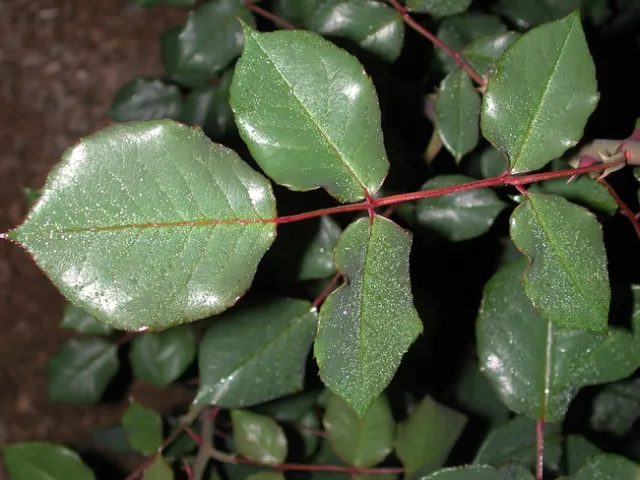
Condensation occurs first on the coolest surfaces as air cools and approaches the dew point. Above, dew formed first on the top of rose leaves near the top of the rose plant (which faces the night sky).
Moving air within the leaf canopy at night helps move the relatively warmer greenhouse air around the cooler leaf and flower surfaces. Even very small temperature effects matter. The result is that condensation on those important crop surfaces may be prevented or reduced.
This has strong implications for disease control.....which will be described in next week's blog.