
By Mike Zigelman, UC Master Gardener
Benefits of Bats
Bats are a primary predator of night-flying insects and many insect pests. One little brown myotis bat can catch up to a thousand mosquitoes an hour. A colony of 150 brown bats can eat enough cucumber beetles to prevent egg laying that would otherwise give rise to an estimated 33 million root worms.
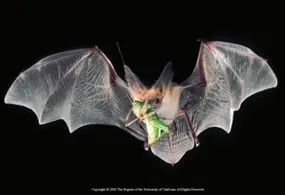
Pallid bat catching dinner mid-air. Credit: Bat Conservation International
Bat House Specifics
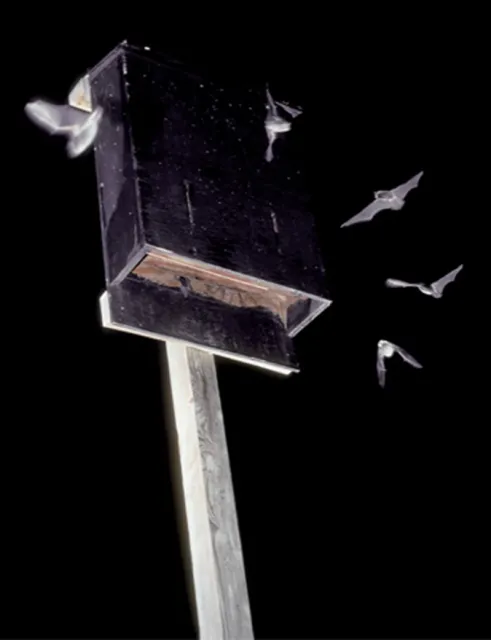
Little brown myotis using a bat house. Credit: Mark and Selena Kiser
- The exterior color of the house should be adjusted to the local microclimate. As a general rule, if the average high temperature in July is 85°F or less, the house should be black. If the average high temperature exceeds 100°F, white is preferred. Intermediate temperatures may use intermediate colors. Black bat houses are suitable for most San Luis Obispo County microclimates, excluding hotter North County areas. A light gray-green color is best for hotter inland locations.
- Bats prefer houses that are dry, warm, dark, non-drafty, and well ventilated.
- Use only water- or latex-based paints and stains, and avoid pressure-treated wood.
- Bats generally prefer houses mounted on poles or building walls rather than in trees. Houses mounted under building eaves but still exposed to sun tend to have the highest occupancy rates. Mount houses 12–20 feet above ground, or at least above the tallest vegetation below.
- The lower portion of the house should include a landing area. Both the landing area and the back wall leading into the house should be roughened (scored with a saw blade) or covered with heavy-duty plastic netting to provide traction. Interiors are typically stained black with a water-based stain to create a dark, warm environment.
- Bat house occupancy rates tend to be highest when houses are located:
- On buildings or poles
- In rural rather than urban areas
- Where surrounding land use within one mile is primarily natural vegetation
- Near agricultural land, especially orchards or mixed orchard/row crop/pasture
- Within one mile of a freshwater source such as a lake larger than 25 acres
References
Design of the bat houses is based on plans found in The Bat House Builder’s Handbook.
Data for this sheet is also drawn from The Bat House Builder’s Handbook by Merlin Tuttle, Mark Kiser, and Selena Kiser, published by Bat Conservation International and distributed by the University of Texas Press.
www.batcon.org