
Adapted from the UC Master Gardener Handbook (12/2005). Created by Johannah Varland, UC Master Gardener.
Use the guide below to plan planting and harvest dates for cool season vegetables. Plant cool season veggies during the months in the shaded area, according to your location. Use the frost dates and average days to maturity for each vegetable to determine planting and harvest dates. Extend seasons by protecting from frost or summer sun, and use soil temperature controls such as mulch and wind protection.
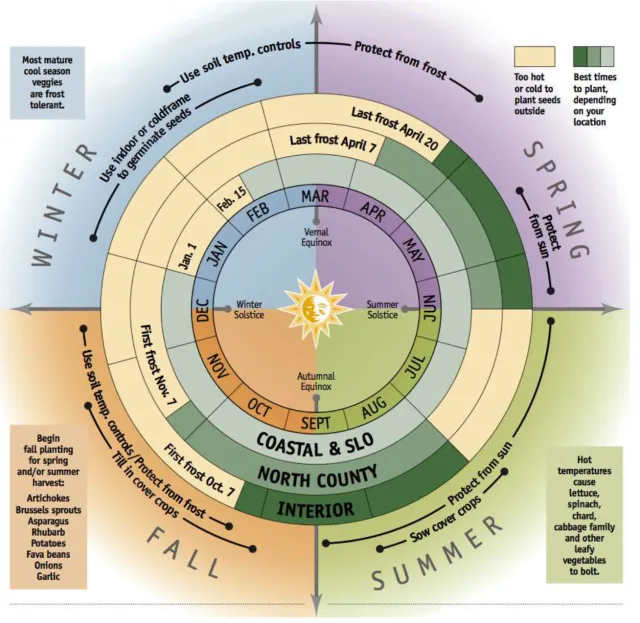
Image description: Circular seasonal planting guide for cool season vegetables in San Luis Obispo County with three regional bands: Coastal & SLO, North County, and Interior. It highlights best months to plant (dark green) depending on location and indicates when it may be too hot or too cold to plant seeds outdoors (tan). The center shows months around the year with seasonal markers (Winter Solstice, Vernal Equinox, Summer Solstice, Autumnal Equinox). Notes call out to use information on seed packets (days to germinate and days to maturity), use soil temp. controls, protect from frost, protect from sun, and sow cover crops. Side notes indicate: most mature cool season veggies are frost tolerant; hot temperatures can cause lettuce, spinach, chard, cabbage family, and other leafy vegetables to bolt; begin fall planting for spring and/or summer harvest (examples listed: artichoke, brussel sprouts, asparagus, rhubarb, potatoes, fava beans, onions, garlic).
Planning checklist
- Calendar
- Journal
- Frost Dates
- Average seasonal temperatures
- Days to germination for selected seeds
- Days to maturity for each crop
- Recommended planting dates
- How will you use the produce?
- How many people will be enjoying the produce?
Cool Season Vegetables
ROOT: beet; carrot; garlic; leek; parsnip; radish; rutabaga; shallots; turnip
STEM: asparagus; kohlrabi; potato; rhubarb
IMMATURE FLOWERS: artichoke; broccoli; cauliflower
LEAVES: bok choy; brussel sprouts; cabbage; celery; chard; cilantro; Chinese cabbage; chives; collards; endive; lettuce; mustard greens; parsley; spinach; watercress
FRUIT: fava beans; snow peas
Characteristics of cool season vegetables
- Grow best in average temperatures of 55 – 75 degrees
- Will tolerate slight frost when mature
- Food value is higher per pound than warm season vegetables because edible parts are the vegetative parts rather than the fruit
- Most have shallow to medium root systems making them well adapted to small gardens or container gardens
- Can be grown all year in temperate zones
- Can be grown in most zones with shade in summer
Season extension and soil temperature
Frost Protection:
- Cover individual plants with cut-off plastic bottles or cardboard cones
- Start seedlings in coldframes
Warm Soil Temperature:
- Cover soil with dark plastic;
- Shield plants from wind
Cool Soil Temperature:
- Cover soil with organic mulch
- Use shade structures to shield from sun and wind
Frost dates
| Area | First Frost | Last Frost |
|---|---|---|
| Interior | Oct. 7 | April 20 |
| North County | Nov. 7 | April 7 |
| Coast/SLO | Dec. 31 | Feb 15 |