

Forest pests and diseases are a natural part of a forest ecosystem. While most native pests or pathogens occur at low population or infection levels, there are times when they can become epidemic. Of particular concern is watching out for introduced pests and pathogens that can cause substantial problems. Forest management can influence habitat and survival of pests and pathogens.
Forest pests and disease affect forest fuels and wildfire, by killing trees and other vegetation and making them more susceptible to ignition and severe Wildfire. Bark beetles related tree mortality has followed California's multi-year drought that began in 2010 and has been especially pronounced in the Southern Sierra Nevada where most of the affected forests are federally owned and managed. On USFS leases and private parcels, these dead trees present public safety hazards.
UC's publication on bark beetles, Bark Beetles (Seybold, Paine, and Dreistadt 2008), provides excellent information on beetle identification and control. They point out that "except for general cultural practices that improve tree vigor, little can be done to control most bark beetles once trees have been attacked." Techniques to improve tree vigor such as thinning to bring tree water use in line with available water supply and thereby reduce drought stress at the individual tree level, providing irrigation water to high value trees, involving specialists to apply behavioral chemicals in traps or repellents, and other chemical controls are described in the UCANR IPM publication.
For more background on forest pests in California forests, please see: Forest Stewardship Series 16 - Forest Pests and Diseases (UC Publication 8246).
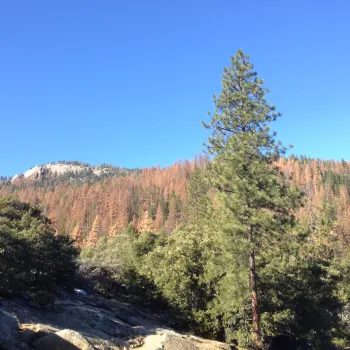
Bark beetles have had massive outbreaks throughout western North America in recent years. The tree mortality resulting from the drought of 2012 to 2016 was unprecedented. Trees died throughout the state but especially in the southern Sierra Nevada. Trees weakened by drought could not defend themselves from beetles, who burrowed under the bark and laid eggs. The larvae hatched and their burrow killed and girdled the trees. Other trees died directly as a result to drought. For more information about the size and effects of this mass tree mortality event, please review the Tree Mortality Data Network in California Agriculture.
University of California and other researchers have been collaborating to measure tree mortality in the Sierra Nevada and identify the causes and future trajectory of affected stands. For information including data summaries and events, please click on the Tree Mortality Data Collection Network page.
More information on the causes, control, and consequences of bark beetle outbreaks can be found in this August 2017 webinar by Dr. Jodi Axelson, UC Cooperative Extension forest health specialist.
Keeping Trees Healthy
Keeping trees healthy so they can fight off bark beetle attack is the best way to help them. Bark Beetles of California
Plant a variety of species adapted to site: In general, native species will withstand the extremes of climate better. Also, many insects attack only a specific tree. Therefore, having a variety of trees means they won't all be attacked at the same time.
Thin / promote healthiest individuals: Many Sierra forests are overstocked after 100 years of fire suppression. Thinning out a forest allows more sun and water for the remaining trees, which will be healthier and better able to repel insect attacks.
Water: Watering trees helps them fight off beetle attacks. Usually this is only feasible for high value trees near the home that can be reached by watering systems. Use of Greywater in Urban Landscapes in California
Chemical treatments: Several pesticides have been shown to be effective at preventing western pine beetle infestation. Carbaryl provides two years of protection and pyrethroids provides one year of protection. They must be applied by licensed pesticide applicators before the trees are attacked. Using Insecticide to Protect Conifers from Bark Beetle Attack
Diagnosing tree attacks
Identify the species of insect attacking a tree:
1) Identify the species of tree (some trees have few or only one species that attack them)
2) Determine the location of insect attack on the stem. For example on large pines, engraver beetles attack near the top, red turpentine beetles attack the bottom of the trunk and others attack the middle of the stem.
3) Identify the pattern of galleries under bark which is individual to each bark beetle species
UC Integrated Pest Management - Bark Beetle Pest Note
Dealing with dead trees
Dead trees pose both a safety and fire hazard depending on where they are. Dead and dying trees near a home or important infrastructure should be removed quickly. This is often a costly and difficult thing to do.
Most beetles, including the western pine beetle, feed only on live trees. Therefore they have usually left the tree before it appears completely dead. However, pine engraver beetles, which kills trees from the top down, can breed in dead or dying trees for up to 5 weeks after they have been felled. Therefore its important to avoid letting slash or green logs accumulate near living trees. Instead, logging debris should be: chipped, cut into smaller pieces (> 4“ in diameter and 3' long) and scattered (lop and scatter), piled and burned, crushed and mashed into the soil, removed from site, or wrapped in clear plastic for up to 5 weeks. More details may be found in CAL FIRE's Tree Note 3 - Controlling Bark Beetles in Wood Residue and Firewood
Exotic Pests
Invasive species are also of concern. Sudden Oak Death (SOD) www.suddenoakdeath.org. SOD Blitz - UCCE Extension Specialist in Forest Pathology Matteo M. Garbelotto has hosted an annual SOD blitz since 2008 with coordinated sampling, production of a SOD map, and public workshops on treatment of SOD.
UCCE North Coast SOD Program - UCCE monitors for the presence of the SOD pathogen in Mendocino, Humboldt, and Del Norte Counties and is working on developing silvicultural techniques for reducing pathogen presence in forested settings.
UC IPM Pest note on the Gold Spotted Oak Borer found in southern California and information on research into that exotic pest.
Pest ID websites:
Identification of forest insects can be tricky. Check out the following websites for descriptions and photos of insects:
UC Resources:
Bark Beetle Outbreaks in Western North American - Causes, Controls and Consequences a webinar presentation by Dr. Jodi Axelson, UC Forest Health Specialist at UC Berkeley in August 2017.
Pests of Native California Conifers - This book is also an excellent resource https://www.ucpress.edu/ebook.php?isbn=9780520936379 (order) This guide synthesizes the most current information available on the pests and environmental conditions that can damage California’s conifers, the vast majority of native trees in the state. Authoritative and easy-to-use, it is an essential reference for biologists, arborists, ecologists, foresters and everyone who needs up-to-date information on conifer pests in one convenient manual.
Other Resources:
CAL FIRE pest specialists - They help protect the state's forest resources from native and introduced pests, conduct surveys and provide technical assistance to private forest landowners, and promote forest health on all forest lands. CAL FIRE also prepares periodic Forests and Rangelands Assessments which include a chapter on forest pests and other threats to ecosystem health.
The US Forest Service Forest Health Protection (FHP) program - FHP is responsible for technical assistance for forest health activities; monitoring and reporting on the health of all forest lands in the Pacific Southwest Region. They work in partnership with the National Forest System, other federal agencies, states, Native American tribes and the private sector, to provide assistance, knowledge and forest health information. FHP has specialists in: forest pathology; forest entomology; pesticide use and safety; remote sensing and geographic information systems.
County Agriculture Commissioners - Each California county has an agricultural commissioner that can assist with identification of insects identification, appropriate pesticides. Commissioners also regulate pesticide use and can provide information on safe and effective use of pesticides.
California Forest Pest Council - The Council (CFPC) fosters education concerning forest pests and forest health, and advises the California Board of Forestry and Fire Protection on forest health protection. They host annual meetings and field trips for forest managers, forest pest specialists, policy makers and analysts, government agencies and anyone interested in forest health.
Forest Health and Carbon Storage in the Sierra Nevada - System Indicators: A final report to the Sierra Nevada Conservancy, December 2012. This reports on the status of Sierra Nevada forests from the standpoint of health, fire and carbon storage.