
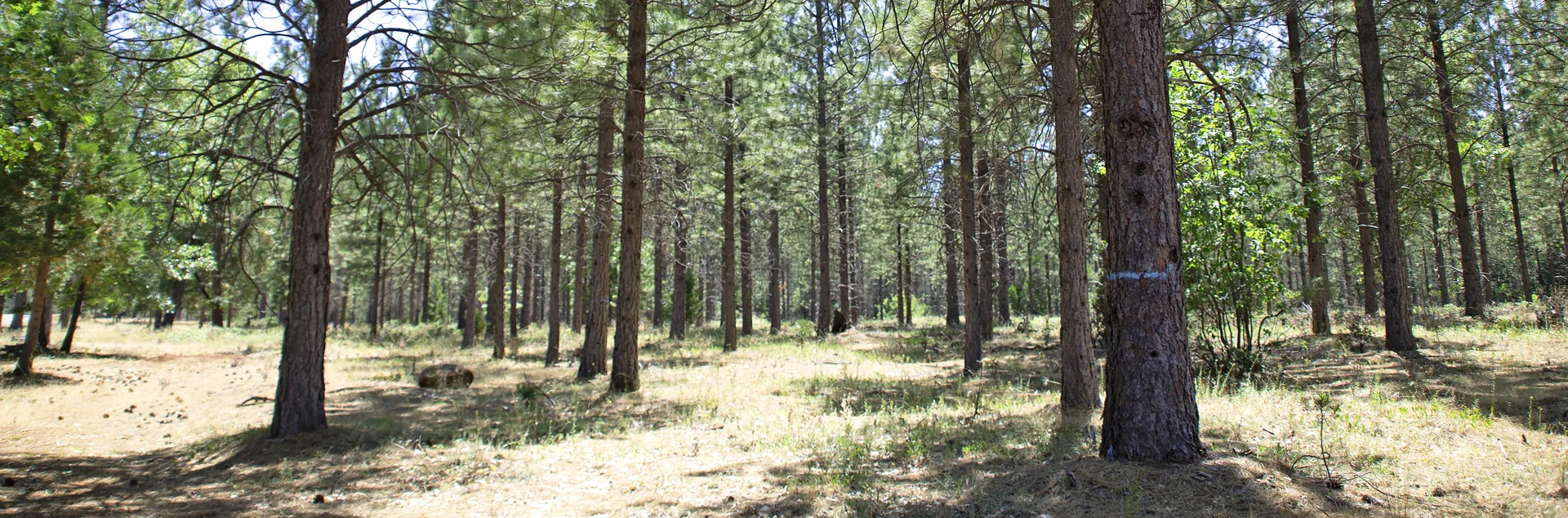
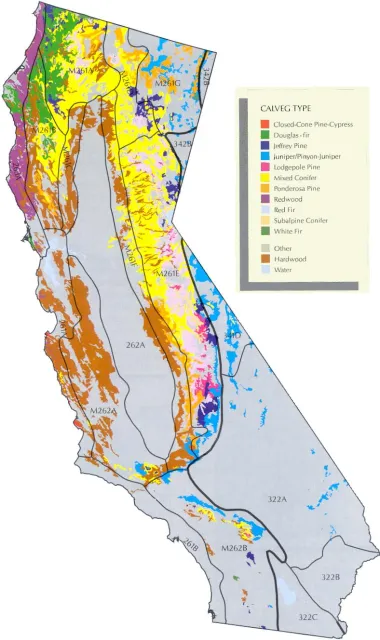
California is a large state, 300 miles east to west and 800 miles north to south. It is very diverse geologically, topographically (mountains and valleys) and climatically (coastal, desert and continental). These diverse conditions conspire to create the many different California forest types, forest ecosystems. For more background on ecology of California forests, please see the UCCE publication Forest Stewardship Series 3 - Forest Ecology Publication 8233
California forests we see today are the product of the long history of physical, biological and cultural events taking place in California. The climate and geology along with a long background of use first by Native Americans, then settlers have shaped the forests into the assemblage trees and wildlife that we find today. For more background on the history of California forests, please see the UCCE publication:
Forest Stewardship Series 4 - Forest History Publication 8234
The growth and yield of California's forest ecosystems is available using a variety of growth and yield models. The Forest Vegetation Simulator (FVS) is a national system of forest growth models maintained by the USDA Forest Service. It is the official tool for stand growth projection on National Forest lands, but it is also used widely on other ownerships.
Redwood forests:
The proceedings of the 2004, 2011, and 2016 Coast Redwood Forests Symposia are available for free download here.
Sierra Nevada mixed conifer forests:
An Ecosystem Management Strategy for Sierran Mixed-Conifer Forests (PSW-GTR-220 in 2009) suggests managers produce different stand structures and densities across the landscape using topographic variables (i.e., slope shape, aspect, and slope position) as a guide for varying treatments. Management recommendations emphasize the ecological role of fire, changing climate conditions, sensitive wildlife habitat, and the importance of forest structure heterogeneity.
Managing Sierra Nevada Forests (Gen. Tech. Rep. PSW-GTR-237 in 2012). This collection of papers presents information and applications relevant to implementation of the concepts presented in GTR 220.
University of resources
Forest Health and Carbon Storage in the Sierra Nevada - System Indicators: A final report to the Sierra Nevada Conservancy, December 2012. This reports on the status of Sierra Nevada forests from the standpoint of health, fire and carbon storage.
Trees and shrubs of California by John Stuart and John Sawyer. This book combines the trees and shrubs of California in one accessible field guide. (order)
Other Resources:
Conifers of California by Ronald Lanner describes and glorifies the 52 native species of conifers found in California including the world's largest pine (Sugar pine), the world's tallest (redwood), the world's most massive (giant sequoia), and the world's longest-lived tree (Great Basin bristlecone pine).
The Urban Forest Ecosystems Institute at California Polytechnic State University, San Luis Obispo has tree identification and selection tools on its website.
The CalFlora website allows users to search for for plant information by common and scientific name.
Other Resources
Ecological Sub-regions of California. USDA Forest Service, Region 5.1997.This manual contains biophysical descriptions, characteristics of Sierra Nevada and Klamath mountains, the Northern California Coast (redwoods),the Southern Cascades,and Southern California's mountains.
http://www.fs.fed.us/r5/projects/ecoregions/
Silvics of North America. This comprehensive guide to the habitat and life history of North American native conifers (volume 1) and hardwoods (volume 2) includes all species of California conifers.