
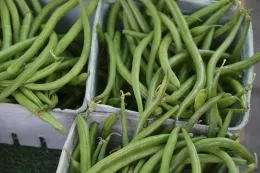
Beans are a warm weather crop that comes in bush and pole varieties. Bush varieties generally produce sooner but may stop after a few flushes, while pole varieties will continue producing into the fall. Pole beans require tall supports (6 to 10 feet) that they can twine around.
Cultural tips for growing beans, UC IPM
Planting
- Direct seed in May to June, possibly July depending on weather and local conditions. For best results, wait until daytime temperatures are consistently above 70°F and the soil temperature is above 60°F. Direct-seeded beans will rot if the soil is too cold.
- Transplant in April to June.
- If growing your own seedlings, start the seeds 3 weeks before you want to plant.
- Nitrogen fertilizer is not needed because beans are legumes that can fix nitrogen from the air.
- For a continuous harvest of bush beans, plant successive crops 2 to 3 weeks apart.
Harvesting
- 50 to 100 days depending on variety.
- Pick frequently, every 2 or 3 days in the height of summer.
Pest management
Pests and disorders of beans, UC IPM
More links
Recommended varieties for Santa Clara County*
| Blue Lake Stringless | Pole, green pod |
| Spanish Musica | Pole, broad green pod |
| Kwintus | Pole, green pod |
| Chinese Green Noodle | Pole, 20-inch long pods, bright green |
| Taiwan Black Seeded | Pole, 38-inch long pods, black seeds |
| Blue Lake 274 | Bush, green pod |
| Greencrop | Bush, green pod |
Other recommended varieties:
- Bush beans: Beurre De Roquencourt, Greencrop, Landreth Bush, Nickel, Purple Podded, Roc d’Or, Royal Burgundy, Slankette, Strike
- Pole beans: Blue Lake, Dutch White Runner, Emerite, Fortex, Kentucky Blue, Marvel of Venice
* Many other varieties may also do well here in Santa Clara County. This list is based on UC Master Gardener trials, taste tests, and feedback from local growers.