
Managing Central Sierra Forests
Forests and woodlands in the Central Sierra Nevada are beautiful, extensive, diverse and owned by both public and private landowners. These ecosystems are adapted to frequent, low severity fires that have been suppressed for over 100 years. As a result, many forests are overcrowded, unhealthy and stressed. As the climate warms, overcrowded forests are increasingly at risk from drought, wildfire and insect-caused mortality.
More active management is needed to reduce forest density and to help forests recover after wildfire. The cost and regulatory environment in which family forest owners must conduct their management is very challenging. The goal of the Central Sierra forestry program is to empower landowners to overcome these challenges. The program consists of:
- Conducting forest stewardship workshops to help landowners develop their own California Cooperative Forest Management Plans to enable them to apply for state and federal cost share programs.
- Encouraging the use of prescribed fire in the Central Sierra as a cost effective tool through outreach and educational workshops and materials.
- Assisting landowners who have experienced in a wildfire to understand how to move forward with recovery and reforestation.
- Increasing access to management information and resources through blogs, publications and websites.
Contact Information
Susie Kocher, Forestry/Natural Resources Advisor
Specialty: Forestry, fire and water quality, facilitation, public participation
Address:
1100 Lyons Ave, Room D-3
South Lake Tahoe, CA 96150
Phone: (530) 542-2571
Email: sdkocher@ucanr.edu
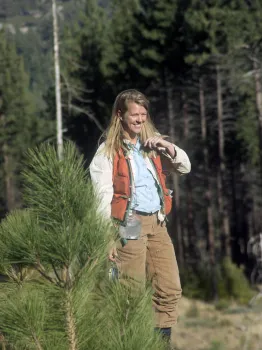
Susie Kocher, Angora Fire Recovery Site
Copyright © 2014 The Regents of the University of California. All Rights Reserved.
Susie's Publications
June 2024
Wilkin et al 2024 Findings from private lands prescribed fire workshops in the Sierra Nevada
May 2023
Restaino et al 2020 Wildfire Home Retrofit Guide Spanish
May 2022
January 2021
Forestry Inventory Video Series: Comprehensive video series demonstrating how to perform basic forest inventory. Reviews tree measurement tools and items needed for evaluating your forest. Includes overview of what inventory is, why it is important, and how to set up your own plots and gather meaningful data. This series is intended for anyone interested in furthering their knowledge relating to basic forest inventory tools and methods.
October 2020
November 2020
Restaino et al 2020 Wildfire Home Retrofit Guide
August 2020
McMahon et al Mass Tree Mortality Fuels and Fire - A Guide for Sierra Nevada Forest Landowners
October 2019
Waks et al 2019 Landowner Perspectives on Reforestation after Wildfire
April 2019
December 2017
Linking knowledge to action: the role of boundary spanners in translating ecology
November 2017
Building climate change resilience in California through UC Cooperative Extension
March 2017
Adapting forests to climate change
Reevaluate the Sierra Nevada landscape after removing dead trees
December 2015
SNAMP final report Appendix F - participation team
Ingram and Kocher 2015 Natural history of the Sierra Nevada - California Naturalist Series
March 2015
Sulak, Huntsinger and Kocher 2015 UC plays crucial facilitating role in SNAMP
December 2012
Kocher and Beckwitt 2012 Status of Sierra Nevada forests indicator report