

Additional authors: Sophie Allen, UCD Jr. Specialist
Pyrethroids are heavily relied upon for management of tadpole shrimp in California rice. Their efficacy has historically been excellent (and mostly still is!); they have proven both effective and very economical given their low material costs, in particular for lambda-cyhalothrin. In many cases, they have been used year after year. As one might say, “if it ain’t broke, don’t fix it”. Right, right?

Pyrethroids have a risk of off-target movement and aquatic invertebrate toxicity, so there has been a risk of regulatory action or additional reporting requirements should pyrethroids move out of fields and into surface waters. In fact, there is now a new Surface Water Quality Management Plan for Pyrethroids (Pyrethroid SQMP) developed by the California Rice Commission to address pyrethroid exceedances at specific monitoring locations. This requires growers within two sub-watersheds to report pyrethroid use and management practices. Heavy reliance on pyrethroids has increased the likelihood of these types of requirements and underscores the need for alternative active ingredients or management strategies.
As with many arthropod pests, repeated exposure to the same active ingredient places strong selection pressure on populations, accelerating the evolution of insecticide resistance. In the past several years, various populations of tadpole shrimp have been reported as resistant to lambda-cyhalothrin, leading to forced changes in management. Field control failures have meant growers have frequently needed to switch to Dimilin, an insect growth regulator.

For tadpole shrimp, the development of insecticide resistance is likely very localized because tadpole shrimp do not move long distances or disperse readily between fields as shrimp or eggs. Eggs hatch when fields are flooded in the spring. The eggs they deposit in the soil remain in the soil within the field, hatching to start the process again the next year. This means that how often pyrethroids are applied in a given field is what really drives the risk and development of resistance rather than region-wide insecticide use patterns.
We have conducted lab bioassays to assess resistance of various tadpole shrimp populations to lambda-cyhalothrin. Some of these were known to be resistant, while others had no history of resistance. In brief, we collected soil from the target fields, flooded the soil, and then cycled the shrimp for several generations to generate enough individuals to use in the bioassay. Shrimp from each population that had sufficient shrimp for testing were treated with 4-5 concentrations of lambda-cyhalothrin and assessed for mortality after 24 hours.
For known resistant populations, we used higher concentrations. At minimum, we tested a concentration (3018 ppm) concentration that approximated a high end of the label application of lambda-cyhalothrin (in this case, Warrior II at 2.56 oz) but sometimes used even higher rates.
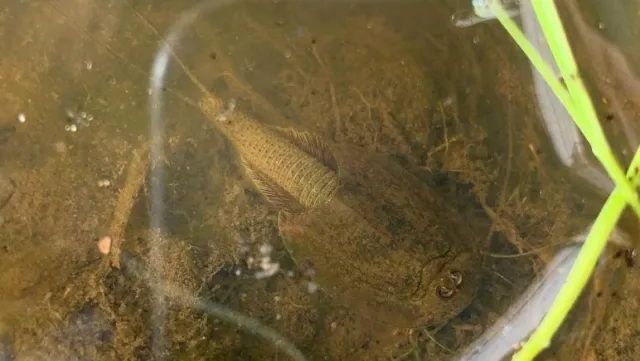
We calculated LC50s (Lethal Concentration 50%, concentration that kills 50% of individuals in assay). The LC50 value allows us to compare how resistant a population is in relation to the most susceptible population. The results shown below highlight that the populations had variable levels of susceptibility, ranging from very susceptible to highly resistant (see Figure). This seems to match what we see region-wide:
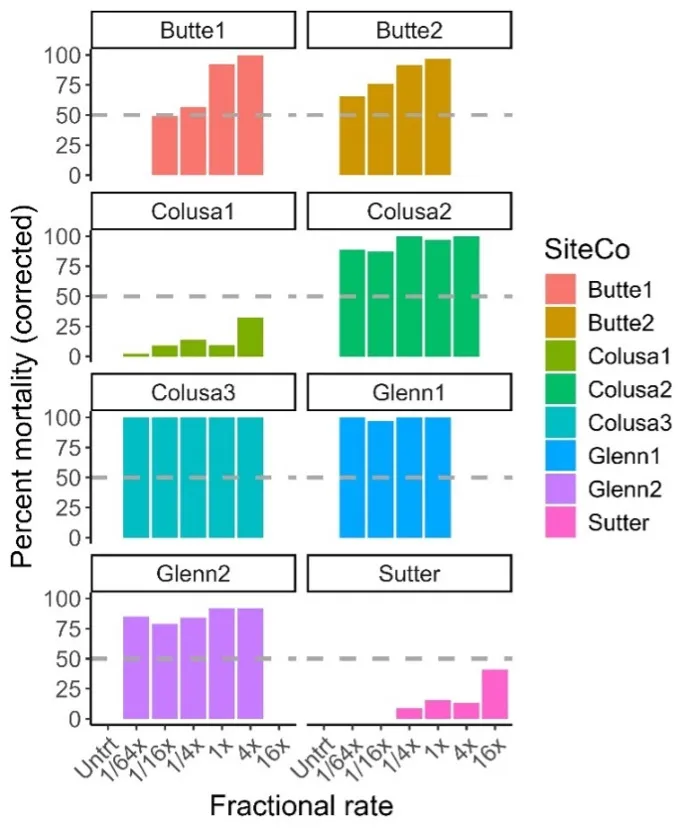
Results of lab bioassays to assess the resistance/susceptibility of various tadpole shrimp populations. Mortality is given for the various concentrations of lambda-cyhalothrin we tested. Fractional rates given are with reference to an upper label rate of Warrior II (2.56 oz/ac).
- When pyrethroids work, they work very well. Extremely low concentrations kill tadpole shrimp. This aligns with the overall toxicity profile of pyrethroids. They are highly toxic to aquatic invertebrates, which includes tadpole shrimp. This is good if we want to manage pests like tadpole shrimp but causes challenges in terms of minimizing potential non-target effects via off-target movement.
- When pyrethroids do not work because of resistance, this can be dramatic. Even very high concentrations (above label rates) do not kill shrimp at times.
On the higher end of susceptibility, Colusa 2, Colusa 3, Glenn 1, and Glenn 2 were all determined to be very susceptible. Even very low concentrations (1/64th of the high end of the label rate of lambda-cyhalothrin) did not result in reduced mortality compared to the higher concentration treatments. Two populations, Butte 1 and Butte 2 (Butte 2 being the Rice Experiment Station) had reduced mortality at lower concentrations. They might still be considered susceptible in terms of control in the field. Butte 1 was 14 times more resistant than Butte 2. Repeated applications of pyrethroids would likely push these populations to greater resistance levels.
Finally, the Sutter and Colusa 1 populations had such high levels of resistance that mortality never exceeded 50% even with very high concentrations. For Colusa 1, the highest concentration tested was a rate 4 times higher than the high end of the label rate, while for Sutter, it was a 16× rate. If we consider that Butte 2 is a susceptible population, the TPS from Colusa 1 and Sutter were 600 and 2400 times more resistant!