
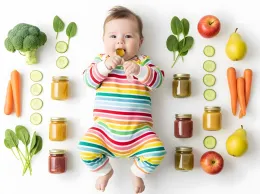
Whether you are expecting your first child or are an old pro in the parenting department, bringing a new life into this world comes with a lot of choices. One choice that parents face is deciding what to feed their infants and toddlers. Some things that should always be adhered to when feeding infants in general: infants under the age of 1 should not eat honey due to a risk of developing botulism; breastmilk or formula should not be replaced with other types of milks; infant formula should never be homemade; infants should never consume raw/unpasteurized dairy products or raw eggs; and rice cereals may contain arsenic (risks of consuming rice based products should be discussed with your pediatrician).
Those restrictions can be overwhelming and a little intimidating, but there are numerous safe and nutritious options for infants and toddlers that can be made and preserved at home. Home-prepared and preserved foods can include methods such as freezing, dehydrating, boiling water, atmospheric steam canning, and pressure canning.
When it comes to canning fruit and vegetable purees, several factors should be considered. Many, but not all, fruit purees are high-acid products that can be easily made and preserved at home using boiling water canning or atmospheric steam canning processes.
An important note: due to their low acidity, the following instructions should never be used for bananas, figs, Asian pears, tomatoes, cantaloupe and other melons, papaya, persimmons, ripe mango, white peaches, or coconut. Additionally, these instructions are not approved for canning vegetable purees, as vegetables are a low-acid product that requires a different processing method. This also means that fruit/vegetable combination purees cannot be safely processed at home for shelf stability. However, low-acid fruits and combination purees can be safely frozen instead of canned, then thawed in the refrigerator overnight, before serving.
Fruits that can be processed using the instructions below include apples, berries, yellow peaches, European pears, and apricots.
According to the National Center for Home Food Preservation, any sugarless fruit puree can be prepared in 4-oz jars, half-pint jars (8oz), or pint jars (16oz) using the following instructions and processing times.
1. Stem, wash, drain, peel, and remove pits if necessary.
2. Measure 4 cups of fruit into a large saucepan, crushing slightly if desired.
3. Add 1 cup of hot water for every 4 cups of fruit.
4. Cook slowly until fruit is soft, stirring frequently.
5. Mash fruit or press through a sieve or food mill.
6. Reheat pulp to a boil. Fill hot product into hot, clean jars. Remove any air bubbles, leaving 1/4-inch headspace. Wipe rims, adjust lids to finger-tip tight, and process jars using boiling water or atmospheric steam canning processes according to your altitude. From 0-1000 feet, process for 20 minutes. From 1,001-6,000 ft, process for 25 minutes. Above 6,000 ft, process for 30 minutes.
Source 1: National Center for Home Food Preservation, University of Georgia - Canning - Fruit Purees
Source 2: National Center for Home Food Preservation University of Georgia - Canning - Canning Fruit - Based Baby Foods
If processed accordingly and the jars are properly sealed, the product is now shelf-stable. Make sure to label your jars, including the date it was processed, what's inside, and the method used to process the product. For the best quality, use the product within one year. Once opened, store leftover product in the refrigerator and use within 2 days of opening.
Try making one of these purees at home and let the Master Food Preservers of Tulare County know what you and your baby thought of them!