
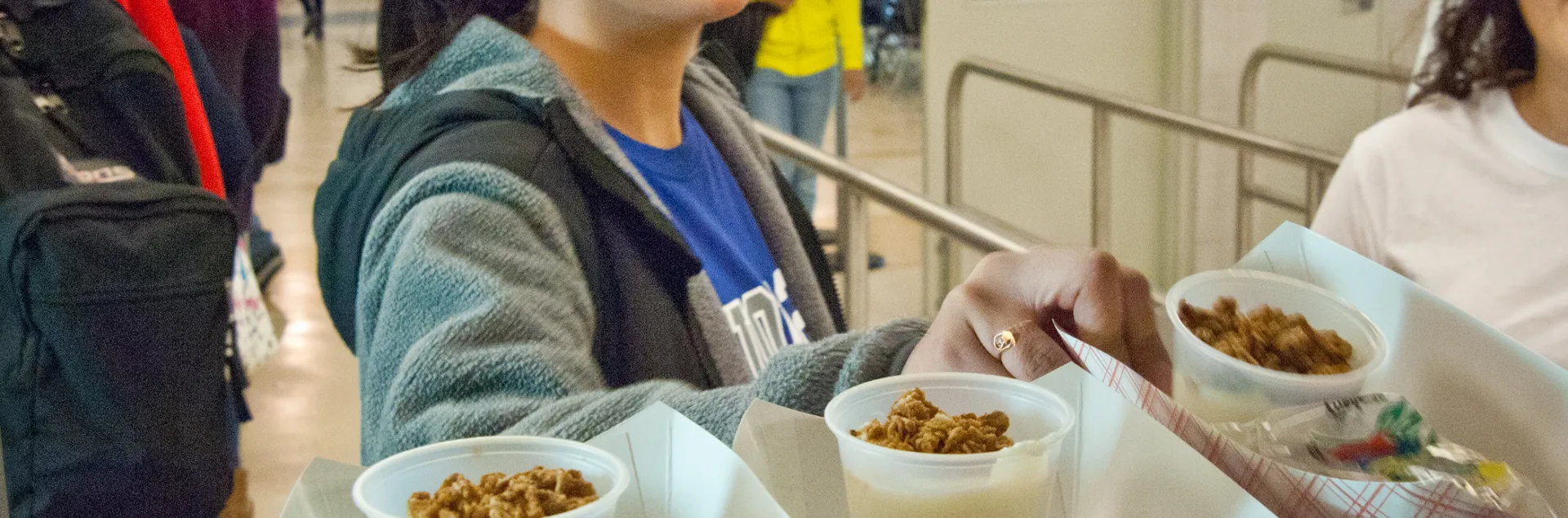

Universal School Meals provide free meals to all students, helping reduce stigma, administrative burden, and unequal access, while also supporting nutrition, health, food security, and academic outcomes. However, after the COVID-19 pandemic, the federal waivers allowing all students, regardless of income, to receive free school meals were discontinued. A recent qualitative study examined how students in Texas and Arizona experienced the transition from pandemic-era universal free meals back to free- and reduced-priced meals based on family income.
Students reported seven themes after Universal School Meals ended: witnessing food insecurity among peers, hunger interfering with learning, increased financial stress and anxiety, meal denial and accumulating school meal debt, reduced participation in school meals, the return of stigma and social hierarchies in cafeterias, and a desire for Universal School Meals to be restored.
Students described peers skipping meals, sharing food, and being turned away at the register when their accounts had insufficient funds. They reported instances of public embarrassment, teasing, and comments such as “your family is poor” directed at students who ate school meals. Additionally, students said these experiences hurt classroom concentration and learning. While some observed that peers who were eligible for free or reduced-price meals avoided applying due to embarrassment. Students contrasted these experiences with the period under Universal School Meals, when they reported less financial worry, fewer visible economic distinctions among peers, and easier access to food during the school day. Overall, students expressed strong support for reinstating universal free meals.
Study authors call for further evaluation of the long-term sustainability and implementation of Universal School Meals, including addressing barriers related to funding, staffing, and food service capacity. They suggest that when full universal coverage is not feasible, implementing policy changes like expanding eligibility, reducing co-pays, and improving meal delivery could reduce stigma and improve participation. Ultimately, the study highlights the importance of Universal School meals as a public health and educational investment.
This study, published in Health Affairs Scholar, was conducted by Tessa Pulido with the University of California, Irvine, Juliana F.W. Cohen with Merrimack College, Punam Ohri-Vachaspati with Arizona State University, Marlene B Schwartz with the University of Connecticut, Anisha I Patel with the Department of Pediatrics, Stanford University, Michele Polacsek with the University of New England, and Nutrition Policy Institute researchers Dania Orta-Aleman, Monica D Zuercher, Caitlin D French, Lorrene D Ritchie, and Wendi Gosliner. This research was funded by California General Fund Senate Bill (SB) 170 (2021), SB 154 (2022), and SB 101 (2023).